

The capital of Burundi is Gitega, a highland town in the middle of the country, roughly 62 kilometres east of Bujumbura. Burundi's parliament made it the political capital by a vote on 16 January 2019. Bujumbura, on Lake Tanganyika, stays the economic capital, the largest city and the main port. Gitega is only the country's fourth-largest city: the commune of Gitega, meaning the town plus its surrounding hills, counted about 155,000 residents at the 2008 census. What it has that Bujumbura lacks is history. For generations it was the royal capital of the Burundian kings, and the hills around it still hold the sanctuaries of the sacred drums that were once the symbol of the monarchy.
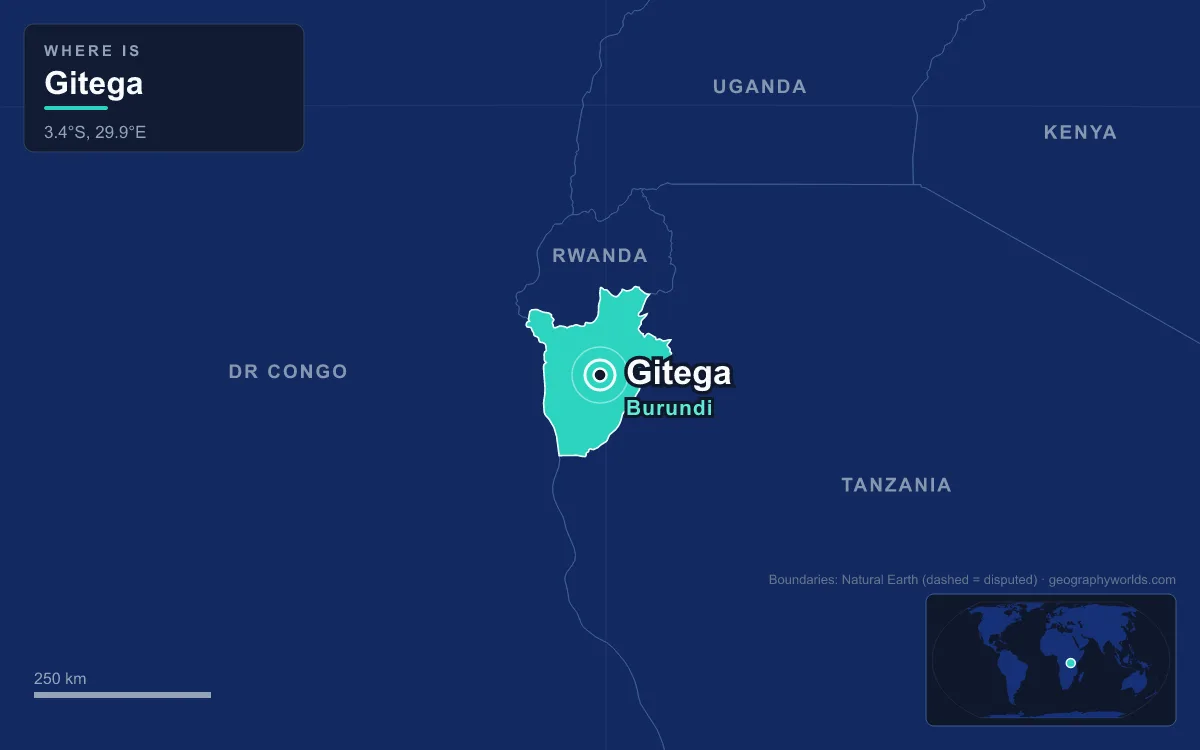
Gitega had held national importance before, which is why the government described the 2019 move as "returning" the capital. Its story makes most sense taken theme by theme: who ruled from it, what was worshipped here, how goods reach it, and what ordinary life looks like on the central plateau.
From Royal Court to the 16 January 2019 Vote
The Kingdom of Burundi's traditional founding date is 1680, when the first mwami (king), Ntare I, united two rival centres of power. The kings came from the Ganwa royal clan, which ruled over both Hutu and Tutsi subjects. Gitega served for a time as the seat of the kingdom and remained the kings' capital until the monarchy was abolished in 1966. The modern street plan dates from 1912, when Burundi was part of German East Africa and German officials drew up the plan for a modern town. After the First World War the Allies gave Ruanda and Urundi to Belgium. The Belgians ran the mandate from Usumbura, now Bujumbura, a lakeside military post, and that made the lake town the centre of government.
Gitega's royal story has a dark ending. In July 1966 Crown Prince Charles Ndizeye deposed his father, Mwambutsa IV, and was crowned in September as Ntare V. In November of the same year Prime Minister Michel Micombero overthrew him and declared a republic. Ntare V went into exile. When he returned in March 1972 he was placed under house arrest in the former royal palace at Gitega. On 29 April 1972, the day a Hutu uprising broke out, soldiers killed him there, aged 24, in circumstances that remain unclear. In the mass killings of Hutus that followed, known as the Ikiza, between 80,000 and 210,000 people died.
The idea of bringing the capital back began in March 2007. President Pierre Nkurunziza said then that Gitega's central location made it a better seat of government than Bujumbura. On 24 December 2018 he announced the move. His CNDD-FDD party held comfortable majorities in both chambers, and parliament approved the change on 16 January 2019. Some ministries began moving two days later, and the whole government was expected to follow within three years. The move has gone more slowly than planned. As of late 2025 the transfer was still not complete.
Gishora Hill and the Sacred Karyenda Drums
In the old kingdom, faith and power met in a drum. The karyenda was a drum with semi-divine status. It stood for the mwami himself, and he was said to turn its beats into laws for the kingdom. Royal coronations, funerals and weddings were announced by drumming, and so were the moments when the king rose in the morning and went to bed at night. The drums were kept in a network of hilltop sanctuaries that were also centres of political and religious power. Mostly Hutu families guarded them. These abatimbo, "those who hit hard", were the only people the king allowed to make, play and keep the drums. Two of the main sanctuaries, Gishora Hill and Higiro Hill, are close to Gitega.
Gishora lies about 7 kilometres north of the town, in the commune of Giheta. Mwami Ntare Rugamba founded the royal residence there in the first half of the 19th century, after defeating rebels led by Chief Ntibirangwa. Its first courtyard, the Intangaro, shelters the sanctuary of the sacred drums. Beyond it lies the royal residence (Ingoro), which only the royal family could enter. The site was placed on UNESCO's World Heritage tentative list on 9 May 2007.
The drumming itself has lasted better than the monarchy. When Burundi became independent in 1962, a karyenda appeared on the national flag and coat of arms. The republic removed it in 1966. Our article on the flag of Burundi covers the design that has flown since. The Royal Drummers of Burundi began touring the world in the 1960s. They carry their heavy drums in on their heads and take turns on the central inkiranya drum. Their performances helped inspire the founding of the WOMAD festival in 1982. In 2014 UNESCO added the ritual dance of the royal drum to its Representative List of the Intangible Cultural Heritage of Humanity. A 2017 presidential decree limited public drumming to male performers.
Mushasha and the Archdiocese of Gitega
Christianity arrived with the colonial era and took hold in Gitega. The first Catholic mission, at Rumonge on the lake, ended on 4 May 1881 when two White Fathers, Deniaud and Promaux, were killed. Missions returned under German and then Belgian rule, and the Church's organisation in the region was repeatedly redrawn. An Apostolic Vicariate of Urundi was created on 25 April 1922. It was renamed the Vicariate of Kitega, the town's old spelling, on 14 July 1949. On 10 November 1959 it was raised to the Metropolitan Archdiocese of Gitega, making the town the seat of an ecclesiastical province. Its first archbishop was the White Father Antoine Grauls, and Simon Ntamwana has led it since 1997. The archbishop's residence is at Mushasha.
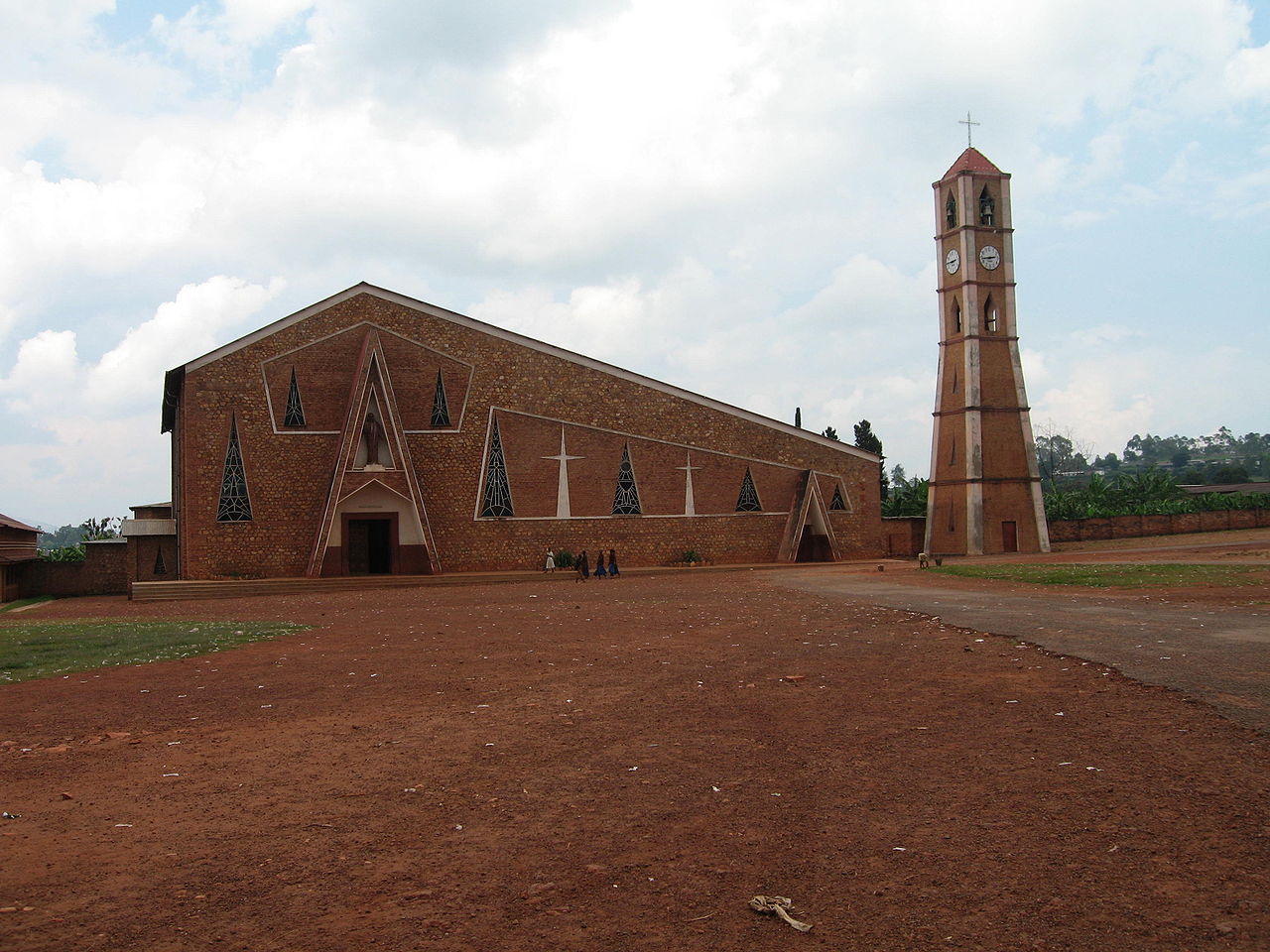
The archdiocese oversees the dioceses of Muyinga, Ngozi, Rutana and Ruyigi. Gitega also has Anglican, Baptist and Assemblies of God congregations, along with some mosques. That mix matches the country as a whole. An estimated 80 to 90 percent of Burundians are Christian, with Catholics making up 60 to 65 percent. Muslims account for between 2 and 5 percent, mostly in towns, and about 5 percent follow traditional beliefs.
RN2 to Bujumbura and the Coffee That Leaves by the Lake
The one thing Gitega did not take from Bujumbura is trade. Burundi is landlocked and mostly agricultural. Farming produced about half of GDP in 2017 and employs more than 90 percent of the population, mostly on subsistence plots that averaged about 0.4 hectares in 2014. Coffee and tea bring in about 90 percent of foreign-exchange earnings. Most of that coffee leaves through Bujumbura's port on Lake Tanganyika, together with cotton and tin ore. For the lake that makes the port possible, see our Lake Tanganyika geography guide.
Gitega's economic role is as a road junction and a market town for the central highlands. Four national roads meet here. The RN2 runs northwest to Bujumbura through Muramvya. The RN15 heads north past Gishora towards Ngozi and on to Rwanda. The RN12 branches off towards Karuzi and Muyinga in the northeast. The RN3 runs southwest to Rumonge on the lake. Air links are gone: Gitega Airport, on a low ridge in the northwest of town at about 1,750 metres above sea level, has closed. Aid-backed schemes have tried to add income beyond crops and cattle. In 1999, for example, 23 men and women set up the Dushirehamwe fish-farming association in the province, and they later funded a second project themselves.

Daily Life on the Kirimiro Plateau
Gitega sits on a broad plateau ringed by hills, a few kilometres southwest of where the Ruvyironza and Rurubu rivers meet. Most of the surrounding province is in the Kirimiro natural region. At this altitude the air is noticeably cooler than in Bujumbura, where daytime highs stay around 29 °C all year. Since the 2025 reform cut Burundi from 18 provinces to five, the town has been the capital of the enlarged Gitega Province. Its hills are densely farmed. Burundi has one of the highest population densities in sub-Saharan Africa, yet in 2019 only about 13 percent of Burundians lived in towns.
Everyday life is conducted in Kirundi, which almost everyone speaks. French and, since 2014, English are also official languages. The town has two museums. The National Museum of Gitega was founded under Belgian rule in 1955 to preserve folk culture that was disappearing as the country modernised. Its collection includes objects from the royal court, but it is displayed in a single room, and in 2014 the museum averaged 20 to 50 visitors a week. The Polytechnic University of Gitega opened in 2014. Pastimes are the ones found across Burundi. Football is the national passion, and ikibugu, a mancala board game played throughout East Africa, is common. Market stalls sell woven inkoko and ibiseke baskets, the country's best-known craft. Hard times have left their marks too. On 7 December 2021 a fire in the overcrowded Gitega prison killed at least 38 people.
Twenty-six kilometres to the east is Ruvubu National Park, the largest in the country, set up in 1980 along the Ruvubu River. That makes Gitega the natural base for exploring Burundi's interior, just as Bujumbura is for the lake. Our Burundi country guide shows how the two capitals fit into the rest of this small, crowded, hilly country.
Quick Facts About Gitega
- Country: Burundi
- Continent: Africa (East Africa)
- Country population: approximately 14.7 million
- Capital city status: Gitega is the capital of Burundi, the seat of national government, and the location of foreign embassies, parliament, and the head of state's official residence.
Frequently Asked Questions
What is the capital of Burundi?
The capital of Burundi is Gitega. Gitega is the seat of national government, hosts most foreign embassies and consulates, and is typically where the head of state and parliament are located.
What continent is Gitega in?
Gitega, the capital of Burundi, is located in Africa, in the East Africa region. As Burundi's capital, Gitega serves as the country's primary connection to the broader African political, economic, and cultural sphere.
Why is Gitega the capital of Burundi?
Gitega was chosen as the capital of Burundi for reasons that typically combine geography, history, and politics. Capital city selections often reflect a desire for centrality (being accessible from across the country), historical importance (being a longstanding seat of government or culture), or neutrality (being acceptable to multiple regions or ethnic groups within the country). The specific reasons for Gitega's designation are detailed in the city's history above.
What is Gitega known for?
As the capital of Burundi, Gitega is best known for housing the country's central government institutions — parliament, presidential or royal residences, supreme court, and key ministries. It is also typically a major cultural and economic center within Burundi, hosting national museums, embassies, and signature monuments. The introduction and history sections above provide detailed coverage of the city's specific notable institutions and landmarks.
Related Pages
- Burundi Country Guide — full geography, climate, economy, and culture overview
- Flag of Burundi — meaning, history, and design of Burundi's national flag