
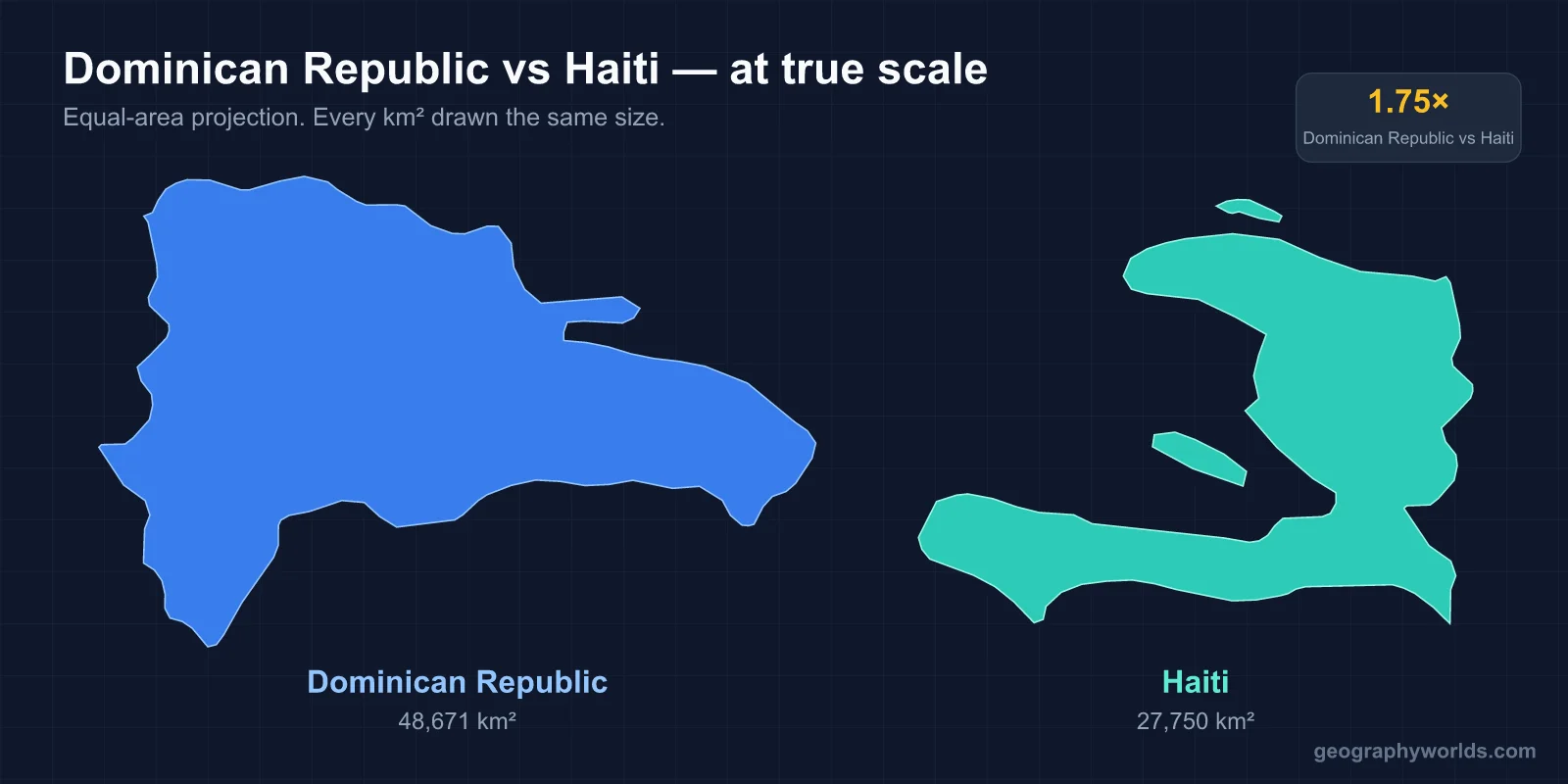
Haiti and the Dominican Republic share the single Caribbean island of Hispaniola, yet they are strikingly different countries. The Dominican Republic is about 1.8 times larger (48,671 km² versus 27,750 km²), speaks Spanish, and earns much of its income from tourism, while Haiti is smaller but slightly more populous (about 12.0 million versus 11.6 million), speaks Haitian Creole and French, and relies on agriculture, textiles, and remittances. The two are divided by a roughly 376-kilometre land border that runs north to south across the island.
This side-by-side comparison breaks down how Haiti and the Dominican Republic differ across area, population, capitals, language, climate, economy, and culture. Whether you are studying for a geography class, planning Caribbean travel, or simply curious about why two neighbours on one island feel like two separate worlds, the facts and figures below give you the complete picture.
One Island, Two Countries
Hispaniola is the second-largest island in the Caribbean after Cuba, and it is unusual in being shared by two sovereign nations. Haiti occupies the western third of the island; the Dominican Republic occupies the larger eastern two-thirds. This division dates to the colonial era, when France controlled the west (as Saint-Domingue) and Spain controlled the east (as Santo Domingo). Those competing empires planted the linguistic, cultural, and economic differences that still define the two countries today.
Because they sit on the same landmass, Haiti and the Dominican Republic share much of their physical geography: the same mountain chains, the same tropical latitude, and exposure to the same Atlantic hurricane belt. What differs is how that geography has shaped each nation's development.
Size & Geography
| Feature | Haiti 🇭🇹 | Dominican Republic 🇩🇴 |
|---|---|---|
| Area | 27,750 km² | 48,671 km² |
| Continent | North America | North America |
| Region | Caribbean | Caribbean |
| Land Borders | Dominican Republic | Haiti |
| Landscape | mostly rough and mountainous | rugged highlands and mountains interspersed with fertile valleys |
The Dominican Republic is roughly 1.8 times larger in area than Haiti. Both countries are mountainous, but the Dominican Republic's terrain includes broad, fertile valleys such as the Cibao, one of the most productive agricultural regions in the Caribbean. Haiti's landscape is more uniformly rugged, with the Massif de la Hotte and Massif de la Selle dominating the south. The island's most dramatic peak, Pico Duarte, rises to about 3,098 metres on the Dominican side, making it the highest point in the entire Caribbean.
One of the starkest contrasts is forest cover. Decades of deforestation have left Haiti with only a small fraction of its original tree cover, while the Dominican Republic retains far more forest, partly through protected national parks. The border between the two is so visibly different from the air that satellite images often show a green-versus-brown line tracing the boundary.
Population & Demographics
| Metric | Haiti 🇭🇹 | Dominican Republic 🇩🇴 |
|---|---|---|
| Population | 12.0 million | 11.6 million |
| Population Density | 433.8 per km² | 238.5 per km² |
Despite occupying less than half the land area, Haiti has a slightly larger population than the Dominican Republic. That combination produces a dramatically higher population density — roughly 434 people per square kilometre in Haiti versus about 239 in the Dominican Republic, a difference of nearly 195 people per km². The result is greater pressure on land, housing, and natural resources in Haiti, especially in and around the capital.
Both populations are young, with a median age in the twenties, and both have large diasporas living abroad — Haitians concentrated in the United States, Canada, France, and the Dominican Republic itself, and Dominicans concentrated heavily in the United States and Spain. Remittances sent home by these communities are a major part of both economies.
Capital Cities
Port-au-Prince serves as the capital of Haiti, while Santo Domingo is the capital of the Dominican Republic. Both sit on the island's southern coast facing the Caribbean Sea. Santo Domingo, founded in 1496, is the oldest continuously inhabited European-established city in the Americas, and its colonial district is a UNESCO World Heritage Site. Port-au-Prince, founded in 1749, grew into Haiti's economic and political hub but has been heavily affected by natural disasters, most notably the catastrophic earthquake of January 2010.
Language, Currency & Culture
| Aspect | Haiti 🇭🇹 | Dominican Republic 🇩🇴 |
|---|---|---|
| Languages | Haitian Creole and French (both official) | Spanish (official) |
| Currency | Haitian Gourde (HTG) | Dominican Peso (DOP) |
Language is the most immediate cultural divide between the two countries. Haiti's official languages are Haitian Creole — spoken by virtually the entire population — and French, a legacy of French colonial rule. The Dominican Republic speaks Spanish, inherited from its Spanish colonial past. The two currencies, the Haitian gourde and the Dominican peso, are separate and not interchangeable.
These differences run deeper than vocabulary. Haitian culture blends West African traditions with French influences, expressed in Vodou religious practice, kompa music, and a celebrated tradition of visual art. Dominican culture is rooted in Spanish Catholic and Taíno heritage, and is world-famous for merengue and bachata music. The shared island has produced periods of both close exchange and serious tension between the two peoples over the centuries.
Climate & Natural Features
| Aspect | Haiti 🇭🇹 | Dominican Republic 🇩🇴 |
|---|---|---|
| Climate | tropical; semiarid where mountains cut off trade winds | tropical maritime; little seasonal temperature variation |
| Key Features | Massif de la Hotte, Citadelle Laferrière, coastal beaches | Pico Duarte (highest Caribbean peak), Los Haitises, Saona Island |
| Economy | agriculture, textiles, remittances | tourism, free trade zones, mining, agriculture |
Both countries have a warm tropical climate year-round, but their rainfall patterns differ. Haiti's mountains block trade winds in places, creating semiarid pockets, while the Dominican Republic's tropical maritime climate brings more consistent moisture and lush vegetation. Both lie squarely in the Atlantic hurricane belt and face risk from major storms between roughly June and November.
Their economies diverge sharply. The Dominican Republic has built one of the most dynamic economies in the Caribbean, driven by mass tourism (Punta Cana is one of the region's busiest resort destinations), export-oriented free trade zones, mining, and agriculture. Haiti's economy is smaller and more agricultural, supplemented by garment manufacturing and the remittances sent home by Haitians abroad.
What Makes Each Country Unique
Haiti holds a singular place in world history: it was the first Black republic and the second independent nation in the Americas, declaring independence in 1804. It was the only nation in history founded by a successful revolt of enslaved people. Its Citadelle Laferrière, a vast mountaintop fortress built in the early 1800s, stands as a symbol of that hard-won freedom and is a UNESCO World Heritage Site.
The Dominican Republic is best known internationally for its Caribbean beaches, merengue and bachata, and an outsized influence on baseball — it has produced more Major League Baseball players than any other country outside the United States. Its colonial capital and warm tropical resorts make it one of the most visited destinations in the Caribbean.
Key Facts
- Shared island: Both countries occupy Hispaniola, the Caribbean's second-largest island.
- Area: Haiti 27,750 km² vs Dominican Republic 48,671 km² (DR is ~1.8x larger).
- Population: Haiti ~12.0 million vs Dominican Republic ~11.6 million.
- Capitals: Port-au-Prince (Haiti) vs Santo Domingo (Dominican Republic).
- Languages: Haitian Creole and French vs Spanish.
- Currencies: Haitian gourde (HTG) vs Dominican peso (DOP).
- Highest point: Pico Duarte (~3,098 m), on the Dominican side, is the tallest peak in the Caribbean.
Frequently Asked Questions
Are Haiti and the Dominican Republic the same country?
No. They are two separate, independent countries that happen to share the island of Hispaniola. Haiti occupies the western third and the Dominican Republic the eastern two-thirds, each with its own government, language, and currency.
Which country is bigger, Haiti or the Dominican Republic?
The Dominican Republic is bigger by area, covering 48,671 km² compared to Haiti's 27,750 km² — about 1.8 times larger. However, Haiti has a slightly larger population, which makes it far more densely populated.
What languages are spoken in Haiti and the Dominican Republic?
Haiti's official languages are Haitian Creole and French, while the Dominican Republic's official language is Spanish. The language difference is a direct legacy of French and Spanish colonial rule on opposite ends of the island. You can learn more on our Haiti flag page.
Why does the Dominican Republic have more forest than Haiti?
Haiti has experienced severe deforestation over many decades for fuel and farmland, leaving very little forest cover, while the Dominican Republic has retained much more woodland, partly through protected national parks. The contrast is so sharp it is often visible from satellite images along the border.
Test Your Knowledge!
Think you know your countries? Try our interactive geography quiz!
Play Geography Games →