
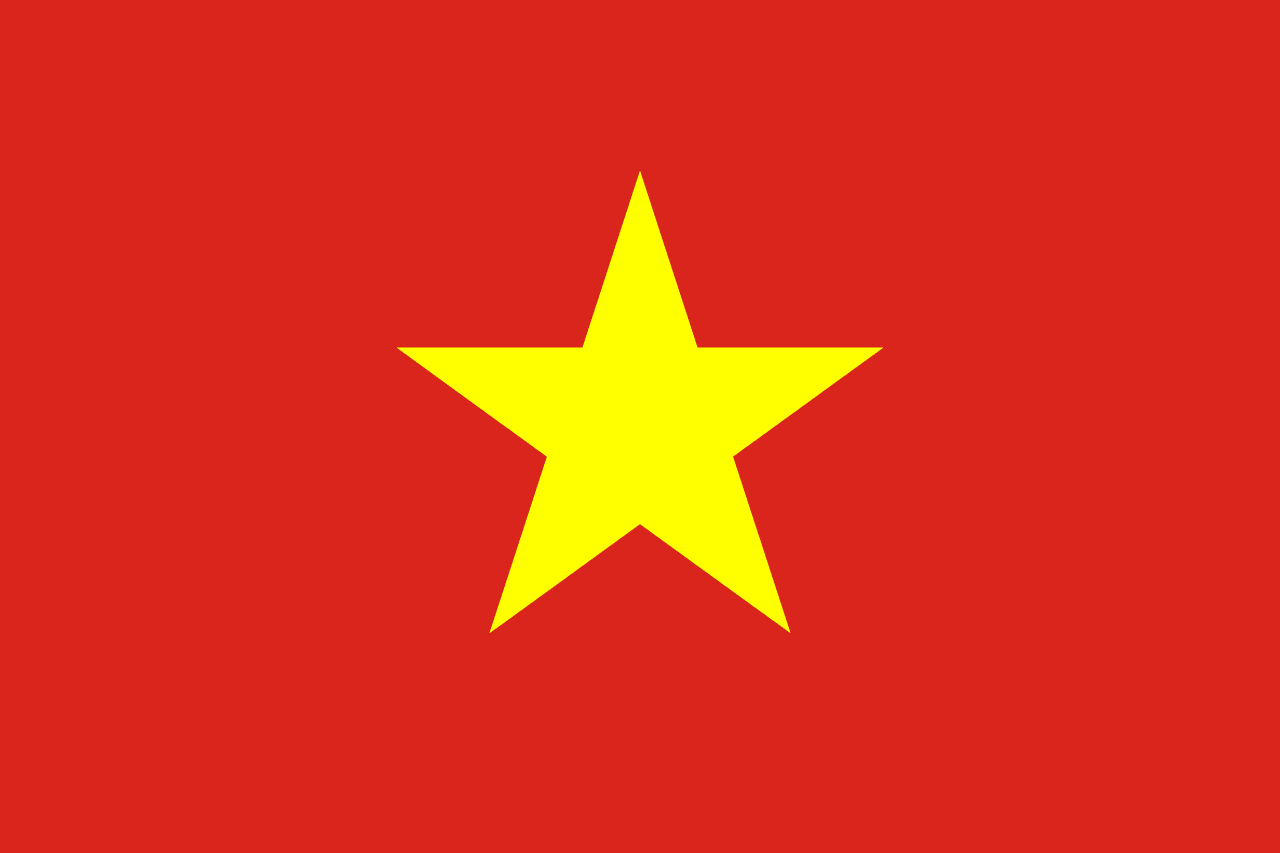

Few national emblems are as instantly readable as the flag of Vietnam. A single golden star floats at the center of a deep red field, and in that simple arrangement sits a whole century of struggle, ambition, and identity. Known in Vietnamese as cờ đỏ sao vàng, literally the "red flag with a yellow star," it is a banner that managed to survive war, partition, and reunification while keeping its essential shape intact. This article looks at what those two colors mean, how the design came to be, and why the same star that once rallied resistance fighters now flies above schools, stadiums, and government buildings across the country.
A Banner Built From Two Colors
The visual logic of the Vietnamese flag is almost startling in its economy. There are only two colors and one shape, yet each element carries deliberate weight. The red field is not merely a backdrop. It stands for revolution and for the blood spilled during Vietnam's long fight for independence, a reminder that the nation's sovereignty was won at considerable human cost rather than simply granted.
Against that crimson ground sits the yellow five-pointed star. Gold has long been associated with the Vietnamese people themselves, and the star's color glows warmly against the red, creating a contrast that reads clearly whether the flag is hanging limp on a still day or snapping in the wind. The pairing of red and gold is also one of the most ancient and auspicious color combinations in the wider region, lending the design a sense of rootedness even though, as a national flag, it is relatively modern.
Decoding the Five-Pointed Star
The star is where the symbolism becomes most specific. Each of its five points is said to represent one of the classes that make up Vietnamese society: workers, peasants, soldiers, intellectuals, and youth. The idea is that no single group stands alone; the points meet and bind together into one luminous body, an image of a unified people pulling in the same direction.
This is what separates the Vietnamese star from the many other stars scattered across world flags. It is not a celestial decoration or a nod to a single guiding ideal. It is a kind of social diagram, a way of saying that the strength of the nation comes from the union of its different walks of life. Placed dead center and rendered large, the star dominates the field, leaving no doubt that the people, in their varied roles, are the heart of the country.
The Design and Its Layout
The construction of the flag is refreshingly straightforward. The proportions are typically rendered at two units tall to three units wide, giving the banner a slightly squarish, sturdy feel compared to the more elongated flags of some other nations. The yellow star sits precisely in the middle of the red field, its points spaced evenly so that the whole figure feels balanced rather than tilted.
One often overlooked detail is the star's orientation: a single point reaches straight upward, with the other four fanning out below and to the sides. This upright posture gives the emblem a sense of aspiration, as if the star is reaching toward something. The clean geometry has a practical benefit too. The design is easy to reproduce at any size, from a tiny lapel pin to an enormous banner draped across a building, without losing its clarity, which is part of why it has remained so recognizable for generations.
From Resistance Movement to National Emblem
The red-and-gold-star banner did not begin life as the flag of a settled state. It was carried by the Viet Minh, the movement at the forefront of Vietnam's struggle against colonial rule and foreign occupation. In those years it functioned as a rallying point, a piece of cloth that signaled allegiance to the cause of independence and self-determination.
As Vietnam's political map shifted through the middle of the twentieth century, the flag traveled with the northern state and eventually became the official banner of the unified Socialist Republic of Vietnam. The version recognized today was formalized in 1955, when the proportions and the shape of the star were standardized. Notably, the basic concept changed very little across all that upheaval. Where many countries cycle through entirely new designs after major political change, Vietnam kept faith with the same red field and the same golden star, so that the emblem of the early resistance and the emblem of the modern republic are, at a glance, one and the same. If you want the broader story of the land behind the flag, the vietnam country guide traces its geography and culture in more depth.
How It Compares to Other Red-and-Star Flags
Vietnam is far from the only country to place a star on a red ground, and at a distance its flag can be confused with a few others. The key is in the details. China's flag, for example, also uses a red field with golden stars, but it carries one large star accompanied by four smaller ones clustered in the upper hoist corner, rather than a single centered star. The arrangement and the count make the two easy to tell apart once you know what to look for.
Morocco offers a different kind of comparison: it too pairs a red field with a green five-pointed star, but the color of the star and the symbolism are entirely distinct. What sets the Vietnamese flag apart from all of these is the combination of one large, perfectly centered yellow star and the specific meaning attached to its five points. Where other star-bearing flags often use the symbol generically, Vietnam's assigns each point a concrete social role, making its star less a motif and more a statement about who the country belongs to.
The Flag in Everyday Vietnamese Life
Today the red flag with the yellow star is woven into the rhythm of public life. It is raised at schools, flown over government offices, and unfurled in vast numbers during national holidays such as Independence Day and Reunification Day, when streets and balconies turn into seas of red and gold. Sporting events bring out an especially fervent display; when the national football team plays, fans paint the star on their cheeks and wave the banner until entire stadiums seem to ripple in unison.
That ubiquity is part of the point. Because the design has stayed constant for so long, the flag links generations together. A grandparent who once saw it carried by resistance fighters and a grandchild waving it at a match are responding to the same image, with the same star pointing upward. As an enduring symbol on the continent of Asia, it represents not just a government but a shared sense of who the Vietnamese people are.
Quick Facts Worth Knowing
- The flag's common Vietnamese name, cờ đỏ sao vàng, translates directly as "red flag, yellow star."
- The five star points stand for workers, peasants, soldiers, intellectuals, and youth.
- Red signals revolution and sacrifice; yellow represents the Vietnamese people.
- The current standardized design dates to 1955, though the banner was used earlier by the Viet Minh.
- One point of the star always faces straight up, giving the emblem its upright, aspirational stance.
- The design's simplicity lets it scale cleanly from tiny pins to building-sized banners.
Frequently Asked Questions
When was the flag of Vietnam adopted?
The current standardized version of the flag was formally adopted in 1955, fixing its proportions and the shape of the central star. The basic red-and-yellow-star design, however, predates that date, having been carried by the Viet Minh during the independence struggle.
What do the colors of the Vietnamese flag mean?
The red field represents revolution and the blood shed in Vietnam's fight for independence, while the yellow star symbolizes the people and the unity of the nation's five social classes: workers, peasants, soldiers, intellectuals, and youth.
What continent is Vietnam on?
Vietnam is located in Asia, specifically in the Southeast Asian region along the eastern edge of the Indochinese Peninsula, bordering the South China Sea.
How is the Vietnamese flag different from the flag of China?
Both use a red field with golden stars, but Vietnam's flag has a single large five-pointed star centered on the field, while China's flag features one large star surrounded by four smaller stars in the upper hoist corner. The number and placement of the stars make them easy to distinguish.
