
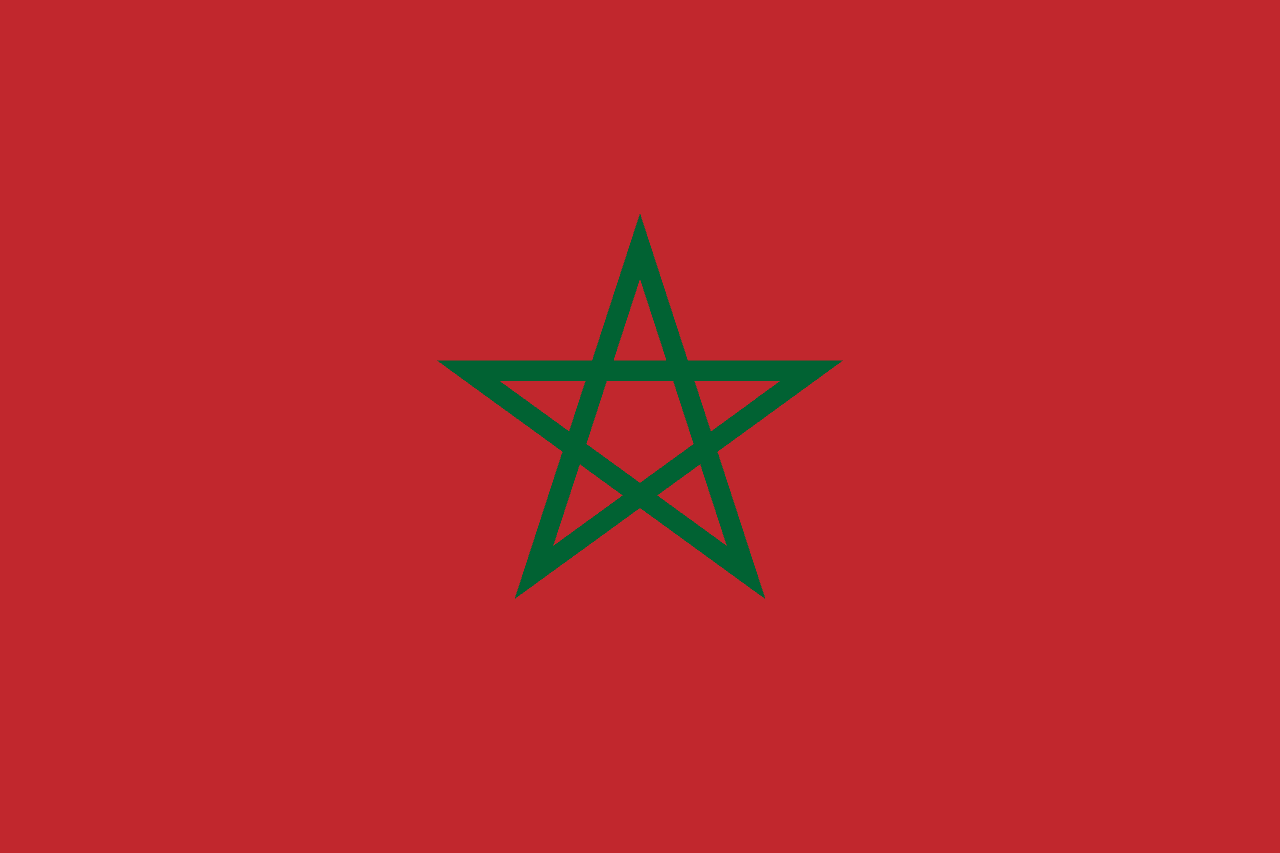
Few national flags manage to be both instantly recognizable and quietly mysterious, but Morocco's manages exactly that. A deep crimson field carries a single slim green star drawn with five interlaced points, floating dead center. There is no crescent, no stripe, no coat of arms crowded into a corner. The result is one of the most graphically confident flags in the world, and behind that simplicity sits centuries of dynastic history and religious meaning.
A Field of Red, A Star of Green
The Moroccan flag uses only two colors, and each carries weight. The red background is the older element of the two, a shade long associated with the ruling Alaouite dynasty that has governed Morocco since the 17th century. Red here is not a generic flourish; it signals lineage, legitimacy, and the continuity of a sharifian monarchy that traces its authority back through generations.
Laid over that red is a green pentagram, a five-pointed star. Green is the traditional color of Islam, and the five points are widely understood to represent the five pillars of Islam: the declaration of faith, prayer, almsgiving, fasting during Ramadan, and the pilgrimage to Mecca. So in just two colors, the flag knits together the throne and the faith, the political house and the spiritual foundation of the nation.
The Seal of Solomon at the Center
The star itself is worth a closer look. It is not a hollow outline but an interlaced pentagram, drawn as a continuous line that weaves over and under itself in five points. This particular figure is known as the Seal of Solomon, an ancient symbol that appears across Islamic, Jewish, and broader Mediterranean traditions and has long been associated with wisdom, protection, and divine authority.
The interlacing is more than decoration. The woven line gives the figure a sense of craftsmanship, echoing the geometric arts that fill Moroccan architecture, from carved plaster to zellige tilework, and the outline-only treatment lets the red field breathe through the gaps so the emblem never feels heavy.
Using a pentagram as the sole device makes Morocco's flag distinctive. Many flags in the wider region lean on the crescent moon and star pairing, but Morocco chose a different geometry entirely. The green five-pointed knot reads cleanly against the red field at any distance, which is part of why the design has aged so well.
How the Modern Flag Came to Be
The plain red banner of the Moroccan sultanate had flown for a very long time before the star arrived. According to the facts this site relies on, the red background has been used since the 17th century, making it one of the enduring colors of North African heraldry. For most of that history, the field was simply red, with no central emblem at all, an unbroken sheet of crimson hoisted over palaces, fortresses, and the ships of the sultanate.
That plainness eventually became a problem. A solid red flag is striking, but it is easy to confuse with the many other red banners of the Mediterranean, and at sea a featureless field could be mistaken for a signal or another power's colors.
The green pentagram was added in 1915, during the French protectorate. The decree placing the interlaced star at the center gave Morocco a clearer visual identity at a moment when its sovereignty was under foreign administration, even as the sultan remained the symbolic head of state. When Morocco regained full independence in 1956, the red-and-green design carried straight through without alteration. That continuity is unusual: many countries redesigned their flags after independence to mark a break with the colonial era, but Morocco kept the symbol it had already made its own, treating the banner as evidence of an identity that predated and outlasted the protectorate.
If you want the wider story of the country behind the banner, our morocco country guide covers its geography, regions, and culture in more depth.
How It Compares to Related Flags
Set Morocco's flag beside its neighbors and the contrasts sharpen. The flags of Tunisia, Algeria, and Turkey all build their identity around the crescent and star, the most common shorthand for the Islamic world. Morocco deliberately skips the crescent, relying on the pentagram alone, making it one of the very few national flags to use a five-pointed star as its only emblem.
The pentagram itself does have cousins. Ethiopia places an interlaced star at the center of its flag, and a five-pointed star turns up on banners from Vietnam to Chile, yet none pair it with this red-and-green combination or render it as an open, woven outline. Crucially, Morocco does not share the green-white-red tricolor logic of Pan-Arab flags, nor the green-yellow-red of the Pan-African palette; it stands outside both color families, which is part of why it never blends into a crowd of similar designs.
What the Flag Means to Moroccans
For Moroccans, the flag is tightly bound to the monarchy and to national unity. Because the red is read as the color of the reigning dynasty, the flag is in some sense a banner of the state and the king as much as of the territory. You see it draped from balconies, painted on rooftops, and waved in dense forests of hands during royal occasions and national celebrations.
The green star also keeps the flag rooted in faith without making the banner explicitly religious in tone. It is a quiet reminder of the role Islam plays in Moroccan public life, folded into a design that still functions as a civic and political emblem. That dual reading, dynasty and devotion, is exactly what gives the flag its resonance at home.
The Flag in Everyday and Public Life
On the African continent, Morocco's flag is among the most visible on a global stage, thanks in large part to sport. Moroccan football supporters have turned the red-and-green into a sea of color at international tournaments, and the flag became a worldwide image during the national team's celebrated runs in recent competitions. It also flies at embassies, sits on official documents, and marks national holidays.
The calendar gives the flag regular moments to shine. Throne Day each summer marks the king's accession and fills cities with banners, while Green March commemorations bring it out again, recalling the mass civilian march of 1975. Schoolchildren raise it during morning ceremonies, and official protocol governs how it is hung, folded, and flown at half-staff during mourning.
Beyond officialdom, the flag shows up in the texture of daily life: on taxis, school walls, market stalls, and the jerseys of fans far from home. Its strong two-color scheme makes it easy to reproduce in fabric, paint, or pixels, which keeps it everywhere from grand stadiums to small village squares.
Quick Facts Worth Knowing
- The flag uses just two colors: a red field and a green five-pointed star.
- The central star is an interlaced pentagram, known as the Seal of Solomon.
- The five points are commonly linked to the five pillars of Islam.
- The red field has been in use since the 17th century, tied to the Alaouite dynasty.
- The green pentagram was added in 1915.
- Morocco sits in North Africa, and the flag is one of the continent's most recognizable.
Frequently Asked Questions
When was the Moroccan flag adopted?
The red field has flown since the 17th century, but the modern flag with its green pentagram dates to 1915. That design has remained in continuous use through independence and up to the present day.
What do the colors of the Moroccan flag mean?
The red represents the Alaouite dynasty, Morocco's long-ruling royal house, while the green pentagram stands for the five pillars of Islam. Together they bind the monarchy and the faith into a single emblem.
What is the green star on the Moroccan flag called?
It is a five-pointed interlaced pentagram known as the Seal of Solomon, an old symbol carrying associations of wisdom and protection.
Why was the star added to a flag that had been plain red for centuries?
A solid red banner was easy to confuse with other red flags across the Mediterranean and the Islamic world, especially at sea. Adding the distinctive green pentagram in 1915 gave Morocco a unique, unmistakable emblem while preserving the dynasty's traditional red.
What continent is Morocco on, and how does its flag compare to similar ones?
Morocco is in North Africa. While many flags in the broader region pair a crescent with a star, Morocco stands out by using only a green pentagram on red, with no crescent at all. The clean, two-color geometry gives it a look distinct from its neighbors.
