
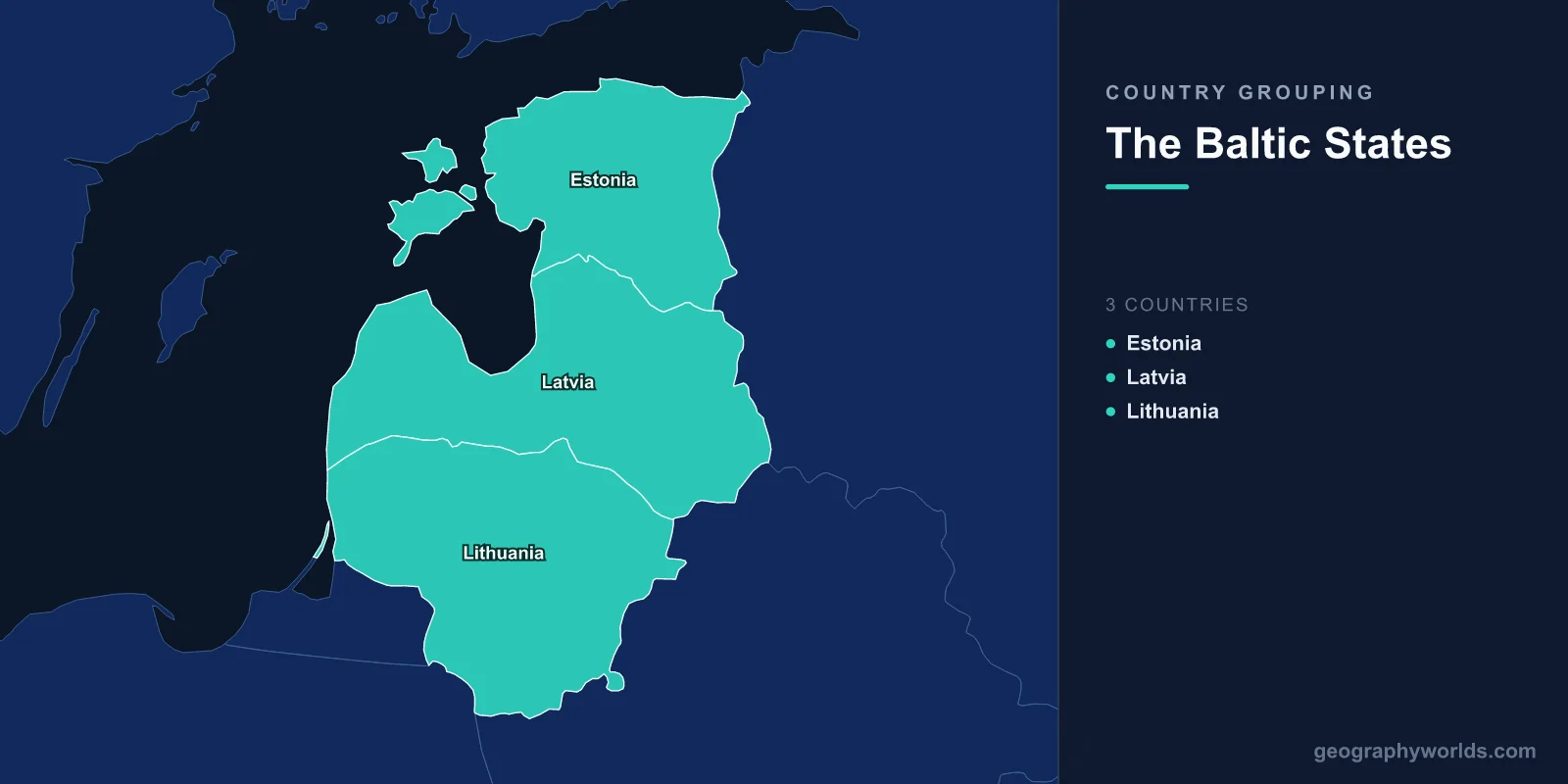
Introduction to The Baltic States
The Baltic States — Estonia, Latvia, and Lithuania — are three small but remarkably dynamic nations perched on the eastern shore of the Baltic Sea. Though often grouped together, each possesses a distinct language, culture, and national identity forged through centuries of foreign rule and a shared twentieth-century struggle for independence. These nations made global headlines in 1989 when an estimated two million citizens joined hands in the Baltic Way, a human chain stretching over 600 kilometers from Tallinn to Vilnius, demanding freedom from Soviet occupation. Since regaining independence in 1991, all three have transformed into modern, digitally advanced European democracies and joined both the European Union and NATO in 2004.

Countries in The Baltic States
- Estonia
- Latvia
- Lithuania
Location: Northeastern Europe, along the eastern coast of the Baltic Sea
Shared Characteristics: Post-Soviet independence, EU and NATO membership, digital innovation
History
The history of the Baltic region spans thousands of years, from ancient Baltic and Finno-Ugric tribes to powerful medieval states. Lithuania was once the largest country in Europe during the 14th and 15th centuries, when the Grand Duchy of Lithuania stretched from the Baltic Sea to the Black Sea. Estonia and Latvia were shaped by centuries of rule by Teutonic Knights, Danes, Swedes, and the Russian Empire. All three nations enjoyed a brief period of independence between the two World Wars before being forcibly incorporated into the Soviet Union in 1940 under the Molotov-Ribbentrop Pact. The decades of Soviet occupation saw mass deportations to Siberia, forced collectivization, and cultural suppression. The Singing Revolution of the late 1980s, fueled by massive public gatherings centered on national songs and traditions, peacefully led to the restoration of independence for all three countries between 1990 and 1991.
Geography & Climate
The Baltic States occupy a relatively flat stretch of land along the eastern Baltic coast, with terrain shaped by ancient glaciers. Estonia is characterized by over 2,200 islands, extensive forests covering roughly half its territory, and more than 1,500 lakes. Latvia features the wide Daugava River valley, dense pine and birch forests, and a long sandy coastline including the famous Jurmala beach. Lithuania is the largest of the three and features the Curonian Spit, a narrow sand dune peninsula shared with Russia that is a UNESCO World Heritage Site. The region experiences a temperate maritime climate moderated by the Baltic Sea, with warm summers, cold winters, and the enchanting white nights of midsummer when darkness barely falls.
Culture & Society
Despite their geographic proximity, the Baltic States possess remarkably distinct cultural identities. Estonia, whose language belongs to the Finno-Ugric family closely related to Finnish, has embraced a tech-forward identity — it pioneered e-governance, digital citizenship, and gave the world Skype. Latvia is renowned for its rich tradition of folk songs called dainas, with over 1.2 million documented verses, and for Art Nouveau architecture in Riga that rivals any European capital. Lithuania takes deep pride in its basketball culture (often called the nation's second religion), its medieval Vilnius Old Town (a UNESCO site), and its tradition of wooden cross-crafting recognized by UNESCO. All three nations celebrate midsummer festivals with bonfires and traditional dress, and their Song and Dance Celebrations, held every five years, are massive expressions of national identity inscribed on UNESCO's intangible heritage list.
Economy
The Baltic economies have undergone dramatic transformations since independence, shifting from Soviet-era planned economies to dynamic free-market systems. Estonia has become a global leader in digital innovation, boasting more startups per capita than almost any other country and pioneering programs like e-Residency that allow anyone in the world to establish a digital business presence. Latvia's economy is driven by transit services, timber, and a growing IT sector, with Riga serving as a regional financial hub. Lithuania has attracted major foreign investment in manufacturing, laser technology (producing a significant share of the world's scientific lasers), and fintech. All three adopted the euro and have experienced among the highest GDP growth rates in the EU, though they face challenges including emigration and income inequality.
The Region Today
Today, the Baltic States stand as success stories of post-Soviet transformation. Their strategic position on NATO's eastern flank gives them outsized geopolitical importance, and Russia's invasion of Ukraine in 2022 has only heightened their focus on defense and regional security. Estonia continues to lead in cybersecurity and digital governance, hosting NATO's Cooperative Cyber Defence Centre of Excellence in Tallinn. Latvia and Lithuania have invested heavily in renewable energy and LNG infrastructure to reduce dependence on Russian gas. All three maintain vibrant cultural scenes, with Tallinn, Riga, and Vilnius drawing growing numbers of tourists to their beautifully preserved medieval old towns, contemporary art scenes, and thriving food cultures.
Interesting Facts About The Baltic States
- Estonia has more startups per capita than most countries in the world and gave the world Skype
- The Baltic Way human chain in 1989 stretched over 600 km and involved roughly 2 million people
- Lithuania was once the largest country in Europe, stretching from the Baltic to the Black Sea
- Latvia has over 1.2 million documented folk song verses — more per capita than any other nation
- Estonia offers e-Residency, allowing anyone worldwide to start and manage an EU-based company digitally
- Basketball is so popular in Lithuania that it is commonly called the country's second religion
Conclusion
The Baltic States (Estonia, Latvia, Lithuania) represent a fascinating regional grouping with shared history, cultural ties, and common challenges. Whether you're studying world geography, planning travel, or simply curious about how the world's nations connect, understanding these regional groupings provides valuable context for making sense of our complex and interconnected world.
