
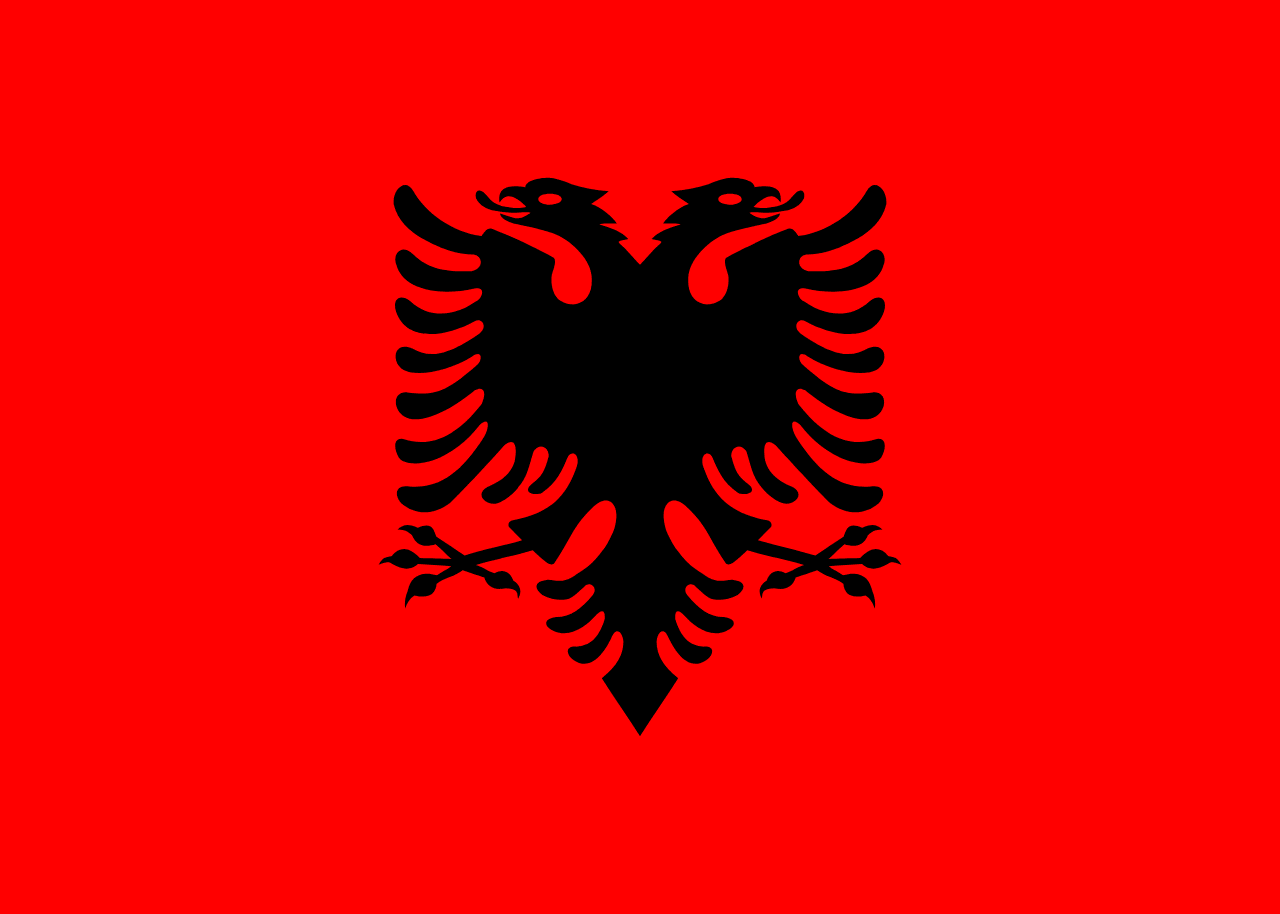
Few national flags announce themselves as boldly as Albania's. A deep crimson field carries a single, unmistakable figure at its center: a black double-headed eagle, wings spread, two heads turned in opposite directions. There are no stripes to count, no cluster of stars, no busy heraldic shield. The whole design rests on the tension between two colors and one ancient bird, and that simplicity is exactly what makes it so memorable. To Albanians, the flag is not decoration but inheritance, tracing a line back to a fifteenth-century warrior whose seal still flies over the country today.
A Field of Red and a Bird of Black
The Albanian flag uses only two colors, and that restraint is part of its power. The background is a rich red, and the emblem laid over it is black. The red field stands for the blood and valor of the Albanian people, a reminder of the struggle and sacrifice woven through the nation's history. Against that warm, charged backdrop, the black eagle reads with stark clarity, its silhouette sharp and immediate.
This is a flag that works at any distance. From across a stadium or fluttering on a distant ridge, the contrast of black on red identifies it instantly. There is no need to squint at fine detail or decode layered symbolism, the message is delivered in a single glance: this is the land of the eagle, defended in blood.
The Double-Headed Eagle Up Close
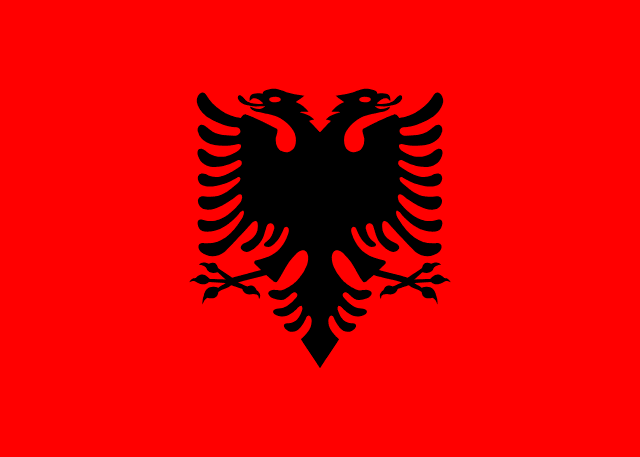
The centerpiece is a black double-headed eagle, placed squarely in the middle of the red field. Its two heads face away from one another, one looking left and one looking right, while the body and outstretched wings fill much of the flag's center. This single emblem is the entire design, and the country built its very identity around the bird, often calling itself the land of the eagles.
The two heads are the design's most discussed feature. They are commonly understood to represent Albania's gaze toward both East and West, a fitting image for a country that has sat at the crossroads of empires, faiths, and cultures for centuries. Whether read as vigilance in two directions or as a bridge between worlds, the dual heads give the eagle a watchfulness that a single-headed bird could never convey.
From Skanderbeg's Seal to a National Banner
The eagle's roots run deep into the late medieval period. The emblem is based on the seal of Gjergj Kastrioti, the fifteenth-century hero better known as Skanderbeg, who led Albanian resistance against Ottoman expansion. The double-headed eagle he raised became a rallying symbol, and over the centuries it never truly disappeared from the Albanian imagination.
When Albania declared its independence in the early twentieth century, the eagle was the natural and inevitable choice for the new nation's banner, an unbroken thread connecting modern statehood to its most celebrated defender. The design has endured through monarchy, occupation, and decades of communist rule, surviving changes of regime that often added or stripped away extra emblems above or around the bird.
The version flown today, the clean red field with the black double-headed eagle and no additional symbols, was adopted in 1992, as Albania emerged from its communist era into a new democratic chapter. That date marks not the birth of the design but its return to a purer form, shedding the politically loaded additions of the previous decades and restoring the eagle to the simple dignity of Skanderbeg's original seal.
Eagles in Company: Comparing the Flag to Its Cousins
The double-headed eagle is one of the most widely shared motifs in world heraldry, which means Albania's flag has a family of relatives even though none is a true twin. The same two-headed bird appears in the coats of arms and symbols of countries such as Montenegro and Serbia, as well as in the historic imagery of empires like Byzantium and the Holy Roman Empire, all of which used it to signal sovereignty over multiple realms or a gaze across two horizons.
What sets Albania apart is the radical simplicity of its execution. Where many double-headed eagles are clutching scepters, wearing crowns, or perched on elaborate shields, Albania's bird stands alone, unadorned, in flat black on flat red. There is no crest, no motto ribbon, no quartered shield. That minimalism is the distinguishing fingerprint, the design feels less like a coat of arms transplanted onto cloth and more like a single, ancient seal pressed directly into the national fabric.
The red-and-black palette also separates it from look-alikes. Many eagle-bearing flags favor white, gold, or blue grounds; Albania's choice of blood-red gives its eagle a fierceness and a martial heat that the others lack. For more on the country behind the symbol, see our albania country guide.
A Symbol Stitched Into National Identity
For Albanians, the eagle is more than a flag emblem, it is a self-description. The Albanian name for the country and its people is bound up with the image of the eagle, and the bird appears everywhere from official seals to sports jerseys to the gesture fans make with interlocked hands to mimic spread wings. Few peoples identify so completely with the creature on their flag.
This identification carries real emotional weight. The flag is a shared inheritance for Albanians both inside the country's borders and across the large diaspora, a population that has carried the eagle to communities around the world. Wherever ethnic Albanians gather, the red banner with its black bird is a quick and powerful statement of belonging, a thread of continuity stretching back to Skanderbeg's resistance.
The Eagle in Modern Albanian Life
Today the flag is woven into the rhythm of public life. It flies over government buildings and schools, and it takes center stage on national holidays, especially Flag Day, when Albanians mark their independence and the raising of the banner. At sporting events the eagle is impossible to miss, draped over shoulders, painted on faces, and formed in the air by the hands of supporters in a gesture instantly recognized by Albanians everywhere.
The simplicity that makes the flag so striking also makes it endlessly adaptable. It scales cleanly from a tiny lapel pin to a banner the size of a building, and it reproduces faithfully in everything from embroidery to digital graphics. That versatility has helped the eagle remain a vivid, living symbol rather than a relic, equally at home on a centuries-old monument and on a modern team kit.
Quick Facts About the Albanian Flag
- Colors: A red field with a black double-headed eagle, just two colors in the entire design.
- Adopted: The current version was adopted in 1992 as Albania moved beyond its communist era.
- Origin: The eagle is based on the seal of the fifteenth-century national hero Skanderbeg.
- The two heads: They are seen as Albania looking toward both East and West.
- Continent: Albania lies in Europe, on the southeastern Balkan Peninsula.
- Nickname: Albania is often called the land of the eagles, a name tied directly to the flag.
Frequently Asked Questions
When was the Albanian flag adopted?
The current flag, a red field bearing a black double-headed eagle with no additional symbols, was adopted in 1992. The design itself is far older, but that year marks its return to a clean form as Albania emerged from its communist period.
What do the colors of the Albanian flag mean?
The flag uses red and black. The red field represents the blood and valor of the Albanian people, while the black double-headed eagle stands for the nation's sovereignty and independence.
Who created the Albanian eagle symbol?
The double-headed eagle is based on the personal seal of Gjergj Kastrioti, known as Skanderbeg, the fifteenth-century hero who led Albanian resistance against the Ottomans. His emblem became the enduring symbol of the Albanian nation.
What continent is Albania on, and how does its flag compare to similar ones?
Albania is in Europe, on the southeastern Balkan Peninsula. Its double-headed eagle is shared with several other symbols and flags, such as those of Montenegro and Serbia and historic empires like Byzantium, but Albania's unadorned black bird on a plain red field is the most strikingly minimal version of the motif.