

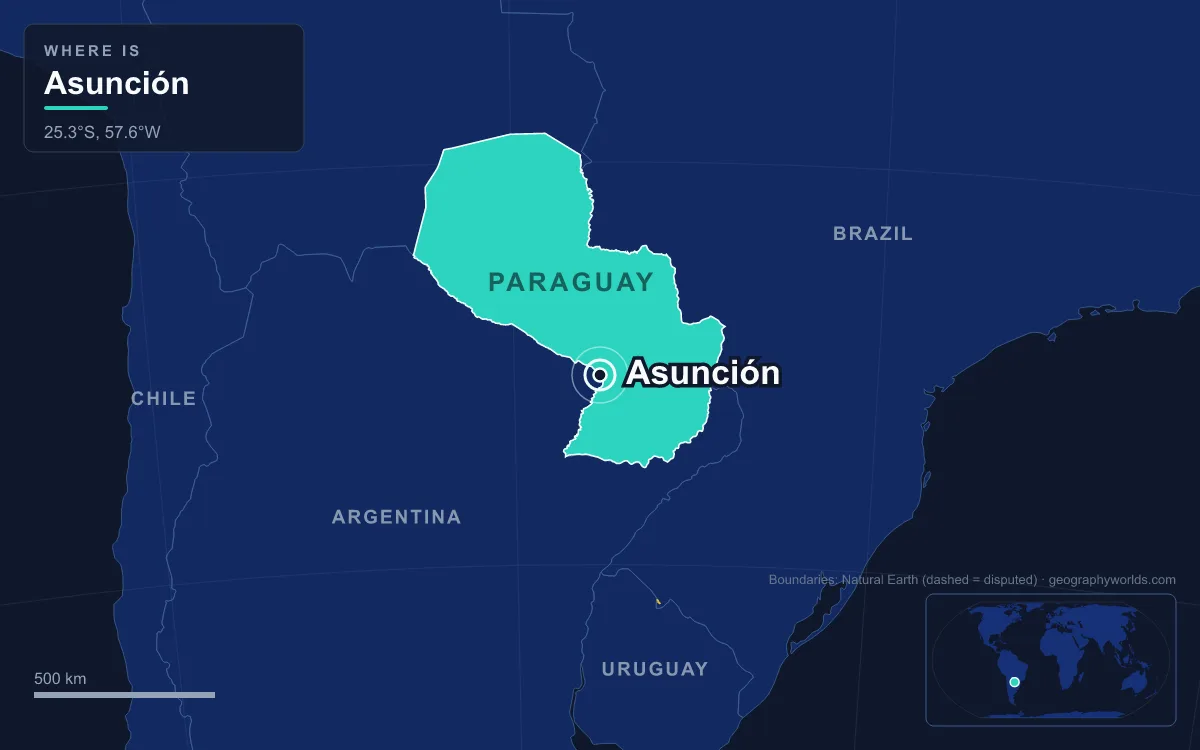
On the eastern bank of the Paraguay River, just north of where the Pilcomayo flows in and facing the Chaco and the Argentine border, stands Asunción, the capital and largest city of Paraguay. The 2022 census counted 462,241 people in the city itself, while its metropolitan area holds more than 2.4 million, around 40% of the country. Founded as a Spanish fort in 1537, it is one of the oldest cities in South America, and its character comes from the people who met there: Guaraní and Spaniards first, then waves of criollos, rural migrants and newcomers from Europe, the Levant and East Asia.
Guaraní Allies and Spanish Soldiers at the 1537 Fort
The city began with an encounter. Juan de Salazar de Espinosa, sent up the Paraguay River to look for the missing conquistador Juan de Ayolas, stopped at a bay on the left bank to resupply his ships. He found the local Guaraní friendly and on 15 August 1537, the Feast of the Assumption, founded a fort he named Nuestra Señora Santa María de la Asunción. The founding document of the cabildo, the town council, is dated 16 September 1541, and it is that document that gives the city its official name.
The relationship between the handful of Spaniards and their Guaraní hosts shaped everything that followed. Through the cuñadazgo, a Guaraní custom in which chiefs gave women to newcomers to seal alliances, and later through violent mass seizures of women known as rancheadas, the colonists built large mixed households. A priest in 1545 called the town the “paradise of Muhammad,” a jibe that stuck to the city for centuries. The children of those unions became the mestizo majority of colonial Paraguay, and their mothers’ language never disappeared. In 1603 the First Synod of Asunción set guidelines for evangelising the natives in their lingua franca, Guaraní. The city’s Guaraní name is simply Paraguái, later applied to the whole nation.
Refugees from Buenos Aires and the ‘Mother of Cities’
In the early 1540s the first Spanish settlement at Buenos Aires, founded by Pedro de Mendoza in 1536, was destroyed by the local peoples, and its survivors retreated upriver to Asunción. For the next four decades the town on the Paraguay River was the centre of a vast colonial province covering present-day Paraguay, north-eastern Argentina and part of Brazil.
From Asunción, expeditions went out to found other towns, which is why Paraguayans call it “la Madre de Ciudades,” the Mother of Cities. Juan de Garay, who moved to Asunción in 1568, led 80 men down the Paraná in 1573 to found Santa Fe, became governor of Asunción in 1576, and in 1580 carried out the second, permanent foundation of Buenos Aires. Corrientes, Villarrica, Córdoba and Santa Cruz de la Sierra are also counted among Asunción’s offspring, together with some 65 other settlements. Many of the first residents of those towns were mestizo sons of Asunción.
Criollo Conspirators at the Casa de la Independencia, May 1811
By the 18th century the city’s criollos, locally born people of Spanish descent, and its mestizos had developed a strong sense of their own interests. A revolt led by José de Antequera y Castro in the 1720s and 1730s, the Comunero movement, was one of the earliest challenges to Spanish rule in the Americas. It failed, but the spirit it expressed returned in 1811.
The independence plot was hatched in a whitewashed house in the centre of town belonging to Juana María de Lara. On the night of 14–15 May 1811 the conspirators moved against the Spanish governor, Bernardo de Velasco, and forced him to surrender. Paraguay dates its independence from that night.

The house is now a museum. It stands in stark contrast to the tower blocks that have risen elsewhere in the city: between 2015 and 2020 real-estate developments absorbed more than US$1 billion of investment, most visibly along Aviadores del Chaco and Santa Teresa avenues.
An English Architect and the Palacio de los López
Under José Gaspar Rodríguez de Francia, who ruled from 1813 to 1840, Paraguay was sealed off from the outside world; in Asunción he built roads and gave the streets names. His successor Carlos Antonio López, president from 1844 to 1862, reversed course with new economic policies that opened the country up. More than 400 schools were opened, metalworks were set up, and one of the first railway services in South America was built. Alonso Taylor, an English architect, directed the construction of the government palace from 1857, a neoclassical building overlooking Asunción Bay intended for López’s son and heir, Francisco Solano López.

The younger López never lived there. He led Paraguay into the War of the Triple Alliance against Brazil, Argentina and Uruguay from 1864 to 1870, and on 1 January 1869 Brazilian forces entered Asunción. They occupied the city until 1876. Estimates of Paraguay’s wartime losses are disputed and vary widely, but some historians put them at more than half of the pre-war population, and the capital was left impoverished and underpopulated. The palace is now the president’s office, although the head of state lives at Mburuvicha Róga, Guaraní for “house of the chief.”
Newcomers After 1870: Europeans, Levantines, Jews, Japanese and Koreans
With so many dead, post-war governments opened the doors. Towards the end of the 19th century immigrants from Europe and the Ottoman Empire began arriving in Asunción, and the city’s appearance changed as they built. Paraguay drew Spaniards, Italians, Germans, French and Slavs, together with mostly Christian Lebanese and Syrians, many of whom had left the Ottoman-ruled Levant for economic and political reasons.
Jewish migration followed a similar arc: Jews from France and Italy in the late 19th century, Sephardim from Jerusalem, Egypt and Turkey around the First World War, Polish and Ukrainian Jews in the 1920s, and refugees from Germany, Austria and Czechoslovakia in the 1930s, many of whom later moved on to Argentina or Brazil. The community today numbers about 1,000, mostly in Asunción, with its own synagogues and the Jewish Museum of Paraguay.
East Asians came later. The Paraguayan-Japanese Center and a Japanese school in Asunción serve the Nikkei community. The first Korean immigrants, from Busan, reached the city on 22 April 1965 after two months at sea and an overland journey from Buenos Aires. They started out in beekeeping and door-to-door clothing sales, moved into importing consumer electronics by the early 1980s, and ran corner shops that were noted for staying open through the siesta. A Korean school has operated in the San Vicente neighbourhood since 1972, although the community has shrunk from about 10,428 in 1999 to roughly 5,200 in 2011. Most newcomers now come from the two big neighbours: in 2002, 84.2% of immigrants in Paraguay were from Brazil or Argentina, the two countries that surround Paraguay to the east and south.
Spanish, Guaraní and Jopará on the Streets of Asunción
Paraguay is unusual in the Americas because its indigenous language never gave way to the colonial one. Guaraní is spoken by the majority of Paraguayans and is one of the country’s two official languages, alongside Spanish. In the capital, though, Spanish dominates daily life. Figures for the city show 56.9% of residents using Paraguayan Spanish as their main language, 27.4% Jopará, the everyday blend of Guaraní and Spanish, and 11.2% Guaraní.
Code-switching is the norm: more Spanish for official and business matters, more Guaraní in art and everyday conversation. The pattern even reaches civic slogans. When Asunción was named the Green Capital of Ibero-America during the 2010–2015 term of intendant Arnaldo Samaniego, the municipal programme was called “Rohayhu Asunción,” Guaraní for “I love you, Asunción.” Guaraní is also one of the three official languages of Mercosur, the bloc created by the Treaty of Asunción in March 1991, which is covered in our guide to Mercosur.
From the Countryside to Gran Asunción: 462,241 in the City, 2.4 Million Around It
The last great migration into Asunción came from inside Paraguay. Until the early 1980s it was the only city in the country with more than 100,000 inhabitants, in a nation that was overwhelmingly rural. Between 1962 and 1992 the capital’s population more than doubled, first with the economic boom of the 1970s and then with the recession in the countryside that pushed families off the land.
Since the late 1990s the city proper has stagnated while its neighbours have boomed. Luque, Lambaré, San Lorenzo, Fernando de la Mora, Mariano Roque Alonso, Limpio, Capiatá and Villa Elisa, all in Central Department, absorbed most of the newcomers because land was cheaper and taxes lower. Every day around 1.5 million people and 600,000 vehicles move through Asunción. The 2022 census put the density at 3,951 people per square kilometre, and the city has 89 men for every 100 women, reflecting the jobs that draw young women from rural areas, and an average age of 31 against a national figure of 27.
Asunción is now an autonomous capital district, outside any department since 1993, and the seat of all three branches of government, the Central Bank of Paraguay and the country’s only stock exchange, the BVPASA. Its streets still carry the layers of those who came: Guaraní words, a colonial house where criollos plotted independence, a palace built under an English architect, and Korean and Japanese schools. To see how the city fits into the river plains and the Chaco around it, read our overview of Paraguay’s geography.
Quick Facts About Asuncion
- Country: Paraguay
- Continent: South America
- Country population: approximately 7.1 million
- Capital city status: Asuncion is the capital of Paraguay, the seat of national government, and the location of foreign embassies, parliament, and the head of state's official residence.
Frequently Asked Questions
What is the capital of Paraguay?
The capital of Paraguay is Asuncion. Asuncion is the seat of national government, hosts most foreign embassies and consulates, and is typically where the head of state and parliament are located.
What continent is Asuncion in?
Asuncion, the capital of Paraguay, is located in South America. As Paraguay's capital, Asuncion serves as the country's primary connection to the broader South American political, economic, and cultural sphere.
Why is Asuncion the capital of Paraguay?
Asuncion was chosen as the capital of Paraguay for reasons that typically combine geography, history, and politics. Capital city selections often reflect a desire for centrality (being accessible from across the country), historical importance (being a longstanding seat of government or culture), or neutrality (being acceptable to multiple regions or ethnic groups within the country). The specific reasons for Asuncion's designation are detailed in the city's history above.
What is Asuncion known for?
As the capital of Paraguay, Asuncion is best known for housing the country's central government institutions — parliament, presidential or royal residences, supreme court, and key ministries. It is also typically a major cultural and economic center within Paraguay, hosting national museums, embassies, and signature monuments. The introduction and history sections above provide detailed coverage of the city's specific notable institutions and landmarks.
Related Pages
- Paraguay Country Guide — full geography, climate, economy, and culture overview
- Flag of Paraguay — meaning, history, and design of Paraguay's national flag