
Most national flags look the same no matter which way the wind blows them, but Paraguay's does not. Pull the cloth taut from the front and you see one emblem; walk around to the back and you find a different one entirely. This quirk makes the Paraguayan flag a favorite trivia answer and a genuine outlier in the world of vexillology. Yet beyond the curiosity, it is a dignified red, white, and blue tricolor that has flown over the landlocked South American republic since 1842, carrying the story of a hard-won independence.
Adopted in the years following Paraguay's break from Spanish and regional control, the flag pairs a familiar horizontal layout with an unusual double-sided design. Understanding it means looking at both its surfaces, its colors, and the young nation that needed a banner of its own.
A Tricolor That Reads Differently Front and Back
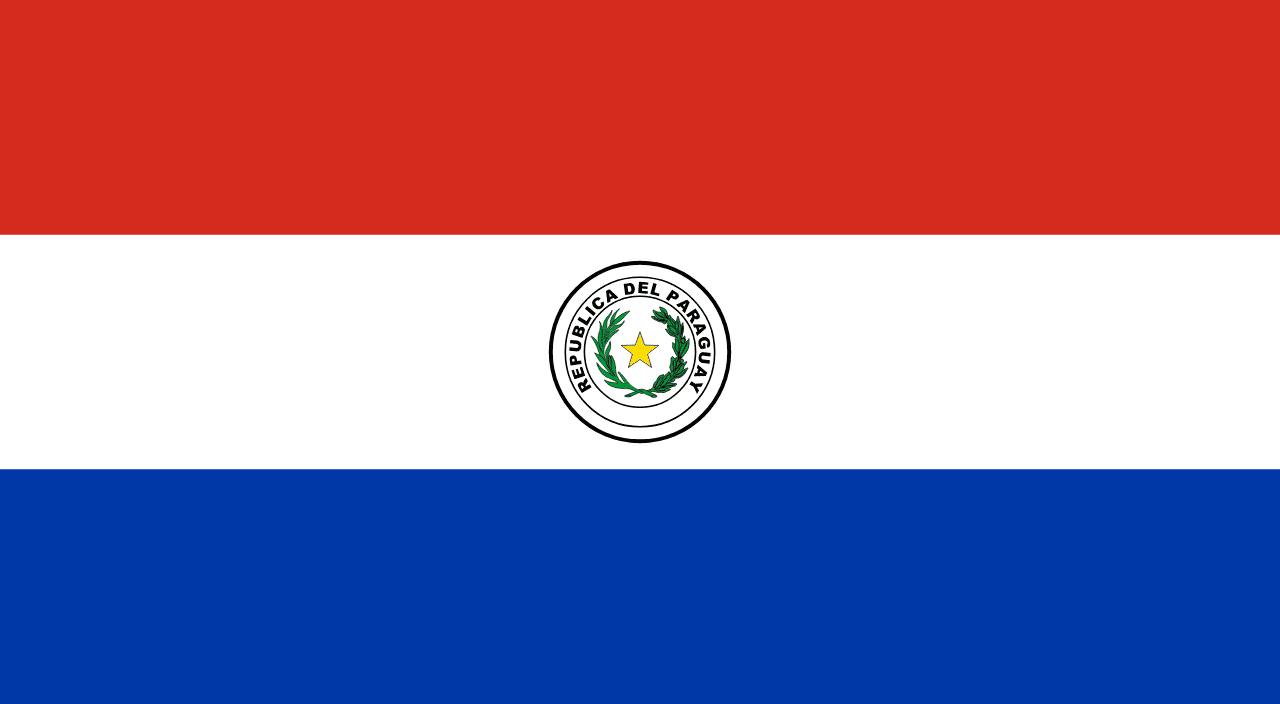
At first glance, the flag of Paraguay is a horizontal triband: three equal stripes of red on top, white in the middle, and blue along the bottom. That arrangement alone would make it resemble several other flags. What sets it apart sits in the center of the white band, and it is here that the design splits in two.
On the obverse, the front-facing side, the central white stripe carries the national coat of arms: a golden five-pointed star encircled by a green wreath of palm and olive branches, ringed by the words "República del Paraguay." On the reverse side, the same spot holds the Treasury Seal instead, featuring a lion guarding a staff topped with a red liberty cap, beneath the motto "Paz y Justicia" (Peace and Justice). Two different emblems, one flag.
This is why Paraguay is so often cited as the only national flag with distinct images on each side. Nearly every other country in the world flies a banner that is identical or simply mirrored when reversed. Paraguay deliberately committed to two separate emblems, and that decision has held for the better part of two centuries.
What the Colors Stand For
The red, white, and blue palette is the symbolic backbone of the flag, and its meaning ties directly to the ideals of the independence era. Broadly, the three colors are read as expressions of patriotism and the values the young republic chose to champion.
The interpretations most commonly attached to them are:
- Red — associated with patriotism, courage, equality, and the sacrifices made for the nation.
- White — linked to peace, purity, and unity among the people.
- Blue — tied to liberty, justice, and the spirit of generosity.
The two emblems carry the heavier historical weight. Both the coat of arms and the Treasury Seal point back to the same idea: independence, sovereignty, and the lawful order of a free country. The golden star of the coat of arms is widely understood as the May Star, recalling the independence declared in May 1811, while the lion and liberty cap of the reverse seal speak to vigilance in defense of freedom.
How the Flag Came to Be
Paraguay declared independence from Spain in 1811, slipping free of colonial rule and also resisting absorption by its larger neighbors. In those early years the country experimented with several flag designs before settling on the red-white-blue tricolor. The colors themselves are often traced to the influence of the French Revolution's ideals, which rippled across the Americas during the independence movements, though Paraguay arranged them in its own distinctive horizontal order.
The version with the two emblems was formally established in 1842, the year most often given as the flag's adoption. From that point the basic concept stayed remarkably stable, even as the precise drawing of the coat of arms and seal was refined over the generations. Modern Paraguayan law has tidied up the official specifications, but the essential identity, three stripes plus two faces, traces straight back to the mid-nineteenth century. To dig deeper into the nation's broader story, see our paraguay country guide.
Cousins in the Crowd: Flags That Look Similar
The red-white-blue horizontal tricolor is one of the most common formats on Earth, so Paraguay's flag shares a family resemblance with several others, yet none are easy to confuse once you look closely.
The Netherlands flies a red-white-blue horizontal triband too, but its stripes run in a different order and it carries no central emblem at all. The same goes for Luxembourg and the historic flags of several other states that use plain horizontal bars. Within South America, observers sometimes line Paraguay up against neighbors, but the layout is its own: many regional flags favor horizontal bands of yellow, blue, and red, or vertical arrangements, none of which match Paraguay's red-over-white-over-blue stack.
The true distinguishing feature, of course, needs no comparison chart. The moment you check the back of the flag and find a second, different emblem, you know exactly which country you are looking at. No other national banner asks you to consider both sides as separate compositions, and that single trait does more to identify Paraguay than any color order ever could.
A Banner Woven Into National Identity
For Paraguayans, the flag is more than a design problem solved cleverly. The two emblems together capture a national character built on defending sovereignty and pursuing peace and justice, the very words stamped on the reverse seal. A small, landlocked country surrounded by far larger neighbors, Paraguay has long leaned on symbols of independence and self-reliance, and the flag puts those values literally on both sides of the cloth.
The bandera nacional appears on government buildings, schools, and currency, and it features prominently in the colors many Paraguayans wear with pride. Because the flag carries both the state arms and the Treasury Seal, it does double duty as a marker of the republic and of its institutions, a compact emblem of the whole governing order.
The Flag in Modern Paraguay
Today the flag turns up wherever national feeling runs high. Independence celebrations in May, when the country marks the events of 1811, bring it out in force across Asunción and beyond, draped from balconies and waved through the streets. Civic ceremonies, military parades, and school events all center the tricolor.
Sport is another stage where the flag thrives. Paraguay's passionate football following carries the red, white, and blue into stadiums at home and abroad, and the national team's supporters turn the colors into a sea of waving cloth. In all these settings, flag-makers must mind the detail that trips up outsiders: a properly made Paraguayan flag shows the coat of arms on one side and the Treasury Seal on the other, never the same emblem twice. Cheaply produced versions that print one image and let it show through reversed are technically incorrect, a small point of pride for those who know the rule.
Quick Facts Worth Remembering
- Paraguay's flag is the world's most famous example of a banner with different designs on its front and back.
- The obverse carries the national coat of arms with its golden star; the reverse carries the Treasury Seal with a lion and liberty cap.
- The colors are red, white, and blue, arranged as a horizontal triband.
- The current double-emblem design was established in 1842.
- The reverse seal bears the motto "Paz y Justicia" — Peace and Justice.
- Paraguay sits in South America, one of only two landlocked countries on the continent.
Frequently Asked Questions
When was the flag of Paraguay adopted?
The flag in its recognizable two-emblem form is generally dated to 1842, a few decades after Paraguay declared independence from Spain in 1811. The country had used red-white-blue designs earlier, but 1842 is the year cited for the established national flag, and its core concept has endured ever since.
What do the colors of the Paraguayan flag mean?
The red, white, and blue together express patriotism and the ideals of the independence era. Red is commonly linked to courage and equality, white to peace and unity, and blue to liberty and justice. The two central emblems carry the deeper message, both representing the nation's hard-won independence and sovereignty.
Why is Paraguay's flag different on each side?
Paraguay deliberately placed two distinct emblems on its flag: the national coat of arms on the front and the Treasury Seal on the back. This makes it the only national flag in the world that is genuinely different on its obverse and reverse, rather than simply mirrored. The choice reflects the country's wish to display both its state arms and its founding ideals of peace and justice.
What continent is Paraguay on, and which flags are similar?
Paraguay is located in South America. Its horizontal red-white-blue tricolor superficially resembles flags such as the Netherlands or Luxembourg, but the stripe order differs and, crucially, Paraguay's flag adds emblems that those banners lack. Once you compare the two distinct sides, no other national flag can be mistaken for it.
