

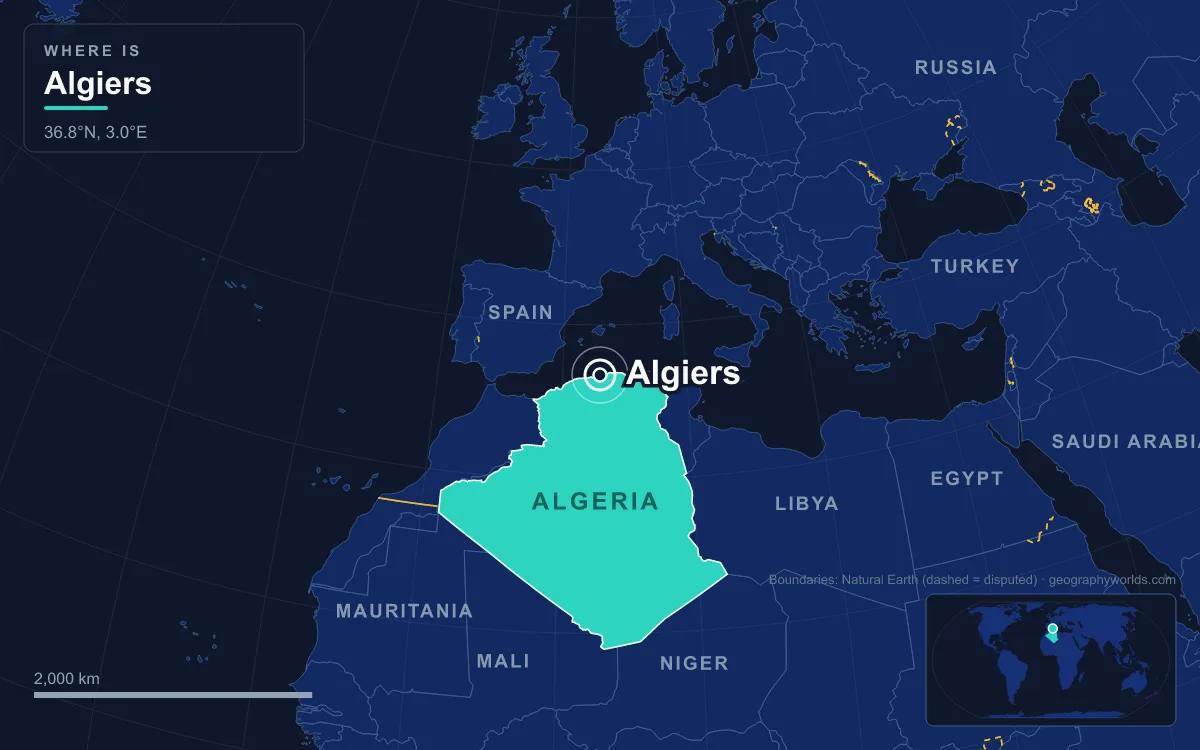
Algiers, whose Arabic name al-Jazāʾir means “the islands”, is the capital and largest city of Algeria, built around the Bay of Algiers on the Mediterranean coast in the north-central part of the country. About 4.3 million people lived in its urban area in 2025, which makes it the third-largest city on the Mediterranean. It has been a capital since 1516, first of the Ottoman Regency of Algiers, then of French Algeria after 1830, and of independent Algeria since 1962. Its heart is the Casbah, the hillside old town listed by UNESCO in 1992. More than its buildings, though, what defines Algiers is the succession of peoples who arrived, ruled, traded, fled and returned: Berber founders, Andalusian refugees, Turkish soldiers, European captives, Jewish merchants, French settlers and Kabyle migrants. Following them in turn is the clearest way to see how the city came to be.
The Beni Mezghenna and Buluggin ibn Ziri’s Islands
The earliest trace of the Punic port of Ikosim dates from the late 6th century BC, and under Rome the town of Icosium belonged to the province of Mauretania Caesariensis. The Greeks liked to explain the name as coming from eikosi, “twenty”, for twenty companions of Hercules said to have founded it. By the early 7th century AD the plain around the ruins was the territory of the Beni Mezghenna, a Berber tribe of the Sanhaja confederation.
The present city dates from 972, when Buluggin ibn Ziri, founder of the Zirid dynasty and a governor for the Fatimid caliphs, built a town here and called it Jazāʾir Banī Mazghanna, “the islands of the Beni Mezghenna”, after the small islets off the shore. Those islets were joined to the mainland only in 1525, by the pier now named after Kheireddine. Algiers’ own residents have always called the city Dzayer and themselves dziri, and one theory links the word to Ziri himself. The town’s population was at first entirely Berber; that began to change after the Tha’alaba, a small Arab tribe expelled from the Titteri region in the 13th century, settled on the Mitidja plain and started a slow Arabisation, particularly of religious life.
Andalusians, Tagarins and 25,000 Moriscos
From the 14th century onward, a new population came across the sea from Spain. Muslim refugees known as Andalusians and Tagarins fled the Christian advance in Iberia, and Sephardic Jews escaping the persecutions of 1391 and the expulsion of 1492 took refuge in Algeria as well. Algiers’ growing piracy drew a Spanish response: after the Reconquista, Ferdinand II of Aragon seized and fortified the Peñón, an islet in front of the city, and made its emir, Salim al-Thumi, swear obedience and loyalty to him.
The largest single wave came after Spain expelled its remaining Moriscos in 1609: in the early 17th century Algiers took in about 25,000 of them, and they drove much of the city’s expansion. The city dwellers developed a dialect that southern nomads and Berbers found hard to follow. The Andalusian inheritance is still visible in the painted “bridal chests” made by Casbah woodworkers, decorated with Arab-Andalusian floral motifs, and audible in the Andalusi modes and rhythms that chaabi, the city’s own popular music, borrowed centuries later.
Turks, Janissaries and Kouloughlis Under the Regency
In 1516 the emir of Algiers invited the corsair brothers Oruç Reis and Hayreddin Barbarossa to drive out the Spaniards. Oruç took the town and had the emir killed, and Algiers became the seat of an Ottoman province, the Regency; his brother Hayreddin finally drove the Spaniards off the Peñón in 1529. For the next three centuries a Turkish minority held the key posts in government, the army and the navy. The janissary corps, the Odjak, grew so powerful that after a coup in 1659 the Regency became in effect a military republic whose rulers were elected by the council, the diwan, rather than appointed from Constantinople.
Many soldiers married local women, and their children formed a distinct group, the Kouloughlis, from the Ottoman Turkish kuloğlu, “son of a kul”, a servant of the sultan. The social map of the city followed these divisions. The lower town, al-Wata, held the administration, the markets and the residences of Turkish officials and wealthy corsair captains, while the upper town, al-Gabal, was divided into about fifty small quarters of Andalusian, Jewish, Moorish and Kabyle families. The citadel that gives the Casbah its name was begun in 1516 and completed in 1592.

Captives, Renegades and Cervantes’s Five Years
Under the Regency the city’s main income came from the corso, privateering against Christian shipping, and one of its largest populations was involuntary. According to one estimate, up to 40% of Algiers’ roughly 100,000 inhabitants in the 17th century were enslaved Europeans, taken in raids that reached as far as Iceland. Captives who could be ransomed often lived in relatively mild conditions; those sent to row the galleys had a far harsher time. The best-known captive was Miguel de Cervantes, held in Algiers for almost five years, who later wrote two plays set in the city.
Alongside the captives lived the renegades, Christians who had converted to Islam, sometimes to escape the law at home. Many held positions of authority: the Englishman Samson Rowlie became Treasurer of Algiers, and renegades were often recruited as corsair captains. Their world ended in stages. Charles V’s attempt to take the city in October 1541, with an army put at 24,000 to 30,000 men, was wrecked by a storm; the Anglo-Dutch bombardment under Lord Exmouth on 27 August 1816 destroyed the ships in the harbour; and the French landing of 1830 finished the Regency.
By then the city had already shrunk. Earthquakes in 1716 and 1755, plague in 1740, 1752, 1787 and 1817, and the decline of piracy drove the population down to about 25,000 on the eve of the conquest, and the first French census in 1831 found just 12,000 people after some 6,000 Turks and many townspeople left.
Berrani From Biskra, Laghouat and the M’zab
Ottoman Algiers also depended on people known as the berrani, “outsiders”: rural communities who came from Saharan towns and oases such as Biskra, Laghouat and the M’zab valley to work in the city. Others moved in from Annaba, Constantine and Tlemcen, and the city was home to freed Black slaves as well. The established townspeople, including Arab families, some of them descended from the Tha’alaba, were the beldiya, the city dwellers, and set themselves apart from the Arabs of the interior.
The Jews of Algiers, From Livorno to the Crémieux Decree
Algiers’ Jewish community drew on several origins: migrants from inside Algeria, Sephardic families from Spain from the 14th century, and, in the 17th century, merchants from Livorno in Italy. Jewish merchants acted as commercial intermediaries between Europe and the Ottoman world, and the dispute that triggered the French invasion concerned unpaid French debts for wheat supplied by two of them; it came to a head in 1827, when the dey struck the French consul with a fly-whisk.
Under France the community’s position changed sharply. The Crémieux Decree of 24 October 1870 made about 35,000 Algerian Jews French citizens while leaving their Muslim neighbours under the discriminatory native code, which deepened the divide between the two. Antisemitism among European settlers ran high: in 1898, amid a campaign led by the antisemitic activist Max Régis, rioters looted and burned more than 158 Jewish-owned shops in Algiers and killed two people. By 1931 Jews made up more than 7% of the city’s population. When the Allies landed on 8 November 1942, 315 of the 377 resistance fighters who seized key points in Algiers were Jewish. After 1962 almost all left; a synagogue built between 1850 and 1865 became a mosque, still called Jamaa li Houd, and by 2017 only about 50 Jews remained in Algeria, mostly in the capital.
Pieds-Noirs and the Exodus of 1962
From 1830, French rule remade both the city and its people. Much of the lower Casbah was demolished to create the Place des Martyrs and Haussmann-style boulevards, and mosques such as Ketchaoua were converted into churches. Algiers became the capital of French Algeria and home to a large population of European settlers, the pieds-noirs, while Muslims lived under the Code de l’indigénat, which enforced their inferior status and barred them from parts of the city.

The Algerian War of 1954–1962 turned the Casbah into an FLN stronghold, and the Battle of Algiers began on 7 January 1957 when the French 10th Parachute Division moved in. Independence came on 5 July 1962. More than 800,000 pieds-noirs left Algeria between 1962 and 1964, many with a single suitcase, and only about 90,000 of some 250,000 harkis, Algerians who had fought for France, and their dependants reached France. In the Casbah, the old beldiya families moved into the flats the Europeans left behind in Bab El Oued and El Biar, and rural migrants took their places.
Kabyles, Chaabi and the Algérois of Today
The biggest migration of all came from the mountains to the east. Algiers sits on the edge of Kabylia, and from the 16th century it was the main destination for Kabyle migrants, though Ottoman distrust kept them to about a tenth of the population. Under French rule they arrived in far greater numbers: the city’s Muslim population only regained its pre-conquest level in 1901, thanks to Kabyle arrivals, and by the 20th century many Casbah families came from the Djurdjura range.
That community gave Algiers its signature music. Chaabi, “music of the people”, emerged in the Casbah in the 1930s, drawing its modes and rhythms from Andalusi music, and was formalised by El Hadj M’Hamed El Anka, born at 4 Rue Tombouctou in 1907 to a family from Taguersift in Greater Kabylia. Sung in Algerian Arabic and in Kabyle, and shared by Muslim and Jewish musicians, it reached the world through Dahmane El Harrachi’s emigration song “Ya Rayah”. El Anka opened the first chaabi class at the Algiers Conservatory in 1957.
A 2012 estimate put Algiers at about 3.3 million people; one breakdown of the population gives 53% from an Arabic-speaking background, 44% from a Berber-speaking one and 3% foreign-born, and the urban area has since grown past 4.3 million. The religious make-up of Algeria explains some of that inheritance; our ranking of the largest cities in Algeria shows how far the capital now outstrips Oran and Constantine; and the Algeria country guide places the city in the wider country its many peoples helped create.
Quick Facts About Algiers
- Country: Algeria
- Continent: Africa (North Africa)
- Country population: approximately 48.0 million
- Capital city status: Algiers is the capital of Algeria, the seat of national government, and the location of foreign embassies, parliament, and the head of state's official residence.
Frequently Asked Questions
What is the capital of Algeria?
The capital of Algeria is Algiers. Algiers is the seat of national government, hosts most foreign embassies and consulates, and is typically where the head of state and parliament are located.
What continent is Algiers in?
Algiers, the capital of Algeria, is located in Africa, in the North Africa region. As Algeria's capital, Algiers serves as the country's primary connection to the broader African political, economic, and cultural sphere.
Why is Algiers the capital of Algeria?
Algiers was chosen as the capital of Algeria for reasons that typically combine geography, history, and politics. Capital city selections often reflect a desire for centrality (being accessible from across the country), historical importance (being a longstanding seat of government or culture), or neutrality (being acceptable to multiple regions or ethnic groups within the country). The specific reasons for Algiers's designation are detailed in the city's history above.
What is Algiers known for?
As the capital of Algeria, Algiers is best known for housing the country's central government institutions — parliament, presidential or royal residences, supreme court, and key ministries. It is also typically a major cultural and economic center within Algeria, hosting national museums, embassies, and signature monuments. The introduction and history sections above provide detailed coverage of the city's specific notable institutions and landmarks.
Related Pages
- Algeria Country Guide — full geography, climate, economy, and culture overview
- Flag of Algeria — meaning, history, and design of Algeria's national flag