

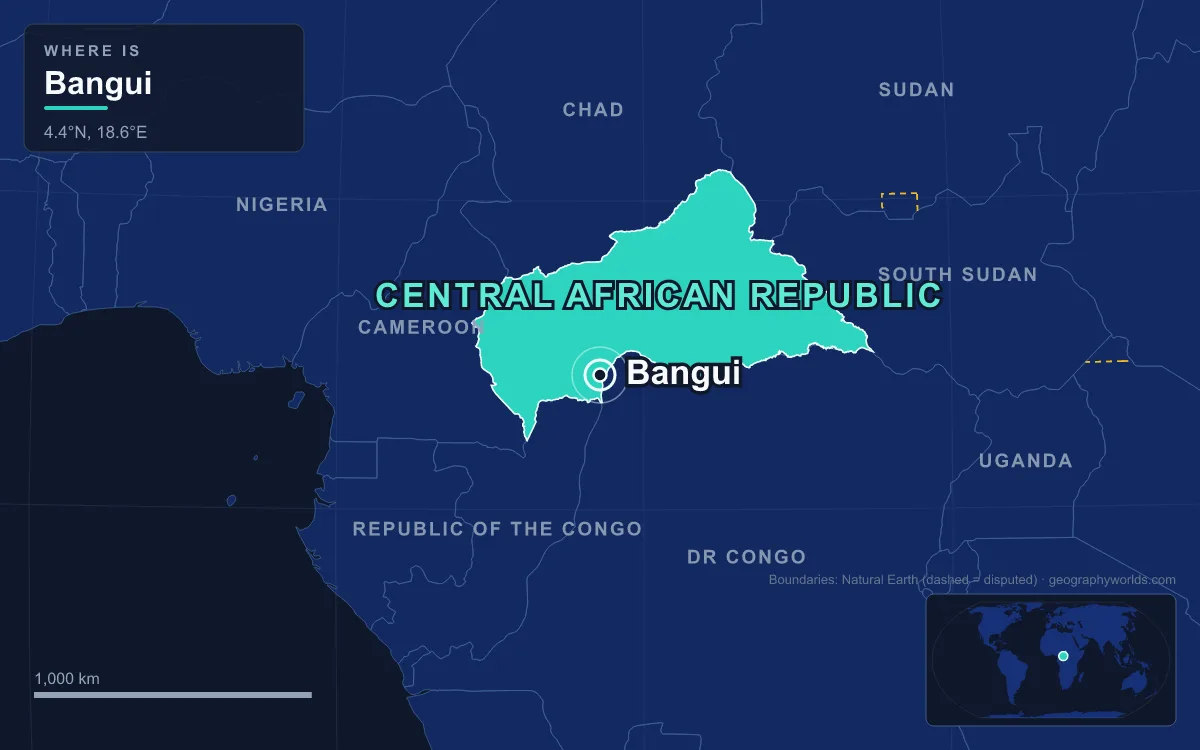
Bangui is the capital and largest city of the Central African Republic. It sits on the northern bank of the Ubangi River, on the country's southern border, facing the Congolese town of Zongo across the water, and had an estimated 889,231 residents in 2020. The city exists because of a line of rapids: French agents founded it in 1889 at the last point boats could reach coming upstream from Brazzaville, and the river that gives the city its name, the Ubangi, takes its own name from the Bobangi word for those rapids. Everything since, from colonial headquarters to imperial coronation to peacekeeping base, has played out on a riverbank strip of just 67 square kilometres.
Before 1889: Iron Smelters Beside the Ubangi Rapids
Long before any French outpost, people were working iron here. Archaeologists have identified at least 26 Iron Age sites in and around the modern city, and UNESCO added them to its World Heritage Tentative List on 11 April 2006. The nearest, Pendere-Sengue, lies about 800 metres from what is now Independence Avenue. Excavations there turned up several thousand pottery shards, iron tools and an iron spatula weighing 9 kilograms. Comparison with similar sites in Nigeria and Sudan suggests the smelting could date to around the ninth century BC, although that estimate rests on parallels rather than a precise date for the site itself.
The river mattered just as much then. The Ubangi is the chief northern tributary of the Congo, and it turns sharply south just below Bangui before joining the main stream just south of the equator. The rapids at the future city site were the natural break in that route: below them, canoes and later steamers could travel south; above them, cargo had to be carried or hauled.
1889–1906: Dolisie's Outpost Below the Rapids
The modern settlement was founded on 26 June 1889 by Michel Dolisie and Alfred Uzac, acting on instructions from the Brazzaville administrator Albert Dolisie. It was then a remote post in the upper reaches of the French Congo, and its first site lay about 10 kilometres south of the rapids. The territory around it was organised as Upper Ubangi (Haut-Oubangui) on 9 December 1891. Although a convention had set a border around the 4th parallel, King Leopold's Congo Free State contested the region from 1892 to 1895.
Bangui was not the first choice for a capital. The early administrative centres were upstream, at les Abiras and Fort de Possel. The problem was the same rapids that had created Bangui: officials above them could not communicate directly by river with Brazzaville. The outpost at the head of navigation kept gaining importance, and on 29 December 1903 France united Upper Ubangi and Upper Shari into the colony of Ubangi-Shari. In 1906 Bangui was chosen as the new headquarters of the French administration.
1906–1960: Headquarters of Ubangi-Shari
For the next half-century the town grew as the administrative and military centre of Ubangi-Shari, which was folded into French Equatorial Africa in 1910 and run from Brazzaville's governor-general. The colony became notorious for the brutality of its concession companies; André Gide's 1927 account of his travels there described the abuses and fed the anti-colonial movement in France. A French radio transmitter in Bangui was described in 1932 as the most remote radio station in Africa.
The Second World War briefly put the town on the strategic map. Ubangi-Shari stayed loyal to Vichy from June to late August 1940, then pro-Gaullist officers took control, and General Leclerc set up his headquarters for the Free French Forces in Bangui. The war also enriched the colony as exports of rubber, cotton, coffee, uranium and diamonds rose, and in 1946 Bangui got its first bank, a branch of the Paris-based Banque de l'Afrique Occidentale.
Postwar politics were made in Bangui too. Barthélemy Boganda, a priest who had studied at the Saint Paul des Rapides mission in the town, founded the Movement for the Social Evolution of Black Africa (MESAN) there on 28 September 1949. On 18 November 1956 he defeated white merchant candidates to become the first Mayor of Bangui. Ubangi-Shari became the autonomous Central African Republic on 1 December 1958, with Boganda as prime minister, but he was killed in a plane crash on 29 March 1959 while flying to Bangui, sixteen months before full independence on 13 August 1960.

1960–1979: Dacko's Diamonds and Bokassa's Imperial Capital
Under David Dacko, president from 1960, diamond output rose sharply after a law ended the French concession monopoly and allowed citizens to dig. Dacko set up a diamond-cutting factory in Bangui and diamonds became the leading export. Corruption and unpaid wages followed, and on the night of 31 December 1965 army chief Jean-Bédel Bokassa and his allies left Camp de Roux to seize the capital. Dacko was arrested at Pétévo Junction on the city's western edge and taken to Ngaragba Prison, and on the morning of 1 January 1966 Bokassa announced the coup on Radio Bangui.
Bokassa reshaped the city in his own image. He founded the University of Bangui in 1969, naming it after himself; it began teaching in 1970. He created the national airline Air Centrafrique in 1971, ordered two luxury hotels, set up three interconnected bus lines and an Ubangi ferry, and built a recording studio where musicians were paid to sing his praises. A large arch dedicated to him still stands near the presidential palace. By 1975 the city had somewhere between 280,000 and 300,000 people, depending on the source, and the nickname La Coquette, the pretty city, dates from this decade.
The excess peaked on 4 December 1977, when Bokassa crowned himself Emperor Bokassa I of the Central African Empire in a Napoleon-inspired ceremony in Bangui. It cost an estimated US$20 million, about a third of the state's annual budget. Less than two years later, in September 1979, while Bokassa was on a state visit to Libya, the French intelligence service SDECE carried out Operation Caban, a bloodless coup that flew Dacko into Bangui and restored him to power; the empire fell on 21 September.
1979–2013: Mutinies, Coups and the Bangui Agreements
General André Kolingba took power on 1 September 1981. By the mid-1980s about 80% of state revenue went on salaries, and donor pressure pushed Kolingba to allow multiparty politics in 1991. Ange-Félix Patassé won the elections that followed, but in May 1996 about 200 soldiers mutinied in Bangui demanding pay and his resignation; more than 50 people were killed before French troops restored order. In January 1997 the government, opposition parties and religious groups signed the Bangui Agreements, which provided for an inter-African military mission and brought ex-mutineers back into government.
The peace did not hold. Rebels stormed strategic buildings in Bangui in a failed coup in 2001, and militias loyal to Patassé took revenge across several neighbourhoods. On 25 October 2002 forces loyal to General François Bozizé attacked several towns and then Bangui itself, and in March 2003 they took power while Patassé was abroad; he was refused permission to land in Bangui and went into exile in Togo.
2013 to Today: Séléka, MINUSCA and a City of 890,000
In late 2012 the Séléka rebel coalition swept south, capturing Bria and Sibut and reaching Damara, the last strategic town before the capital. A January 2013 ceasefire and power-sharing deal collapsed, and on 23 March 2013 the rebels took Bangui and Bozizé fled. The violence that followed, between Séléka fighters and anti-Balaka militias, emptied whole districts: by early January 2014 about 500,000 people, almost half the city's population, had fled their homes, and many of Bangui's Muslim residents were forced out.
The United Nations peacekeeping mission MINUSCA was created on 10 April 2014 and became operational that September, absorbing an African Union force of about 6,000. Faustin-Archange Touadéra, a former prime minister, was sworn in as president on 30 March 2016. On 13 January 2021 about 200 rebels attacked the capital and were repelled after killing a peacekeeper. Russian personnel from the Wagner Group and later Africa Corps have supported Touadéra's government, and a 2023 referendum removed presidential term limits.

Physically, the modern city still follows the colonial plan. The old town keeps its wide boulevards leading to a central market square. Near the river are the presidential palace, the Bokassa arch and the central market; about five kilometres north lies the residential heart, with the largest market and most of the nightlife. In the outer districts many families live in kodros, mud-brick houses with thatched roofs. Administratively Bangui is divided into eight arrondissements, 16 groupements and 205 quartiers, and since December 2020 it has formed part of Bangui Prefecture. The National Assembly's 105 members sit here, as does the Boganda Museum, with its bark cloth and traditional instruments.
Geography still sets the rhythm. Bangui has a tropical savanna climate, with the rains concentrated between roughly March and November; a 1991–2020 average at M'Poko airport gives about 1,458 millimetres a year, peaking at 218 millimetres in August. Several low-lying neighbourhoods flood, and storms in June and July 2009 left 11,000 people homeless. The river discharge triples in the wet season, which is when ferries run most reliably to Zongo and down to Brazzaville. Beneath the city lies the centre of the Bangui Magnetic Anomaly, an ellipse about 700 by 1,000 kilometres and the largest crustal magnetic anomaly in Africa, whose origin is still not fully understood.
Sango, spoken by about 90% of the population, is the language of the street, and French the language of government and schooling. Basketball is the favourite sport: Bangui hosted the 1974 FIBA Africa Championship, which the national team won. Boat races on the Ubangi still draw hundreds of participants. For the national picture beyond the capital, see our Central African Republic country guide; to follow the river south, read about Brazzaville, the port Bangui's founders answered to and the wider Congo River system that the Ubangi feeds.
Quick Facts About Bangui
- Country: Central African Republic
- Continent: Africa (Central Africa)
- Country population: approximately 5.7 million
- Capital city status: Bangui is the capital of Central African Republic, the seat of national government, and the location of foreign embassies, parliament, and the head of state's official residence.
Frequently Asked Questions
What is the capital of Central African Republic?
The capital of Central African Republic is Bangui. Bangui is the seat of national government, hosts most foreign embassies and consulates, and is typically where the head of state and parliament are located.
What continent is Bangui in?
Bangui, the capital of Central African Republic, is located in Africa, in the Central Africa region. As Central African Republic's capital, Bangui serves as the country's primary connection to the broader African political, economic, and cultural sphere.
Why is Bangui the capital of Central African Republic?
Bangui was chosen as the capital of Central African Republic for reasons that typically combine geography, history, and politics. Capital city selections often reflect a desire for centrality (being accessible from across the country), historical importance (being a longstanding seat of government or culture), or neutrality (being acceptable to multiple regions or ethnic groups within the country). The specific reasons for Bangui's designation are detailed in the city's history above.
What is Bangui known for?
As the capital of Central African Republic, Bangui is best known for housing the country's central government institutions — parliament, presidential or royal residences, supreme court, and key ministries. It is also typically a major cultural and economic center within Central African Republic, hosting national museums, embassies, and signature monuments. The introduction and history sections above provide detailed coverage of the city's specific notable institutions and landmarks.
Related Pages
- Central African Republic Country Guide — full geography, climate, economy, and culture overview
- Flag of Central African Republic — meaning, history, and design of Central African Republic's national flag