
Introduction
How do Cuba 🇨🇺 and Dominican Republic 🇩🇴 compare? Caribbean island neighbors. In this geographic comparison, we examine how these two nations stack up across size, population, capitals, natural features, and more.
Whether you're studying geography, planning travel, or simply curious about how countries differ, this side-by-side comparison of Cuba and Dominican Republic provides the key facts and figures you need.
Size & Geography
| Feature | Cuba 🇨🇺 | Dominican Republic 🇩🇴 |
|---|---|---|
| Area | 109,884 km² | 48,671 km² |
| Continent | North America | North America |
| Region | Caribbean | Caribbean |
| Land Borders | None (island nation) | Haiti |
| Landscape | mostly flat to rolling plains; rugged hills in southeast | rugged highlands and mountains interspersed with fertile valleys |
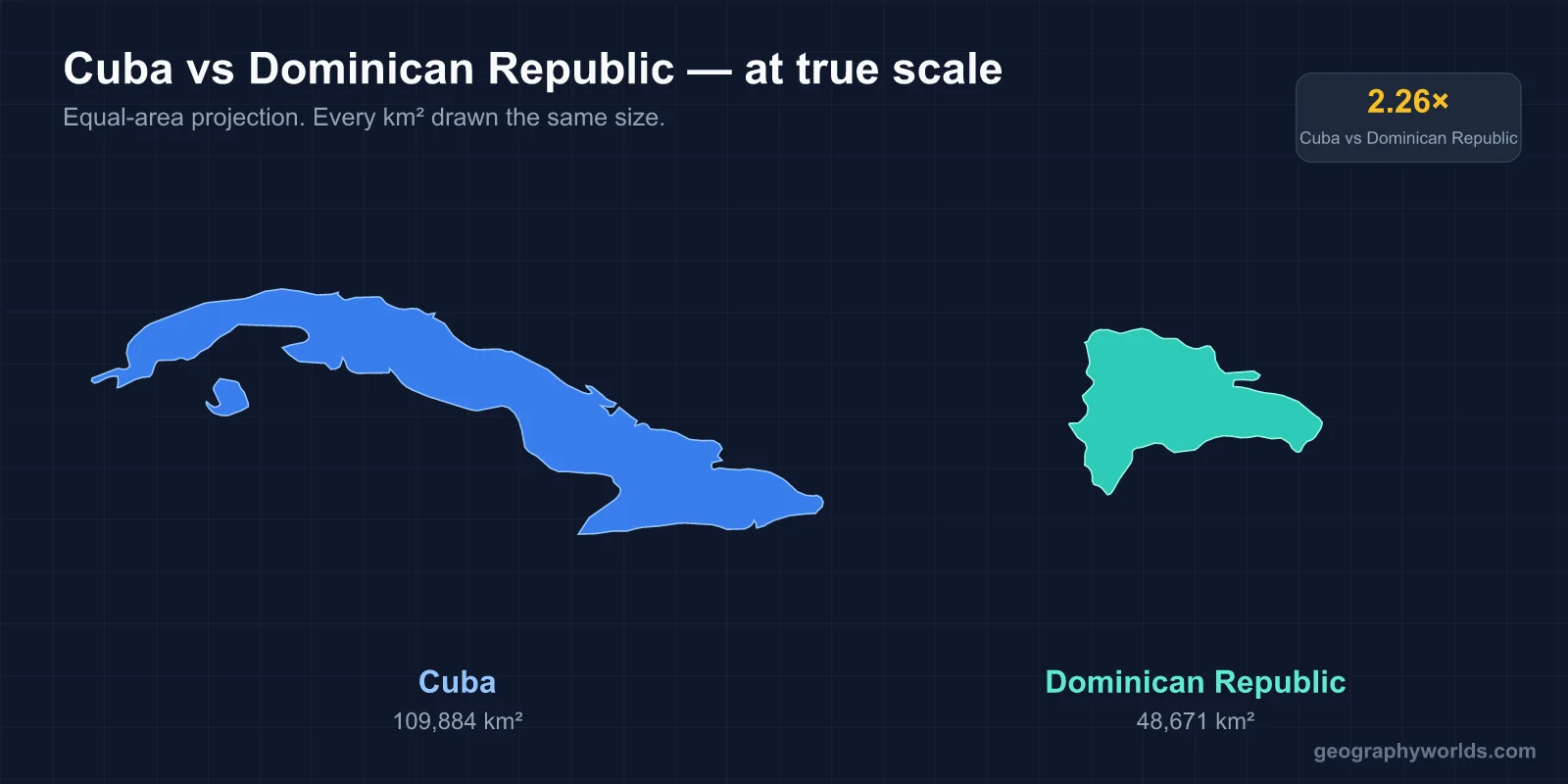
Cuba is approximately 2.3 times larger in area than Dominican Republic. Cuba features mostly flat to rolling plains; rugged hills in southeast, while Dominican Republic is characterized by rugged highlands and mountains interspersed with fertile valleys.
Population & Demographics
| Metric | Cuba 🇨🇺 | Dominican Republic 🇩🇴 |
|---|---|---|
| Population | 10.9 million | 11.6 million |
| Population Density | 99.1 per km² | 238.5 per km² |
Dominican Republic has a larger population, approximately 1.1 times that of Cuba. In terms of population density, Dominican Republic is more densely populated, with a difference of about 139.4 people per km².
Capital Cities
Havana serves as the capital of Cuba, while Santo Domingo is the capital of Dominican Republic. Both capitals are located in North America, specifically in the Caribbean region.
Language, Currency & Culture
| Aspect | Cuba 🇨🇺 | Dominican Republic 🇩🇴 |
|---|---|---|
| Languages | Spanish (official) | Spanish (official) |
| Currency | Cuban Peso (CUP) | Dominican Peso (DOP) |
In Cuba, Spanish (official) is widely spoken, while Dominican Republic uses Spanish (official). These linguistic differences reflect each country's unique colonial history, indigenous heritage, and cultural evolution over centuries.
Climate & Natural Features
| Aspect | Cuba 🇨🇺 | Dominican Republic 🇩🇴 |
|---|---|---|
| Climate | tropical; moderated by trade winds | tropical maritime; little seasonal temperature variation |
| Key Features | Viñales Valley, Sierra Maestra, coral reefs, colonial architecture | Pico Duarte (highest Caribbean peak), Los Haitises, Saona Island |
| Economy | tourism, tobacco (cigars), sugar, nickel, pharmaceuticals | tourism, free trade zones, mining, agriculture |
Cuba has a tropical; moderated by trade winds climate, featuring notable landmarks such as Viñales Valley, Sierra Maestra, coral reefs, colonial architecture. Meanwhile, Dominican Republic experiences a tropical maritime; little seasonal temperature variation climate and is known for Pico Duarte (highest Caribbean peak), Los Haitises, Saona Island.
What Makes Each Country Unique
Cuba is internationally renowned for classic vintage cars, cigars, revolutionary history, salsa music, and colorful Havana architecture. Cuba has one of the highest literacy rates in the world (over 99%) and has produced more doctors per capita than most nations.
Dominican Republic is best known for Caribbean beaches, merengue and bachata music, baseball talent, and Punta Cana resorts. The Dominican Republic has produced more Major League Baseball players per capita than any other country outside the United States.
Key Differences at a Glance
- Area: Cuba (109,884 km²) vs Dominican Republic (48,671 km²) — Cuba is 2.3x larger
- Population: Cuba (10.9 million) vs Dominican Republic (11.6 million) — Dominican Republic is 1.1x more populous
- Capitals: Havana vs Santo Domingo
- Currency: Cuban Peso (CUP) vs Dominican Peso (DOP)
- Continents: North America vs North America
- Density: Dominican Republic is more densely populated (difference of ~139.4 people per km²)
- Languages: Spanish (official) vs Spanish (official)
Verdict
Cuba and Dominican Republic — caribbean island neighbors — each offer unique geographic characteristics that make them fascinating to compare. While Cuba claims the larger land area (2.3x), Dominican Republic leads in population (1.1x), showing how size and population don't always go hand in hand.
Cuba stands out for its tropical; moderated by trade winds climate and landmarks like Viñales Valley, whereas Dominican Republic is defined by its tropical maritime; little seasonal temperature variation climate and features such as Pico Duarte (highest Caribbean peak). Economically, Cuba focuses on tourism while Dominican Republic drives growth through tourism.
Both nations contribute uniquely to our world's geographic tapestry. Whether you're planning a visit, studying world geography, or simply satisfying your curiosity, understanding these differences helps build a richer picture of our diverse planet.
Test Your Knowledge!
Think you know your countries? Try our interactive geography quiz!
Play Geography Games →