
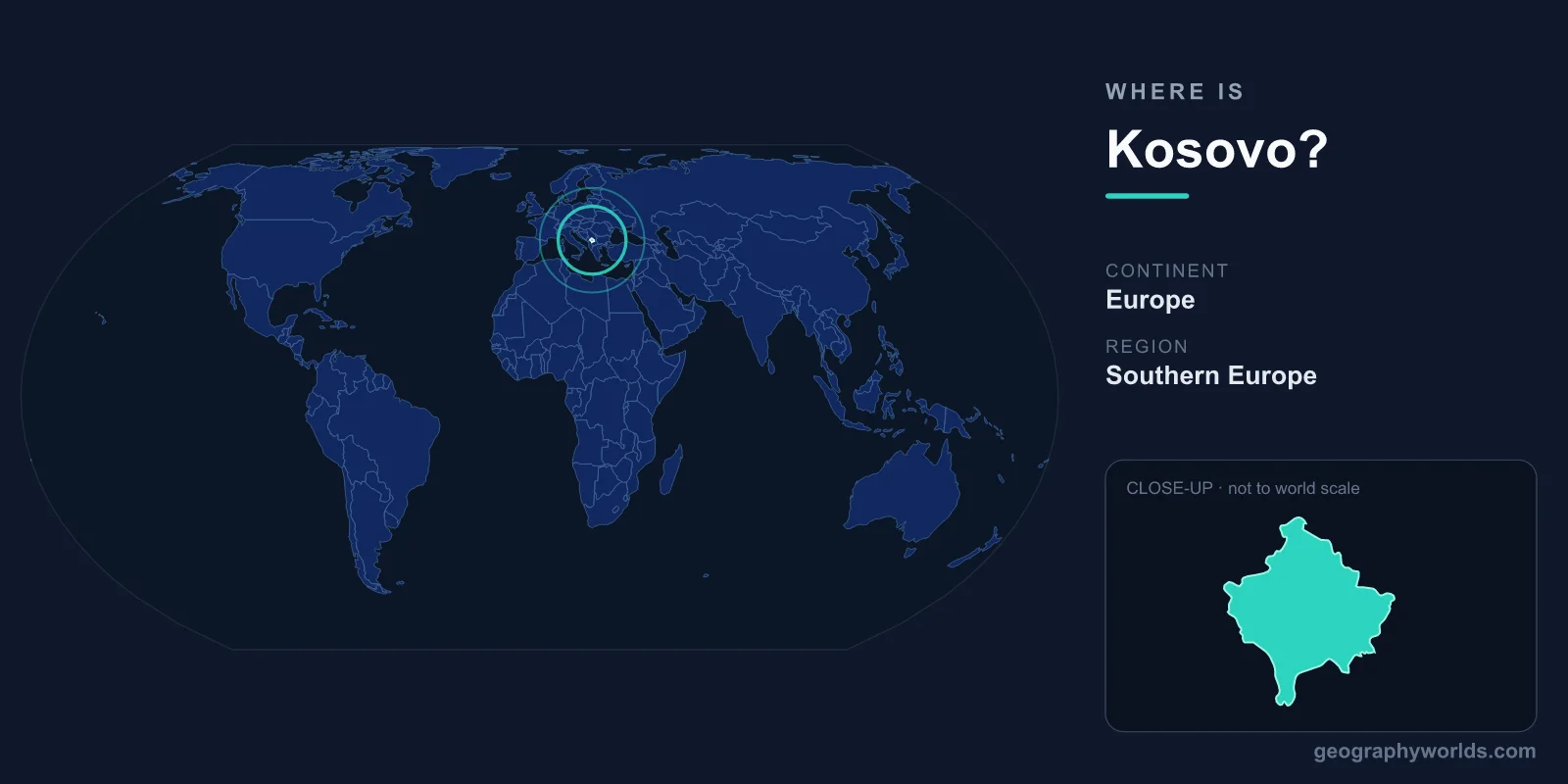
Kosovo occupies a landlocked position in the central Balkans of southeastern Europe. Bordered by Serbia, North Macedonia, Albania, and Montenegro, this 10,887 km² territory declared independence in 2008 and is recognized by approximately 100 UN member states.
Location
Kosovo is located in the central Balkans of southeastern Europe. It is a landlocked territory covering 10,887 km², roughly the size of Jamaica or the US state of Connecticut. The capital and largest city is Pristina (population ~210,000), situated in the northeastern part of the country.
Kosovo lies between approximately 42°N and 43°N latitude and 20°E and 21.5°E longitude. It declared independence from Serbia on February 17, 2008, and is recognized by approximately 100 UN member states, including the United States and most EU members, though Serbia, Russia, and China do not recognize its sovereignty. It is not a UN member but participates in some international organizations.
Region & Neighbors
Kosovo shares borders with four countries:
- Serbia — borders to the north and east (352 km). The Serbia-Kosovo border remains politically sensitive, with ethnic Serb-majority municipalities in northern Kosovo.
- North Macedonia — borders to the south (159 km). The border follows mountain ridges of the Šar Mountains.
- Albania — borders to the west (112 km). Ethnic and linguistic ties across the border; both countries are predominantly Albanian-speaking.
- Montenegro — borders to the northwest (76 km). The border runs through mountainous Prokletije (Albanian Alps) terrain.
Kosovo sits at a geographic crossroads that has been contested for centuries. The region connects the Adriatic-facing western Balkans with the Danube basin and central Europe, making it strategically significant throughout history.
Key Geographic Facts
Kosovo's geography is defined by two major basins surrounded by mountain ranges. The Kosovo Plain (Kosovo Polje) in the east is the larger of the two, a fertile lowland drained by the Sitnica River. The Metohija basin (also called the Dukagjini Plain) in the west is drained by the White Drin River, which flows toward Albania and the Adriatic.
The basins are ringed by mountains on all sides: the Šar Mountains to the south (reaching 2,651 m at Bistra, shared with North Macedonia), the Prokletije (Albanian Alps) to the west (Gjeravica at 2,656 m is Kosovo's highest point), and the Kopaonik range to the north. This basin-and-mountain geography has historically made Kosovo a natural crossroads, as several major routes through the Balkans converge in the Kosovo Plain.
The climate is continental, with warm summers (averaging 20-22°C in July) and cold, snowy winters (averaging -1°C to 1°C in January). The Šar Mountains receive heavy snowfall and contain glacial lakes and alpine meadows. Kosovo has significant mineral resources including lignite (brown coal), lead, zinc, and nickel.
Travel & Access
Pristina International Airport "Adem Jashari" (PRN) is Kosovo's sole commercial airport, with connections to major European cities including Vienna, Zurich, Munich, Istanbul, and London (via low-cost carriers). There are no direct flights from North America; travelers typically connect through a European hub.
Overland access is straightforward, with bus connections to Skopje (North Macedonia, ~1.5 hours), Tirana (Albania, ~4 hours), and Podgorica (Montenegro, ~4 hours). The road to Serbia passes through the politically sensitive northern border crossings. Kosovo's road network has been significantly upgraded in recent years, including a modern highway connecting Pristina to Albania.
Key Facts
- Location: Central Balkans, southeastern Europe. Landlocked.
- Area: 10,887 km² (roughly the size of Jamaica or Connecticut).
- Capital: Pristina.
- Coordinates: Approximately 42-43°N, 20-21.5°E.
- Borders: Serbia (north/east), North Macedonia (south), Albania (west), Montenegro (northwest).
- Highest point: Gjeravica, 2,656 m (Prokletije/Albanian Alps).
- Declared independence: February 17, 2008.
- Recognition: ~100 UN member states recognize Kosovo's sovereignty.
Fun Facts
- The Battle of Kosovo in 1389, fought on the Kosovo Plain between Serbian and Ottoman forces, is one of the most important events in Serbian cultural memory.
- Kosovo has one of the youngest populations in Europe, with a median age of about 30 years.
- The Marble Cave (Gadime Cave) near Pristina contains rare formations of aragonite and calcite crystals.
- Despite being one of Europe's smallest territories, Kosovo has significant lignite reserves — among the largest in the world.
- Kosovo's Šar Mountains are home to the Šarplaninac, a large livestock guardian dog breed that has been protecting flocks in the Balkans for centuries.
Test Your Knowledge!
Think you know your world geography? Try our interactive quiz!
Play Country Quiz →