
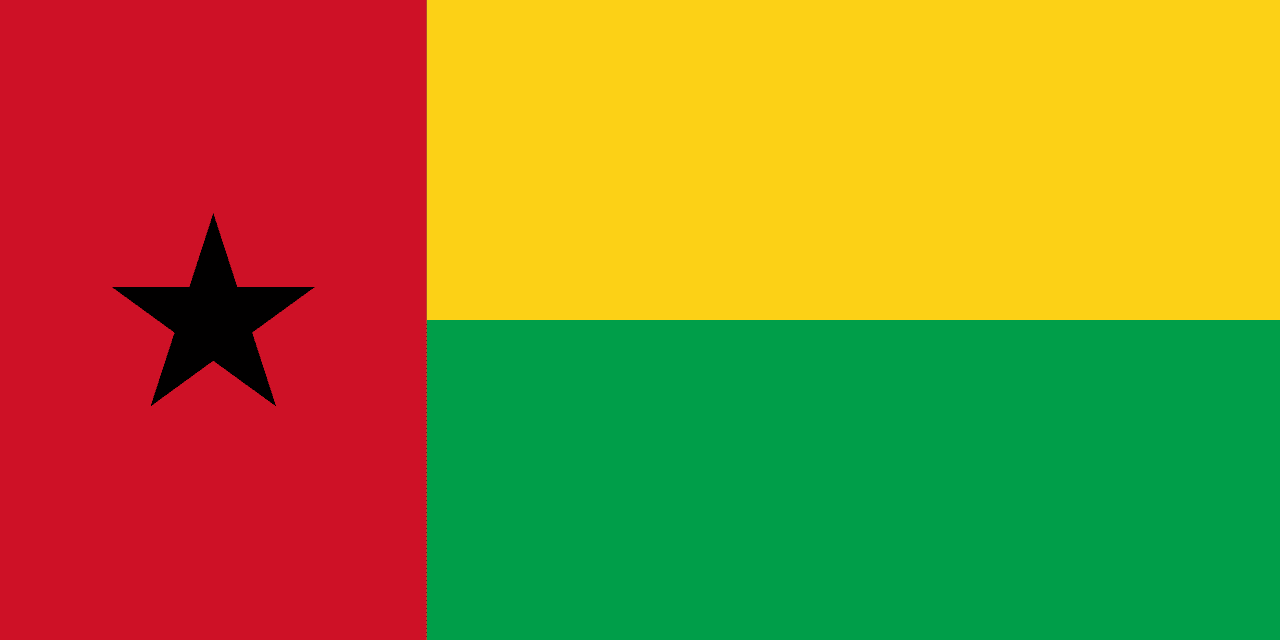
Few flags on the African continent wear their political history as openly as the flag of Guinea-Bissau. Raised at the very moment a small West African nation declared itself free, it is less decorative cloth than a portrait of a liberation movement that became a country. With a bold red stripe down the hoist, two horizontal bands of yellow and green, and a single black five-pointed star, the design speaks the visual language of Pan-Africanism while telling a story unique to this corner of the Atlantic coast.
A Banner Born From Independence
Guinea-Bissau adopted its flag in 1973, the same year that nationalists unilaterally declared independence from Portugal. The flag did not emerge from a design competition or a committee of bureaucrats. Instead, it grew directly out of the banner of the PAIGC, the African Party for the Independence of Guinea and Cape Verde, the movement that had waged a long armed struggle against colonial rule. When the new state needed a symbol, it elevated the party emblem that fighters had already carried, stitching liberation politics permanently into the national identity.
That origin matters. Many flags are designed to represent a country that already exists; this one helped call a country into being. The bands and lone star were already familiar to people who had spent years dreaming of self-rule, so the flag arrived with meaning fully formed.
The context behind that 1973 declaration explains the flag's urgency. The PAIGC, founded in 1956 and led by the revolutionary Amílcar Cabral, had turned much of the rural interior into liberated territory long before Lisbon acknowledged defeat. Cabral was assassinated in January 1973, only months before the independence he had pursued was proclaimed that September, so the flag carried the weight of a leader who never lived to see it fly. Portugal recognized the independence only in 1974, after the Carnation Revolution swept away its dictatorship. The flag thus predates the colonizer's surrender, a banner of a state that insisted on existing before it was permitted to.
Reading the Colors
The flag uses the classic Pan-African palette of red, yellow, and green, joined by a black star. These were the colors championed across the continent as emblems of African solidarity and decolonization, and Guinea-Bissau embraced them wholeheartedly. Each carries its own resonance:
- Red forms the vertical band against the hoist and is most often read as the blood shed during the fight for independence and the sacrifice that struggle demanded.
- Yellow, the upper horizontal band, is associated with the sun, the wealth of the land, and the labor of the people who work it.
- Green, the lower band, evokes the country's forests, farmland, and natural abundance, a fitting symbol for a nation of mangrove coasts and fertile interior.
- The black star sits at the center of the red band and stands for the African people and the broader ideal of African unity.
Together the colors tie Guinea-Bissau to a continental movement while also describing the land, the people, and the price of freedom in local terms. The order matters too: placing red against the hoist, the most prominent part of any flag, keeps the theme of sacrifice closest to the staff, and the star set into that band anchors the whole composition.
The Geometry of the Design
What sets this flag apart from many of its Pan-African cousins is its mixed layout. Rather than choosing only vertical or only horizontal stripes, it combines both. A single vertical red band occupies the side nearest the flagpole, while two equal horizontal bands, yellow on top and green below, fill the rest of the field. Centered within the red band is the black five-pointed star.
The flag flies in a 1:2 ratio, twice as wide as it is tall. The vertical red band takes up roughly the first third of the length, leaving the yellow and green bands to share the rest in equal halves, with the solid black star centered in the red column. The eye is drawn first to that red column and its star, then carried outward across the stretch of yellow and green. It is a balanced design that reads clearly whether flying from a government building, painted on a wall, or printed on a lapel pin.
A Familiar Resemblance
Anyone who knows the flag of Ghana will feel a flash of recognition here, and that is no accident. Both flags draw on the same Pan-African colors and feature a black star, a motif Ghana popularized after its independence in 1957. The difference lies in the arrangement: Ghana stacks three horizontal stripes with the star in the center, while Guinea-Bissau introduces that distinctive vertical red band and pushes the star into it. For a deeper look at the nation behind the banner, see our guinea bissau country guide.
The resemblances do not stop with Ghana. Guinea-Bissau's flag is most closely related to that of Cape Verde as it appeared between 1975 and 1992, when the two countries shared the PAIGC and dreamed of eventual union. The old Cape Verdean flag used the same red, yellow, and green with a black star. When Cape Verde replaced its flag with a blue, white, and red design in 1992, Guinea-Bissau kept the shared inheritance, becoming the sole surviving heir to that revolutionary banner. Set beside the look-alikes of Mali, Senegal, and Cameroon, Guinea-Bissau is distinguished by two features: the off-center red band and the single bold star tucked inside it.
National Identity and Everyday Use
For a country that endured centuries of colonial administration, the flag functions as shorthand for hard-won sovereignty. It appears on official documents, government buildings, embassies, and military uniforms, and it is raised on the September 24 anniversary of the 1973 proclamation. Rooted in the PAIGC, it also keeps the memory of the liberation generation visible, a reminder of how recently and forcefully the nation claimed its place.
On the football pitch, supporters of the national team, nicknamed the Djurtus, wave the red, yellow, and green at competitions such as the Africa Cup of Nations, and in a region where many neighbors share similar colors, the vertical band and star let fans spot their own flag in an instant. Schoolchildren learn to draw it, market stalls in the capital Bissau sell it in miniature, and it drapes the coffins of those given state honors, threading the symbol through civic life.
Interesting Facts at a Glance
- The flag and the country share a birth year, both dating to the 1973 declaration of independence.
- It was lifted almost directly from the PAIGC liberation party's flag rather than designed from scratch.
- The black star is a direct visual echo of the symbolism made famous by Ghana.
- The mix of one vertical band and two horizontal bands is relatively unusual and helps the flag stand out.
- It once had a near-twin in Cape Verde's first flag, with which it shared the PAIGC movement until 1992.
Frequently Asked Questions
When was the flag of Guinea-Bissau adopted?
The flag was adopted in 1973, the year Guinea-Bissau declared its independence from Portugal. It was based on the existing flag of the PAIGC liberation movement, so it became the national flag essentially at the moment of the country's founding.
What do the colors of the flag mean?
The flag uses the Pan-African colors. Red represents the blood and sacrifice of the independence struggle, yellow stands for the sun and the wealth of the land, and green symbolizes the country's forests and agriculture. The black star at the center represents the African people and the ideal of African unity.
Who designed the flag and where does it come from?
Rather than the work of a single named designer, the flag descends from the banner of the PAIGC, the party that led the fight for independence. When the new nation was proclaimed, the party flag was adopted as the national flag, carrying its symbolism straight into statehood.
Why does it look so similar to the flag of Ghana?
Both flags share the Pan-African colors and a black star, a symbol Ghana introduced after its independence and that became an emblem of African freedom. Guinea-Bissau, located in West Africa, adopted the same elements but arranged them differently, using a vertical red band with the star alongside two horizontal yellow and green bands.
Has the flag of Guinea-Bissau ever changed since independence?
No. Unlike many former colonies that revised their symbols after independence, Guinea-Bissau has flown the same flag continuously since 1973. Its close relative, the first flag of Cape Verde, was retired in 1992, but Guinea-Bissau retained the original PAIGC-derived banner, making it the lasting representative of that shared revolutionary heritage.
