

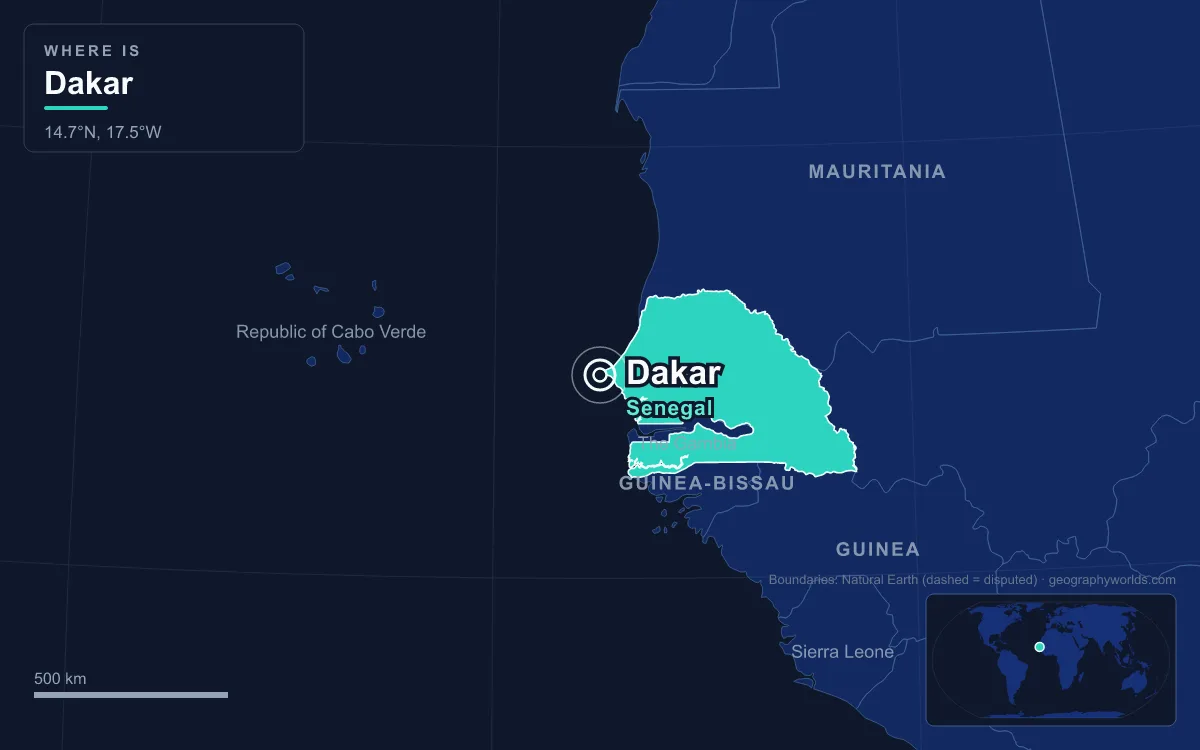
Dakar is the capital and largest city of Senegal. It covers the tip of the Cap-Vert peninsula, the westernmost point of mainland Africa. The department of Dakar has about 1.28 million residents, and the metropolitan area had roughly 4.0 million people in 2023. The city began as a Lebu fishing village facing the island of Gorée. It grew into the capital of French West Africa in 1902 and became the capital of independent Senegal in 1960. This guide follows six places in and around the city, from a slave-trade island to a bronze statue on a volcanic hill, and uses them to explain how Dakar came to run a country.
Gorée Island and the House of Slaves
Dakar's story starts on the water, about two kilometres from the modern harbour. Gorée is a rock of just 18.2 hectares, roughly 900 metres long and 350 metres wide. It has almost no drinking water, so nobody lived there permanently before Europeans came. Portuguese sailors reached the bay in 1444 and settled on the island, and by 1536 they were using it as a base for exporting enslaved Africans. The Dutch took it in 1588 and named it Goeree after an island at home. The English under Admiral Robert Holmes seized it in the 1660s, and France took it for good in 1677.
The island's best-known building is the Maison des Esclaves, or House of Slaves. It was built in the late 18th century by Nicolas Pépin, brother of the wealthy signare trader Anne Pépin. It became a museum in 1962, and its long-serving curator, Boubacar Joseph Ndiaye, claimed that more than a million captives had passed through its "Door of No Return" onto waiting ships. Historians have questioned that figure. Many think Gorée played only a small part in the Atlantic trade compared with Saint-Louis to the north or the river mouths of the Gambia. The argument has not weakened the building's pull. It remains a stop on state visits and a place of remembrance for visitors from Africa, Europe and the Americas. In 1978 Gorée was one of the first twelve sites inscribed on UNESCO's World Heritage List.

Gorée also explains why the capital ended up on the mainland. The island's traders needed food and water, and in the 17th century a Lebu village called Ndakaaru grew up on the shore opposite to supply them. That village gave the city its name. When France abolished the slave trade in its territories in 1848 and pushed peanut farming instead, the island of about 6,000 people proved far too small to work as a port. Traders moved to the mainland, setting up warehouses at Rufisque in 1840, and France planted a military post at Ndakaaru in 1857. By the 2013 census Gorée had only 1,680 residents, and it is now the smallest of Dakar's 19 communes d'arrondissement.
The Plateau, Headquarters of French West Africa
The Lebu of Cap-Vert did not simply wait for France. In 1795 they joined a revolt against the Damel, the ruler of the kingdom of Cayor. They built laterite walls across the peninsula from Yoff to Hann, beat off the Damel's army, and founded a Muslim state that the French later called the Lebu Republic, with its capital at Ndakaaru. The Serigne of Ndakaaru is still recognised by the Senegalese state as the traditional authority of the Lebu. When France set up its post in 1857 it annexed the Lebu Republic, although Lebu institutions carried on in name.
The high ground at the southern tip of the peninsula, known as the Plateau, became the centre of colonial rule. A railway to Saint-Louis was finished in 1885. Dakar became a separate commune in 1887, with an elected mayor and a share in sending a deputy to the National Assembly in Paris. In 1902 it replaced Saint-Louis as the capital of French West Africa, a federation that stretched across much of the region. The Plateau filled with ministries, trading houses and European homes. It remains the city's administrative heart today. The commune d'arrondissement of Dakar-Plateau holds most government ministries yet has only about 34,600 residents.
The Plateau also saw two moments that changed the direction of the empire. From 23 to 25 September 1940, Free French and British warships tried to take the harbour from Vichy forces and failed. Then on 1 December 1944, French troops opened fire on West African soldiers who had mutinied over poor conditions at the Thiaroye camp on the edge of the city. French officials put the dead at about 35. Veterans of the time said the true toll was over 300. The massacre became a lasting grievance for the independence movement.
The Médina and the Grand Mosque of Dakar
After plague broke out in 1914, the colonial authorities forced much of the African population out of the Plateau. They moved people into a new district called the Médina, kept apart by a "sanitary cordon". The Lebu, who could claim to be the land's first owners, resisted being moved. They were backed by Blaise Diagne, the first person of full West African descent elected to the French Chamber of Deputies, who was also mayor of Dakar from 1920 until his death in 1934. The segregation still shapes the city's map. Médina, with about 136,700 residents, is the densest and most populous of Dakar's 19 communes d'arrondissement.
The Médina is also home to the Grand Mosque of Dakar on Allée Pape Gueye Fall. It was designed by Moroccan and French architects and opened in 1964 by King Hassan II of Morocco and President Léopold Sédar Senghor. Its minaret rises 67 metres. The building looks a lot like the Mausoleum of Mohammed V in Rabat, which shows the close religious ties between the two countries. The Islamic Institute of Dakar, founded the same year, stands inside the mosque's walls. Most of the city's worshippers belong to the Sufi brotherhoods that shape Senegalese Islam, a subject explored in our guide to religion in Senegal. On Cap-Vert that includes the Layène order, which grew among the Lebu villages of Yoff and Cambérène.

The Dakar–Niger Railway and the Train Express Régional
Dakar became a capital because of its port and its railway. The Dakar–Niger line, built in stages and completed in the 1920s, linked the harbour to the Niger River in what is now Mali. Its full length is 1,287 kilometres, of which 641 kilometres lie in Mali, and it runs through Thiès, Kayes and Bamako to Koulikoro. For French West Africa it was the main route out of the Sahel. Groundnuts and other goods came down to the Atlantic, and manufactured goods went back up the line.
The railway workers also made history. In 1947 they struck for several months to win the same rights as French railwaymen. They won a 20 percent pay rise, although strike leaders were jailed or sacked. Ousmane Sembène later turned the strike into his 1960 novel God's Bits of Wood. When the Mali Federation broke up in 1960, after Dakar had served briefly as its capital, the line was split between two national operators. There have been no international passenger trains since 2010.
The city's newest railway looks outward instead of inland. The Train Express Régional, or TER, began regular passenger service on 27 December 2021. It runs 36 kilometres from central Dakar through 13 stations to Diamniadio, on the mainland east of the peninsula. Work on a 19-kilometre extension to Blaise Diagne International Airport began in March 2022.
The Museum of Black Civilisations
Senghor, the poet who became Senegal's first president, wanted Dakar to be the "Athens of sub-Saharan Africa". One of his plans was a museum covering the history and culture of Black people everywhere. The Museum of Black Civilisations finally opened on 6 December 2018, at a cost of about 30 million US dollars. Its director, the archaeologist Hamady Bocoum, says it exists to show Africa's contribution to the world's cultural and scientific heritage. He has stressed that ironworking was discovered in Africa 2,500 years before Christ.
The museum opened in the middle of a debate over returning African objects held in European collections. Its opening came just after the Sarr–Savoy report on restitution was delivered to the French president in November 2018, and that report listed the Dakar museum among Africa’s “ultramodern museums”. Time magazine put it on its list of the World's 100 Greatest Places of 2019. The museum is part of a longer effort to turn the capital into a cultural centre as well as a seat of government.
The African Renaissance Monument on the Collines des Mamelles
At the western end of the peninsula, two old volcanic hills called the Mamelles rise above the Ouakam district. The inland hill, about 100 metres high, carries the African Renaissance Monument, while a lighthouse stands on the seaward one. The monument is a bronze statue 50 metres high. It shows a man carrying a child on his arm and holding a woman by the waist, looking out over the Atlantic. President Abdoulaye Wade came up with the idea, and the Senegalese architect Pierre Goudiaby Atepa designed it. It was built by Mansudae Overseas Projects of North Korea and dedicated on 4 April 2010, the 50th anniversary of independence. It is the tallest statue in Africa.

The statue was controversial from the start. It cost about 27 million US dollars, paid not in cash but with 30 to 40 hectares of land. Thousands of people marched against it before the unveiling. Opposition politicians called it a financial scandal. Art critics panned it, and local imams objected that a statue of human figures was idolatrous and its semi-nude figures immodest. Nineteen African heads of state still came to the opening.
A few kilometres north-west of the Mamelles is Pointe des Almadies, at about 17.5 degrees west. It is the westernmost point of the African continent and of the whole Afro-Eurasian landmass, 8 degrees further west than Cabo da Roca, the westernmost point of mainland Europe. That position explains a lot about Dakar. Portuguese fleets bound for India stopped in its bay in the early 1500s to repair ships and take on fresh water, and Amerigo Vespucci was anchored there in 1501 when he began to form his idea that the Americas were a New World. Three Trans-African Highways, to Cairo, N'Djamena and Lagos, now begin in the city.
Dakar keeps adding to this list of landmarks. From 31 October to 13 November 2026 it hosts the Summer Youth Olympic Games, the first Olympic event ever held in Africa. For the other cities that competed with Dakar for power, including the old colonial capital of Saint-Louis on its river island, read our guide to the Senegal River, or step back to the whole country in our Senegal country guide.
Quick Facts About Dakar
- Country: Senegal
- Continent: Africa (West Africa)
- Country population: approximately 19.4 million
- Capital city status: Dakar is the capital of Senegal, the seat of national government, and the location of foreign embassies, parliament, and the head of state's official residence.
Frequently Asked Questions
What is the capital of Senegal?
The capital of Senegal is Dakar. Dakar is the seat of national government, hosts most foreign embassies and consulates, and is typically where the head of state and parliament are located.
What continent is Dakar in?
Dakar, the capital of Senegal, is located in Africa, in the West Africa region. As Senegal's capital, Dakar serves as the country's primary connection to the broader African political, economic, and cultural sphere.
Why is Dakar the capital of Senegal?
Dakar was chosen as the capital of Senegal for reasons that typically combine geography, history, and politics. Capital city selections often reflect a desire for centrality (being accessible from across the country), historical importance (being a longstanding seat of government or culture), or neutrality (being acceptable to multiple regions or ethnic groups within the country). The specific reasons for Dakar's designation are detailed in the city's history above.
What is Dakar known for?
As the capital of Senegal, Dakar is best known for housing the country's central government institutions — parliament, presidential or royal residences, supreme court, and key ministries. It is also typically a major cultural and economic center within Senegal, hosting national museums, embassies, and signature monuments. The introduction and history sections above provide detailed coverage of the city's specific notable institutions and landmarks.
Related Pages
- Senegal Country Guide — full geography, climate, economy, and culture overview
- Flag of Senegal — meaning, history, and design of Senegal's national flag