

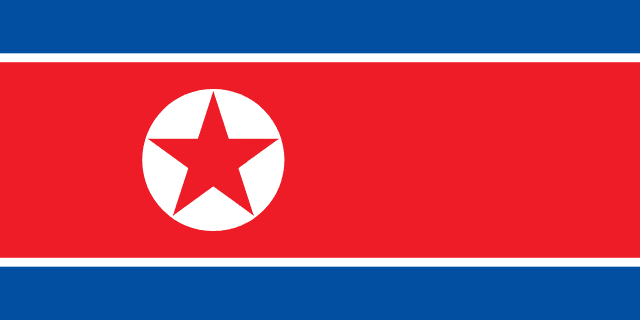
Few national flags carry as much political weight in such a compact arrangement as the banner of North Korea. Officially known as the Ramhongsaek Konghwagukgi, or "blue and red colored flag of the republic," it pairs a bold red center stripe with a single white-rimmed red star, all framed by ribbons of blue. Adopted in 1948 at the founding of the Democratic People's Republic of Korea, the flag deliberately broke with centuries of Korean tradition to announce a new state built on revolutionary ideals. To understand it is to read a piece of mid-twentieth-century history compressed into three colors and one five-pointed star.
A Quick Look at the Design
The flag follows a horizontal three-band layout, but it is more layered than a simple tricolor. A wide red band dominates the center, bordered above and below by thin white stripes, which in turn sit between two blue bands at the top and bottom edges. Offset toward the hoist side, a white disc carries a red five-pointed star at its heart. The white circle floats within the red field rather than spanning the whole flag, giving the star a clean, isolated frame that draws the eye immediately. The overall effect is orderly and symmetrical along the horizontal axis, with the star providing the single point of asymmetry that keeps the composition from feeling static.
What the Colors and Star Mean
Each element of the flag was assigned a clear ideological meaning when the design was introduced. The broad red field stands for the revolutionary spirit and the struggle that, in the state's own telling, brought the republic into being. The blue bands represent sovereignty and the aspiration to stand alongside other nations of the world. The white stripes signify purity, and they nod to a long-standing Korean cultural affection for white, a color historically woven into traditional dress and identity across the peninsula. At the center of it all, the red star is the unmistakable emblem of communism and the ruling party, a symbol shared by many socialist movements of the twentieth century.
Taken together, the palette tells a deliberate story: a pure people, asserting their sovereignty, animated by revolutionary fervor, led by a communist vanguard. The fact that the meanings were spelled out at adoption, rather than accumulating organically over generations, reflects how consciously the new government used the flag as an instrument of messaging.
How the Flag Came to Be
For most of recorded Korean history, the peninsula was a single cultural and political entity, and from the late nineteenth century onward it flew the Taegukgi, a white banner bearing the blue-and-red yin-yang circle and black trigrams rooted in Confucian and Taoist cosmology. After liberation from colonial rule and the division of the peninsula at the end of the Second World War, the northern half fell under a different political orientation than the south. When the Democratic People's Republic of Korea was formally established in 1948, its leaders chose to abandon the traditional Taegukgi entirely.
That decision was significant. Rather than adapting the old emblem, the new state introduced a flag whose visual language belonged to the international socialist family rather than to classical Korean philosophy. The red star, the bold fields of color, and the absence of the trigrams all signaled a sharp break with the past. The southern half of the peninsula, by contrast, retained the Taegukgi, so that the two Koreas came to fly flags as different from each other as their political systems. The North Korean design has remained essentially unchanged since its introduction, a stability that itself communicates a message of permanence.
Comparisons With Other Red-Star Flags
The red star is one of the most widely traveled symbols in vexillology, and North Korea's flag sits within a broad family of banners that used it during the socialist era. Casual observers sometimes group it with flags like the former Soviet Union's hammer-and-sickle banner, the People's Republic of China's red field with its cluster of golden stars, or Vietnam's single gold star on red. What sets the North Korean flag apart is its structure. Where many socialist flags lean on a single dominant red field, this one balances red against substantial blue bands and crisp white dividing lines, producing a more layered, tricolor-like appearance.
The white disc surrounding the star is another distinguishing touch. Few national flags place their star inside a contrasting circle in this way, and the device gives the emblem a focused, almost target-like clarity that is unique among red-star designs. While the color red and the five-pointed star place the flag firmly in a recognizable political tradition, the specific combination of blue borders, white framing, and an off-center white-circled star makes it instantly identifiable and not easily confused with its neighbors. For more on the country itself, see our north korea country guide.
Cultural Weight and Everyday Presence
Within the country, the flag is treated with intense reverence and appears at virtually every level of public life, from government buildings and schools to the elaborately choreographed mass gymnastic displays for which the state is internationally known. In those performances, thousands of participants holding colored cards have been used to render enormous flag images and slogans, turning the banner into a living mosaic. On the world stage, the flag accompanies North Korean athletes at the Olympic Games and other international competitions, where it is one of the few moments the rest of the world regularly sees the country's national symbol in a non-political setting.
Because the flag is so closely tied to the state and its founding ideology, it functions less as a folk emblem that citizens casually personalize and more as an official insignia of the republic and its leadership. Its consistency over the decades reinforces the idea of an unbroken national project, and its careful, almost ceremonial use underscores the seriousness with which national symbols are regarded.
Interesting Facts at a Glance
- The flag is officially nicknamed the Ramhongsaek Konghwagukgi, meaning the "blue and red colored flag of the republic."
- It was adopted in 1948, the same year the Democratic People's Republic of Korea was established.
- North Korea deliberately discarded the traditional Taegukgi, which the south still uses, marking a clean visual break between the two Koreas.
- The red star is a classic communist emblem, shared with many other socialist movements of the twentieth century.
- White, used in the flag's stripes and the disc around the star, has deep roots in Korean tradition as a color associated with purity.
- The star sits in a white circle offset toward the hoist, an unusual placement among the world's many red-star flags.
Frequently Asked Questions
When was the North Korean flag adopted?
The flag was adopted in 1948, coinciding with the formal establishment of the Democratic People's Republic of Korea. It replaced the traditional Taegukgi that had previously represented Korea, and its design has remained essentially unchanged ever since.
What do the colors of the flag mean?
Red represents the revolutionary spirit, blue stands for sovereignty, and white signifies purity. The central red star is the emblem of communism and the ruling party, tying the whole design to the state's founding ideology.
Who designed the North Korean flag?
The flag emerged as an official state symbol when the republic was founded in 1948, created to embody the new government's revolutionary and socialist character. Rather than attribute it to a single celebrated artist, it is best understood as a deliberate state design that broke with traditional Korean iconography in favor of internationally recognized socialist motifs.
What continent is North Korea on, and how does its flag compare to similar ones?
North Korea is located in East Asia, on the Asian continent, occupying the northern half of the Korean Peninsula. Its flag belongs to the broad family of red-star socialist banners alongside flags like those of China, Vietnam, and the former Soviet Union, but its layered blue-white-red bands and the white circle framing the star make it distinct and easy to tell apart.