
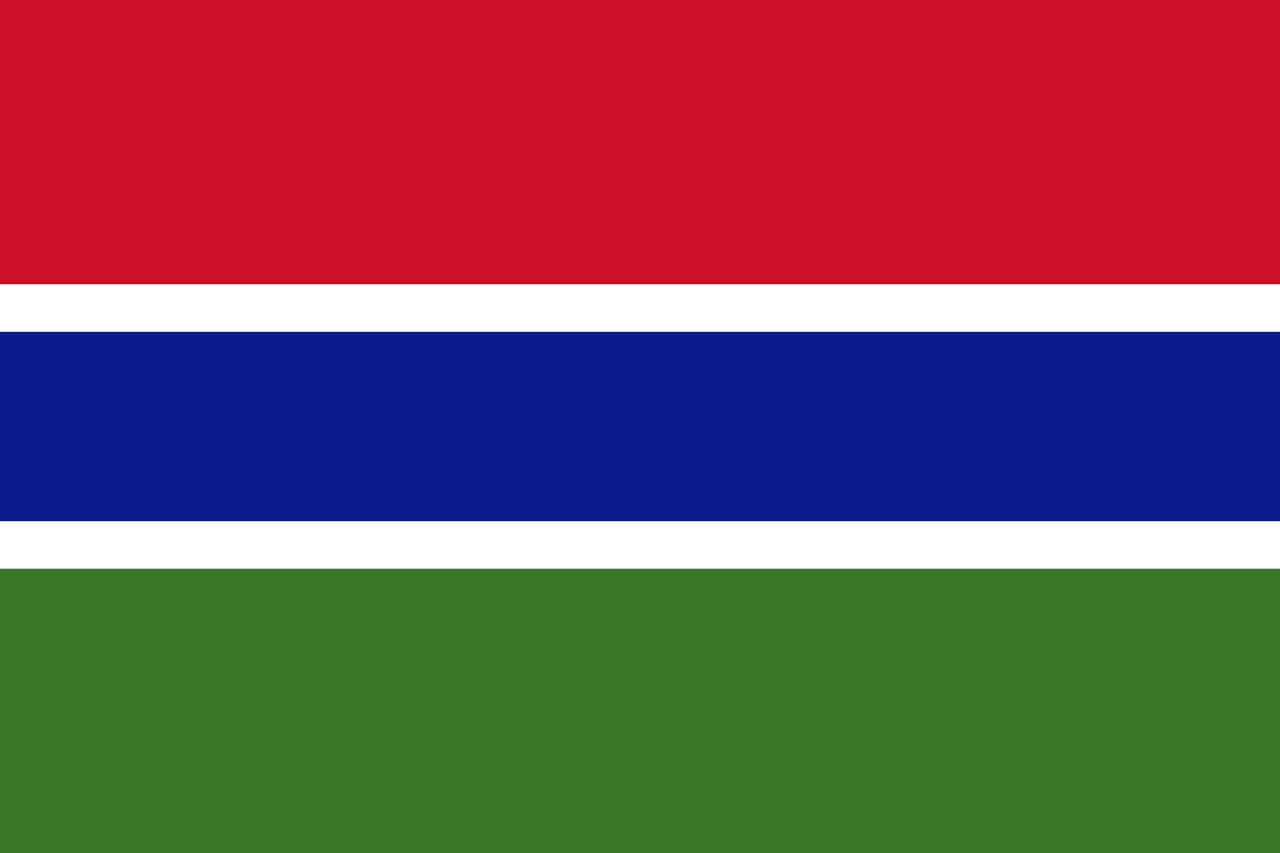
Stretch a map of West Africa across a table and The Gambia almost disappears into the squiggle of a single river. The country is a narrow ribbon of land hugging the banks of the Gambia River, wrapped on nearly every side by Senegal, and its flag tells that geographic story with unusual honesty. Most national banners reach for abstractions: liberty, blood, unity. The Gambian flag instead points at something you can touch and travel on, a blue band that stands in plainly for the river that gives the nation its shape, its name, and much of its livelihood.
Adopted in 1965, the flag is a study in clarity. Three broad horizontal bands of red, blue, and green are separated by slender white stripes, and the result feels less like a coat of arms and more like a landscape painting reduced to its essentials. Below we unpack what each colour carries, how the design holds together, and why a small country chose such a confident, uncluttered emblem at the moment it stepped onto the world stage.
What the Colours Stand For
The Gambian flag works with four colours, and each has a job. The top band is red, representing the sun that beats down on this tropical, low-lying land and powers everything that grows there. Directly beneath sits a band of blue, the heart of the design, standing for the Gambia River that runs the entire length of the country from east to west. At the bottom lies green, the colour of agriculture, forests, and the fertile soil that supports groundnuts, rice, and the farming communities along the water.
The fourth colour, white, appears as two thin stripes that fence the central blue band away from the red above and the green below. White here reads as peace and purity, but it also does quiet visual work, which we will come to. What is striking is how literal the symbolism is: sun on top, river through the middle, land at the bottom. Read top to bottom, the flag is almost a cross-section of the country itself.
Reading the Design
The layout is a horizontal triband, but it is the proportions and the white dividers that give it personality. The red, blue, and green bands are broad and roughly comparable in weight, while the two white stripes are deliberately narrow, more like seams than fields of their own. That narrowness matters. By keeping the white slim, the designers let the three main colours dominate while still preventing them from bleeding into one another visually.
The choice to separate the bands with white rather than butt them directly together is what keeps the river reading as a river. A blue stripe wedged between red and green could feel arbitrary; framed by two thin white lines, it gains crispness and seems to flow, much like water bordered by its banks. There is no central emblem, no star, no crest, only horizontal lines. This restraint is part of the flag's charm: it communicates at a glance, scales cleanly from a lapel pin to a stadium banner, and never relies on fine detail that would blur at distance.
From Colony to Sovereign State
The Gambia spent the colonial era under British control, its borders famously drawn to follow the navigable reaches of the river. When independence arrived on 18 February 1965, the country needed an emblem of its own to replace colonial insignia, and the new flag was raised as part of that transition. Unlike many newly independent African states that leaned heavily on the pan-African palette of red, gold, and green, The Gambia chose a scheme rooted firmly in its own environment.
That decision was a quiet statement of identity. The flag did not borrow another movement's symbolism wholesale; it described the place. The river that the British had once prized for navigation became, on the new flag, a source of national pride rather than imperial convenience. For readers who want the wider story of the land, people, and culture behind the banner, our gambia country guide fills in the geography and history that the colours only sketch.
A Symbol of Everyday Identity
Because its meaning is so grounded in the physical country, the Gambian flag carries an everyday, lived-in quality. The river it celebrates is not a metaphor; it is the artery along which goods, fishermen, and ferries still move. When Gambians see the blue band, they are looking at the waterway many of them live beside. That directness has helped the flag remain stable and uncontested through decades of political change, including the shift to a republic and the country's brief period within a confederation with Senegal.
The flag also signals neutrality and independence in a region where it would have been easy to be read as simply an annex of larger neighbours. By choosing colours that describe The Gambia and only The Gambia, the banner asserts a distinct national self despite the country's small size and the way Senegal nearly surrounds it.
The Flag in Modern Life
Today the flag turns up in all the expected places and a few that matter especially to a small nation. It flies on Independence Day each February, when parades and school events fill the streets of Banjul and Serrekunda. It is worn and waved at football matches, where the national team, nicknamed the Scorpions, has given supporters fresh reasons to drape themselves in red, blue, and green. It marks government buildings, diplomatic missions abroad, and the documents of state, and it appears on souvenirs sold to the tourists who come for the beaches and birdwatching along the very river the flag honours.
For a country often overlooked on the continental map, the flag is a compact ambassador. Its simple horizontal logic makes it instantly recognisable once you know it, and its colours invite the obvious question that tends to start a conversation: why is there a river running through the middle of it?
Quick Facts About the Gambian Flag
- It uses four colours in total: red, blue, green, and white.
- The arrangement is a horizontal triband with two thin white separating stripes.
- It was adopted in 1965, the year The Gambia gained independence from Britain.
- The central blue band specifically represents the Gambia River, the country's defining geographic feature.
- Red stands for the sun, while green represents agriculture and the land.
- Unlike many African flags, it does not use the pan-African colour scheme.
- The design has no central emblem, crest, or star, only stripes.
Frequently Asked Questions
When was the flag of The Gambia adopted?
The flag was adopted in 1965, the same year the country became independent from Britain. It was raised as part of the independence transition on 18 February 1965 and has remained the national flag ever since, surviving the country's later move to republican status without change.
What do the colours of the Gambian flag mean?
Red represents the sun, blue stands for the Gambia River that runs the length of the country, and green symbolises agriculture and the fertile land. The two thin white stripes that separate the bands represent peace and purity, while also visually framing the blue river band.
What continent is The Gambia on?
The Gambia is in West Africa. It is one of the smallest countries on the African mainland, a narrow strip of land surrounding the Gambia River and almost entirely enclosed by Senegal, with a short Atlantic coastline at its western end.
How does the Gambian flag compare to similar flags?
It shares the broad horizontal-triband format with many flags, but the thin white dividing stripes and the river symbolism make it distinctive. Notably, it avoids the pan-African red-gold-green palette common across the continent, choosing instead colours that describe The Gambia's own landscape rather than a shared political movement.
