
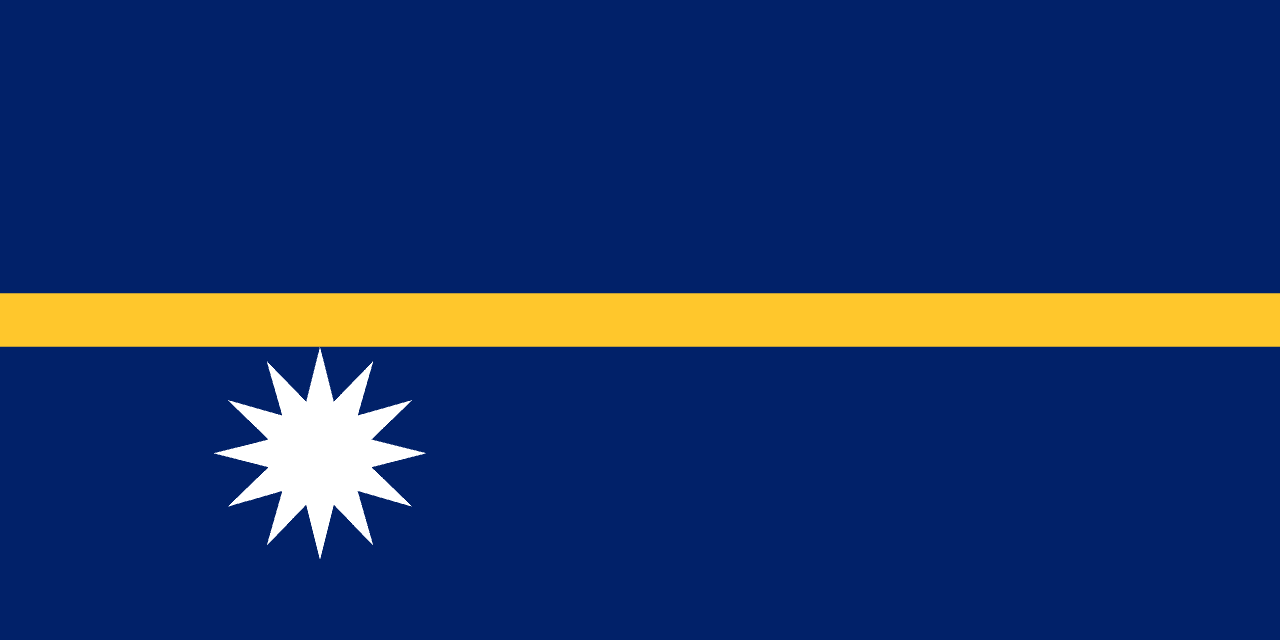
Few national flags double as a map, but the flag of Nauru does exactly that. Adopted in 1968 when this tiny Pacific island became one of the world's smallest sovereign states, the design is a piece of cartography rendered in cloth: a deep blue field crossed by a single golden stripe, with a white star tucked just below the line. Look at it long enough and you realize you are not looking at an abstract emblem at all, but at the island itself, sitting alone in the vast ocean, almost exactly where the equator runs. Nauru measures only about 21 square kilometers, yet its flag manages to capture both its smallness and its place in the world with remarkable economy.
A Banner That Reads Like a Map
The genius of Nauru's flag lies in how literally it depicts geography. The blue background is the Pacific Ocean, an expanse that surrounds the island for hundreds of kilometers in every direction. The horizontal yellow stripe running across the middle stands for the equator, the invisible line that loops around the Earth. And the white star? That is Nauru itself, placed deliberately below the yellow band because the country lies just south of the equator. In other words, the flag is a stylized aerial view of where the nation sits on the globe. This kind of self-locating symbolism is unusual in vexillology, and it gives Nauru one of the most quietly clever banners in the world.
The Colors and What They Carry
Nauru's palette is built from three colors, each with a clear job to do. Blue dominates the field and represents the Pacific Ocean, the defining feature of an island nation whose history, diet, and identity are tied to the sea. Yellow forms the narrow stripe and stands for the equator, anchoring the island geographically and reminding viewers of Nauru's tropical position near the planet's midline. White appears only in the star, marking the island and lending the design a crisp focal point against the dark background.
The restraint here is deliberate. There is no clutter, no crowded coat of arms, no row of competing emblems. Three colors and one star are enough to tell the whole story, which is part of why the flag works so well at a distance, whether flying over a government building in Yaren or rippling on a ship at sea.
The Star and Its Twelve Points
The single white star is the emotional center of the flag, and it carries a second layer of meaning beyond simply marking the island. The star has twelve points, and each point represents one of the twelve original tribes of Nauru. These clans form the historic social fabric of Nauruan society, and acknowledging all twelve on the national flag was a way of binding the people together at the very moment they became an independent nation. That same twelve-pointed star also appears on the Nauruan coat of arms, reinforcing its status as the country's core symbol of unity.
It is worth pausing on how much the small star is asked to do. It is at once a geographic marker (the island), a demographic record (the tribes), and a unifying emblem (the nation as one people). Where many flags spread their symbolism across multiple devices, Nauru concentrates it into a single shining point.
From Phosphate Colony to Independent State
Nauru's flag was adopted on 31 January 1968, the day the island gained independence. Before that, Nauru had passed through a complicated colonial history: German administration in the late nineteenth century, then a period administered by Australia, with involvement from Britain and New Zealand, and a wartime Japanese occupation during the Second World War. For much of the twentieth century the island's fate was bound up with its enormous phosphate deposits, mined intensively by outside powers.
Independence from Australia in 1968 marked the moment Nauruans took control of their own affairs and their own resources. The flag, chosen through a design competition, was meant to express that new sovereignty in clear, confident terms. Its imagery looked outward to the ocean and the equator while looking inward to the unity of the tribes, a fitting statement for a nation stepping onto the world stage. Those wanting deeper context on the island's story can explore our nauru country guide.
How It Stands Apart From Other Pacific Flags
Blue fields with single white stars are not unheard of in the Pacific and beyond, so it is worth noting what makes Nauru's distinctive. The flag is sometimes loosely compared to other ocean-and-star designs, but the horizontal yellow stripe is the decisive feature that no neighbor shares. That stripe transforms a generic star-on-blue into a precise geographic statement about the equator.
Compare it, for instance, to flags that use stars to represent constellations like the Southern Cross, which speak to navigation and the southern sky. Nauru's star is not part of a constellation at all; it is the island. And unlike multi-star Pacific flags that map archipelagos or island groups, Nauru deploys exactly one star because it is exactly one island. The twelve points then add a layer of meaning rooted in local tribal structure rather than astronomy. The result is a flag that, despite using a common color pairing, cannot really be confused with any other once you understand what each element stands for.
The Flag in National Life Today
For a country of only a few thousand square kilometers' worth of people, the flag punches above its weight as a marker of identity. It flies over the parliament and government offices in the Yaren district, appears at official ceremonies, and is raised each year to mark Independence Day on 31 January, the anniversary of both nationhood and the flag's own adoption.
On the international stage, the banner travels with Nauru's small but proud delegations to events like the Commonwealth Games and the Pacific Games, where Nauruan weightlifters in particular have earned the island a reputation far larger than its size would suggest. In those arenas, the blue field with its golden line and lone white star becomes instantly recognizable shorthand for one of the planet's least populous independent nations, a reminder that even the smallest country can carry a clear and dignified symbol.
Quick Facts Worth Knowing
- The flag is essentially a map: blue ocean, a yellow equator, and a white star marking Nauru just below the line.
- It was adopted on independence day, 31 January 1968, after separating administratively from Australia.
- The white star has twelve points, one for each of the island's twelve original tribes.
- Only three colors are used, making it one of the more minimalist national flags in the Pacific.
- The star sits below the yellow stripe specifically because Nauru lies just south of the equator.
- Nauru is part of the Oceania region, in the central Pacific Ocean.
Frequently Asked Questions
When was the flag of Nauru adopted?
The flag was adopted on 31 January 1968, the day Nauru became independent. Because independence and the flag's debut share the same date, the anniversary celebrated each year as the country's national day is also effectively the flag's birthday.
What do the colors of the Nauru flag mean?
Blue represents the surrounding Pacific Ocean, the yellow horizontal stripe represents the equator, and the white star represents the island of Nauru itself. The star is positioned below the yellow stripe to show that the island sits just south of the equator.
Why does the star have twelve points?
The twelve points of the white star stand for the twelve original tribes of Nauru. Including all of them on the flag was a way of symbolizing the unity of the Nauruan people at the moment of independence, and the same star appears on the national coat of arms.
What continent or region is Nauru in, and what flags is it similar to?
Nauru is in Oceania, in the central Pacific Ocean. While blue flags bearing a single white star appear elsewhere, Nauru's design is distinguished by its yellow equatorial stripe and its literal, map-like layout, which together make it unmistakable once you know what each element represents.