
Few national flags carry such a clear record of political change as the one flown over Myanmar. The current design, a bold horizontal arrangement of yellow, green and red crowned by a single white star, is surprisingly young: it was hoisted for the first time in 2010 under a new constitution, replacing a banner that had represented the country through decades of socialist rule. The result is a flag that feels both freshly minted and rooted in older Southeast Asian color traditions, and it tells a story about how a nation chose to present itself to the world during a moment of transition.
A Quick Snapshot of the Flag
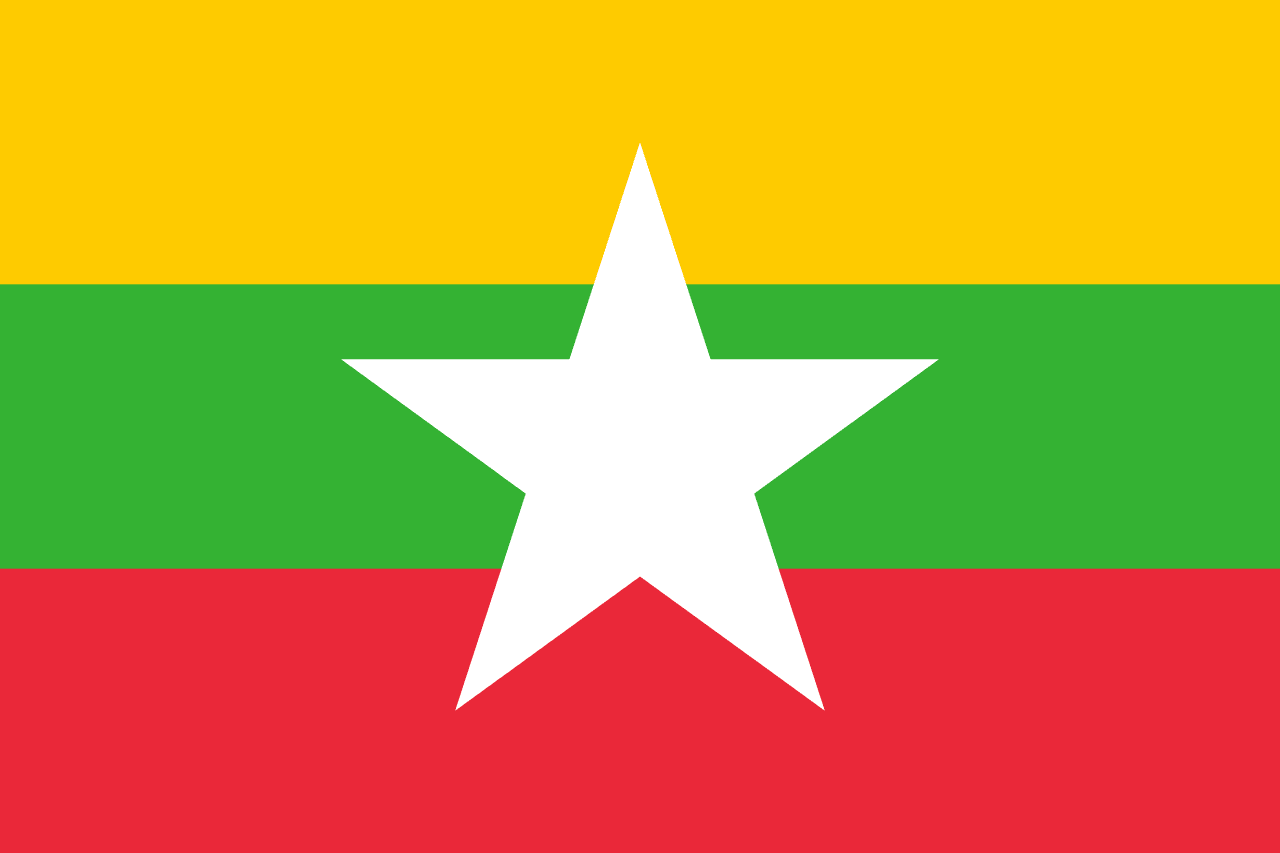
The flag of Myanmar is a horizontal triband, meaning it is divided into three equal stripes stacked one on top of the other. From top to bottom, the bands run yellow, green and red. Centered across the boundary between those stripes sits a large five-pointed white star, large enough that its points reach into all three colored fields at once. The effect is striking and immediately recognizable: warm, saturated tones beneath a single luminous emblem. Because the star straddles every band, it visually stitches the three colors together rather than belonging to any one of them, which is exactly the point the designers intended.
What the Colors and the Star Represent
Each element of the flag was chosen to express a value the country wished to project. The yellow band stands for solidarity, the sense of a people bound together across differences. The green band represents peace, along with the tranquility and lush natural abundance of the land. The red band symbolizes courage and decisiveness, qualities a nation likes to claim for itself.
The white star at the heart of the flag is the unifying symbol. It represents the union of the country, the idea that Myanmar's many regions and peoples form a single nation. White, as it does on so many flags, suggests purity and honesty. Placed deliberately at the center where the three stripes meet, the star becomes a hinge holding solidarity, peace and courage in balance, an emblem of unity rather than of any single group or province.
From Socialist Banner to the Modern Tricolor
To understand today's flag, it helps to know what came before it. For much of the late twentieth century, the country flew a red flag bearing a blue canton in the upper hoist filled with white symbols associated with the socialist era. That earlier banner reflected the political ideology of its time, with imagery meant to celebrate industry and agriculture.
The flag adopted in 2010 marked a deliberate break from that design. Brought in under a new constitution, the tricolor abandoned the socialist-era symbolism in favor of the simpler, more universal language of colored bands and a single star. The change was part of a broader effort to redefine the country's image, and swapping out a flag is one of the most visible ways any state can signal that a new chapter has begun. For travelers and learners who want the fuller picture of the nation behind the banner, our myanmar country guide traces the geography and culture in greater depth.
How It Compares to Similar Flags
A yellow-green-red horizontal stack is a palette shared by a number of flags around the world, which can make Myanmar's banner look familiar at first glance. The combination of those three colors appears, in various arrangements, on flags as far afield as Africa and Latin America, so the family resemblance is real even when the meanings differ entirely.
What sets Myanmar apart is the prominent central white star spanning all three bands. Many tricolors of this color family rely on the stripes alone, or place an emblem within a single band; Myanmar's oversized star, reaching across the full height of the flag, is its distinguishing signature. Compared to its immediate Southeast Asian neighbors, the contrast is even sharper. Thailand uses a five-stripe red-white-blue pattern, Laos centers a white disc on a blue band between two red stripes, and Cambodia features its temple silhouette. Against that regional backdrop, Myanmar's clean yellow-green-red triband with a single star reads as distinctly its own.
Cultural Meaning and National Identity
Because the current flag is relatively recent, it represents the country as it chose to define itself in the twenty-first century rather than carrying centuries of accumulated heraldry. That newness gives the design a forward-looking quality. The emphasis on union through the central star speaks directly to a nation made up of many ethnic groups and regions, where the idea of holding diverse communities together as one is a central and ongoing theme of public life.
The values encoded in the colors, solidarity, peace and courage, are aspirational. A flag of this kind does not merely describe what a country is; it states what it hopes to be. For citizens, the banner appears on government buildings, official documents and ceremonies, anchoring the institutions of the state in a shared visual identity.
The Flag in Everyday and Public Life
Like national flags everywhere, Myanmar's banner has a busy public life. It flies over government offices and is raised at official ceremonies and national observances. It accompanies athletes at international sporting events, where the yellow-green-red and white star travel as a compact shorthand for the whole country. It appears in classrooms and civic settings, and it is the image most people around the world picture when they think of the nation at a glance.
Here are a few quick points worth remembering about the flag:
- It was first adopted in 2010, making it one of the more recently introduced national flags in Asia.
- The layout is a horizontal triband: yellow on top, green in the middle, red on the bottom.
- A single large white five-pointed star sits at the center, overlapping all three stripes.
- The colors stand for solidarity (yellow), peace (green) and courage (red), while the star stands for the union of the country.
- It replaced an earlier socialist-era design, marking a clear visual break with the past.
- Myanmar lies in Asia, in the Southeast Asian region bordering Thailand, Laos, China, India and Bangladesh.
Frequently Asked Questions
When was the flag of Myanmar adopted?
The current flag was adopted in 2010, introduced under a new constitution. It replaced the previous socialist-era flag and has represented the country ever since, making it a relatively young national banner compared with many others.
What do the colors of the Myanmar flag mean?
The three horizontal bands each carry a meaning: yellow represents solidarity, green represents peace, and red represents courage. The white star in the center symbolizes the union of the country, tying the three values and the nation's many regions together as one.
Who designed the flag and what continent is Myanmar on?
Myanmar is located in Asia, specifically in Southeast Asia, sharing borders with Thailand, Laos, China, India and Bangladesh. The flag was introduced officially under the 2010 constitution rather than being credited to a single famous individual designer, so it is best understood as a state-adopted national emblem of that period.
How does the Myanmar flag compare to similar flags?
The yellow-green-red color combination is shared by several flags worldwide, which can create a passing resemblance. What makes Myanmar's flag unmistakable is the large central white five-pointed star that spans all three stripes, a feature that clearly distinguishes it from other tricolors using the same palette and from its Southeast Asian neighbors.