
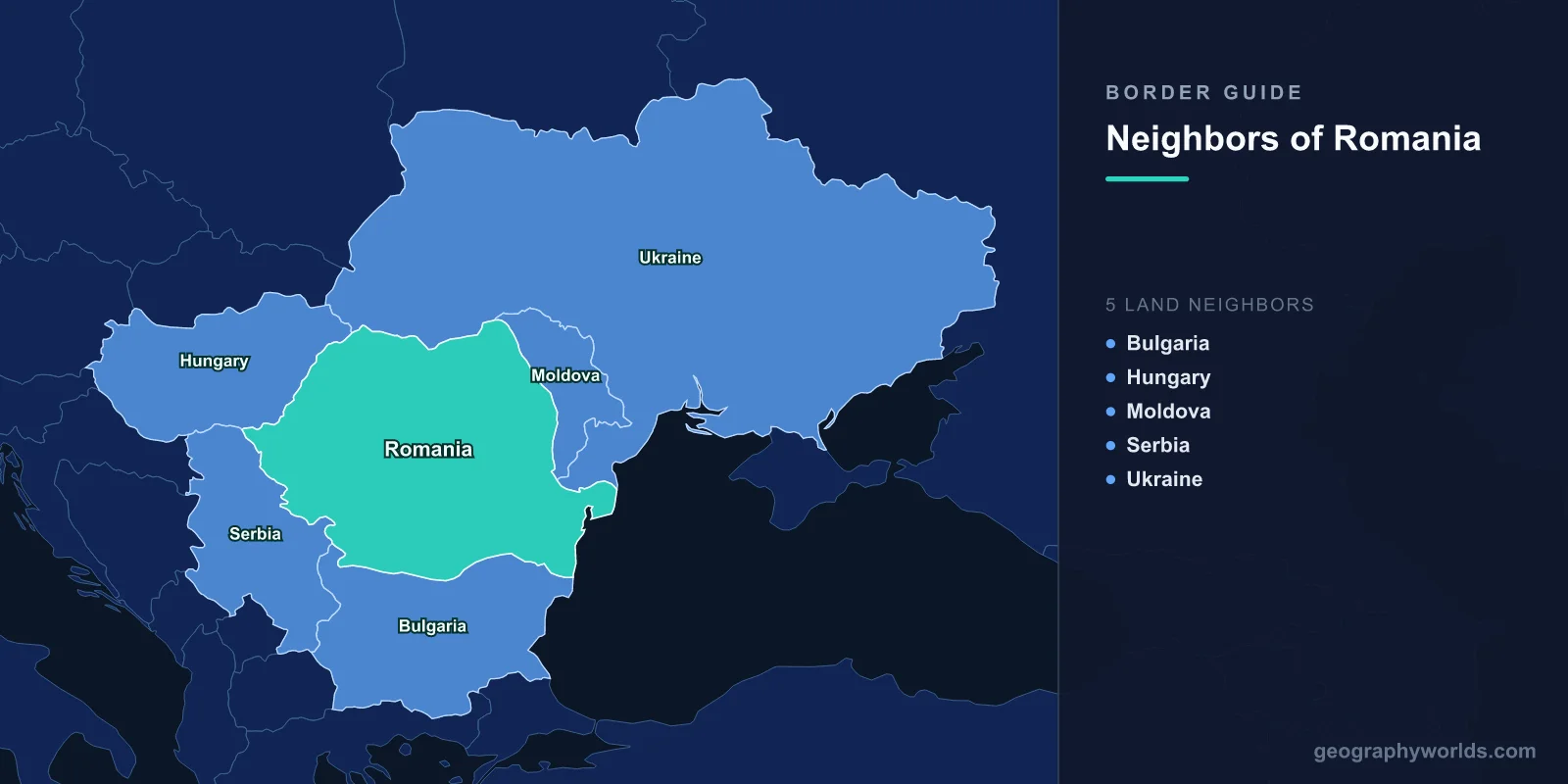
Romania shares land borders with five neighboring countries: Hungary, Serbia, Bulgaria, Moldova, and Ukraine, with a combined land border length of roughly 2,844 km. Positioned at the crossroads of Central and Southeastern Europe, Romania touches the Balkans to the south, the Carpathian heartland to the west, and the former Soviet states to the east and north, making its frontiers some of the most geographically and culturally varied on the continent.
The Five Countries That Border Romania
Going roughly clockwise from the west, Romania's neighbors are Hungary and Serbia to the west and southwest, Bulgaria to the south, and Ukraine and Moldova to the north and east. Two of these borders are heavily defined by water: the Danube River traces much of the southern boundary with Serbia and Bulgaria, while the Prut River separates Romania from Moldova. To the southeast, Romania is not landlocked at all — it opens onto the Black Sea along a coastline near the port city of Constanța, giving it a maritime frontier in addition to its five land neighbors. You can explore more in the romania country guide.
Western Neighbors: Hungary and Serbia
Hungary lies to the northwest and shares a border of around 448 km. This frontier runs through the flat, fertile Pannonian Plain and is one of Romania's busiest, crossing the historically Hungarian-influenced region of Transylvania. Cities such as Oradea and Arad sit close to the line, and the region is home to a sizeable ethnic Hungarian minority. Both countries are members of the European Union, which makes cross-border travel and trade relatively seamless.
Serbia borders Romania to the southwest along roughly 476 km. Here the dramatic Iron Gates gorge channels the Danube between the Carpathian and Balkan ranges, forming one of the most spectacular river borders in Europe. The Đerdap (Iron Gates) hydroelectric dam, jointly operated by the two nations, is a landmark of Cold War-era cooperation and remains a major source of power for both countries.
Southern Neighbor: Bulgaria
Bulgaria sits directly to the south, sharing about 605 km of border. For much of its length this boundary follows the Danube, with the Romanian city of Giurgiu facing the Bulgarian city of Ruse across the Friendship Bridge — for decades the only road-and-rail crossing over the lower Danube between the two states. Closer to the Black Sea the border becomes a land frontier across the Dobruja plateau. Like Romania, Bulgaria is an EU member, and the two nations share deep historical and Orthodox Christian cultural ties.
Eastern and Northern Neighbors: Moldova and Ukraine
Moldova borders Romania to the east along the Prut River, a frontier of approximately 681 km. The two countries share a common language and a closely intertwined history — much of present-day Moldova was once part of the historical region of Bessarabia, joined to Romania between the world wars. This shared heritage makes the Romania-Moldova relationship among the closest of any neighbors, and Romania has been a strong supporter of Moldova's European aspirations.
Ukraine is Romania's largest neighbor and shares a border of around 614 km, split into two separate stretches — one in the north near the Maramureș and Bukovina regions, and another in the southeast near the Danube Delta where the river empties into the Black Sea. This division reflects the complex 20th-century redrawing of borders across the region. The Danube Delta, a UNESCO World Heritage Site shared in part with Ukraine, is one of Europe's most important wetland ecosystems.
How the Borders Were Shaped
Romania's modern frontiers are the product of centuries of treaties, empires, and wars. The country expanded dramatically after World War I, gaining Transylvania from Austria-Hungary and Bessarabia and Bukovina from the collapsing Russian Empire. World War II and its aftermath reversed some of these gains, transferring Bessarabia and northern Bukovina to the Soviet Union — territory now divided between independent Moldova and Ukraine. The Danube's role as a natural boundary, meanwhile, dates back far longer, having served as a frontier even in Roman times when the river marked the edge of the empire.
Frequently Asked Questions
How many countries border Romania?
Romania borders five countries: Hungary, Serbia, Bulgaria, Moldova, and Ukraine. It also has a Black Sea coastline to the southeast, so it is not landlocked.
What is the longest border Romania shares?
Romania's longest land border is with Moldova, running about 681 km along the Prut River. Its borders with Ukraine and Bulgaria are also lengthy, each over 600 km.
Which river forms much of Romania's borders?
The Danube River forms a large part of Romania's southern border with Serbia and Bulgaria, including the dramatic Iron Gates gorge, while the Prut River separates Romania from Moldova.
Which of Romania's neighbors are in the European Union?
Hungary, Bulgaria, and Romania itself are EU members, while Serbia, Moldova, and Ukraine are not — though all three have pursued closer ties with the European Union.