
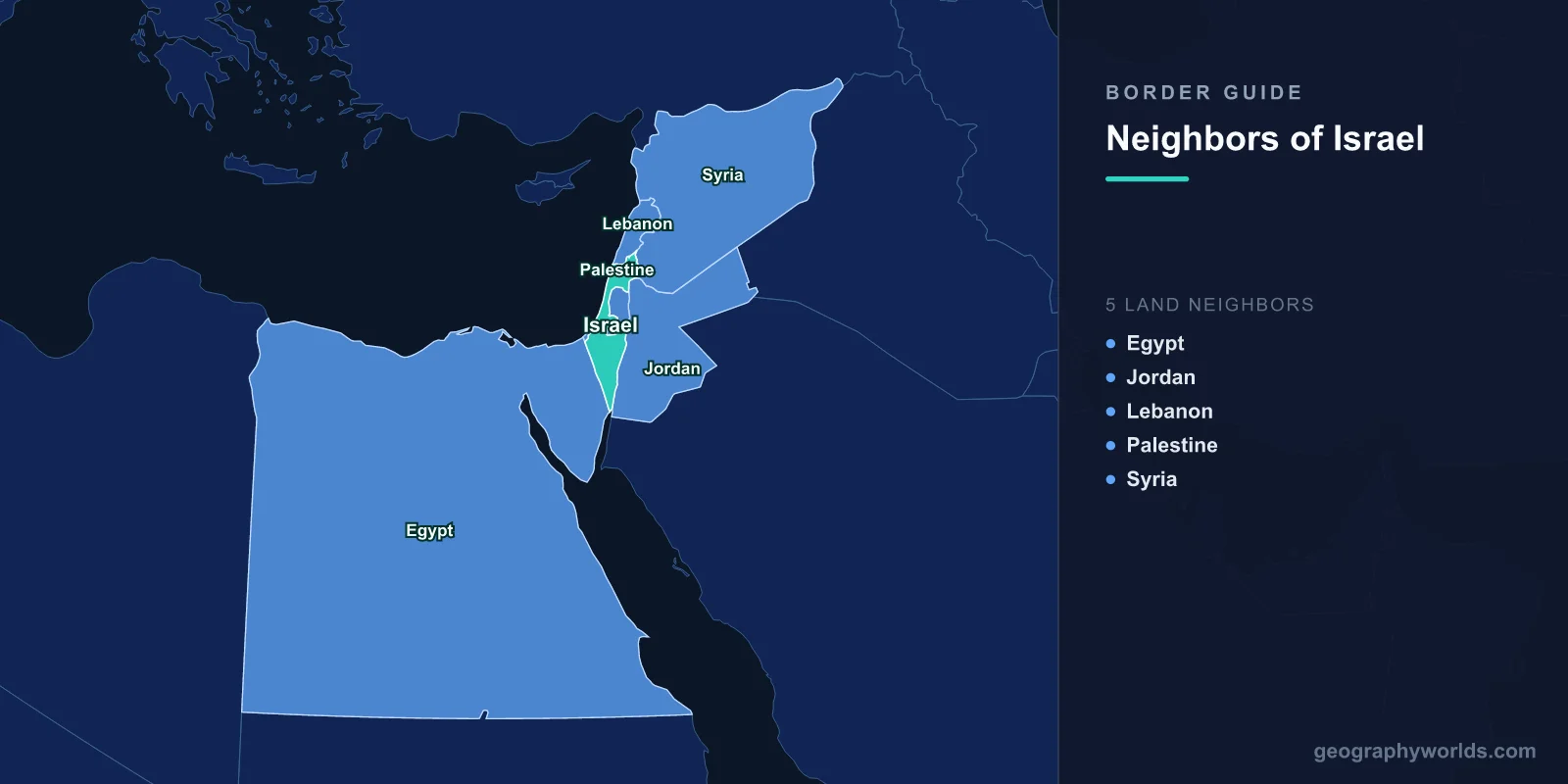
Israel borders five neighbors by land — Egypt, Jordan, Lebanon, Syria, and the Palestinian territories — along roughly 1,068 km of frontier, while sharing a maritime boundary with Cyprus across the Mediterranean Sea. These borders trace deserts, rivers, mountain ridges, and ceasefire lines, and each one carries a distinct political and geographical story.
The Five Land Borders at a Glance
Israel sits at the crossroads of the Eastern Mediterranean, the place where the continents of Africa and Asia meet. Its land frontiers run for about 1,068 km in total, wrapping the country from the Red Sea in the south to the foothills of the Anti-Lebanon range in the north. Some of these boundaries are settled by formal peace treaties, while others remain armistice lines or disputed zones rather than mutually recognized international borders.
- Egypt — long southwestern desert border ending at the Red Sea port of Eilat/Taba.
- Jordan — the longest border, running down the Jordan River and the Great Rift Valley.
- Lebanon — a short, heavily fortified northern frontier known as the "Blue Line."
- Syria — a ceasefire line across the Golan Heights in the northeast.
- Palestinian territories — the West Bank and the Gaza Strip, bounded by separation barriers.
Egypt and Jordan: Borders Sealed by Peace
Two of Israel's five neighbors have signed formal peace treaties, and these are the borders where diplomatic relations, tourism, and cross-border trade genuinely flow.
Egypt made peace with Israel in 1979 following the Camp David Accords, ending decades of war. The border stretches across the arid Negev and Sinai, meeting the Red Sea at the twin resort towns of Eilat (Israel) and Taba (Egypt). It is the only frontier Israel shares with an African state.
Jordan is Israel's longest neighbor by border length. The two signed a peace treaty in 1994, and the boundary follows one of the planet's most dramatic geological features: the Jordan River and the Great Rift Valley, descending to the shores of the Dead Sea — the lowest land point on Earth at roughly 430 m below sea level. Crossings such as the Allenby Bridge and the Yitzhak Rabin/Wadi Araba terminal connect the two countries.
Lebanon and Syria: Tense Northern Frontiers
The picture changes sharply along the northern borders, where Israel has no peace agreements and the lines are military rather than diplomatic.
Lebanon lies to the north, separated by a short, fortified boundary that the United Nations demarcated in 2000 and named the "Blue Line." The two countries remain technically in a state of war, and the area is patrolled by the UN Interim Force in Lebanon (UNIFIL). There are no open civilian crossings.
Syria sits to the northeast, beyond the strategic plateau of the Golan Heights. Israel captured the Golan in the 1967 war and effectively annexed it in 1981, though most of the international community does not recognize the move. The line between the two is a disengagement zone monitored by UN observers (UNDOF) rather than a settled international border.
The Palestinian Territories
Israel also borders the Palestinian territories, made up of two non-contiguous areas: the West Bank in the east, surrounding parts of Jerusalem, and the Gaza Strip in the southwest along the Mediterranean coast. These boundaries are defined by separation barriers, fences, and crossing points rather than open frontiers, and their final status remains one of the most debated issues in international politics. Palestine is recognized as a state by a large number of UN members, though its borders are not finalized.
Israel's Maritime Neighbor
Beyond its land frontiers, Israel faces the Mediterranean Sea along its western coast. Across these waters lies Cyprus, with which Israel has agreed an Exclusive Economic Zone boundary. This maritime border has grown in importance with the discovery of major offshore natural gas fields such as Leviathan and Tamar, which feed energy cooperation across the region. To the far south, the narrow Gulf of Aqaba gives Israel its only outlet to the Red Sea at Eilat.
For more on the country's geography, history, and culture, see our israel country guide.
Frequently Asked Questions
How many countries border Israel?
Israel shares land borders with five neighbors: Egypt, Jordan, Lebanon, Syria, and the Palestinian territories. It also has a maritime boundary with Cyprus across the Mediterranean.
Which countries have peace treaties with Israel?
Among its immediate neighbors, Egypt (1979) and Jordan (1994) have signed formal peace treaties. Lebanon and Syria do not have peace agreements with Israel.
What is Israel's longest border?
The border with Jordan is the longest. It runs down the Jordan River and the Great Rift Valley, passing the Dead Sea, the lowest dry-land point on Earth.
Does Israel border any African country?
Yes. Egypt is Israel's only African neighbor, with the two countries meeting in the Sinai and Negev deserts and at the Red Sea near Eilat and Taba.
