
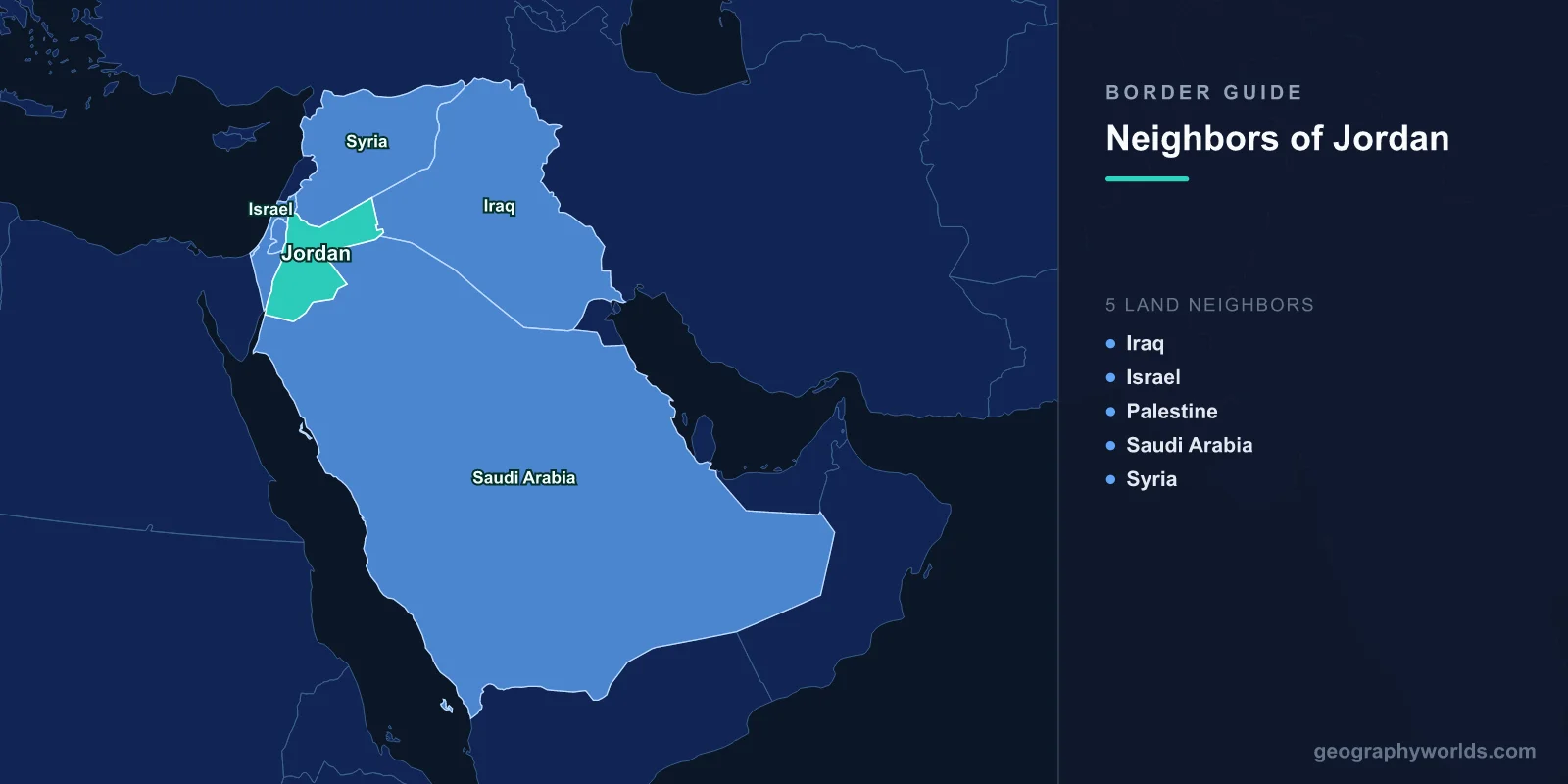
Jordan shares land borders with five neighboring countries: Saudi Arabia, Iraq, Syria, Israel, and the Palestinian West Bank, totaling roughly 1,744 km of frontier. Sitting at the crossroads of the Middle East, Jordan is almost entirely landlocked, with just a 26-kilometre sliver of coastline on the Gulf of Aqaba providing its only outlet to the sea. Its borders trace deserts, rivers, and historic trade routes that have linked Arabia, the Levant, and Mesopotamia for thousands of years.
Saudi Arabia: The Longest Border
Saudi Arabia is Jordan's largest neighbor and shares its longest border, stretching for several hundred kilometres across the arid plains and gravel deserts of the south and southeast. Much of this frontier runs through the remote Badia, sparsely populated terrain that gives way to the dramatic sandstone landscapes of Wadi Rum near the southern tip. The two kingdoms famously adjusted their boundary in 1965 in a land swap that gave Jordan a longer Red Sea coastline around Aqaba in exchange for inland desert. This corridor remains vital for overland trade, religious pilgrimage routes toward Mecca, and energy links between the Gulf and the Levant.
Iraq and Syria: The Northern and Eastern Frontiers
To the northeast, Jordan meets Iraq along a short desert border in the area near the Karameh and Trebil crossings. This frontier is a key commercial artery, carrying truck convoys that historically supplied Iraq with goods and brought back fuel, even during periods of conflict.
To the north, Jordan borders Syria along a frontier that passes near the city of Daraa and the fertile Hauran plain. The Nasib (Jaber) crossing on this border is one of the most important trade gateways in the region, connecting Jordan to Damascus and onward to Turkey and Europe. The Syrian civil war disrupted this route for years and brought large numbers of refugees into northern Jordan, reshaping towns like Mafraq and the surrounding governorates.
Israel and the West Bank: The Western Boundary
Jordan's western border is defined largely by water and rift geology. The Jordan River, the Dead Sea, and the Wadi Araba valley separate the kingdom from Israel and the Palestinian West Bank. This is the lowest land border on Earth, dipping to more than 400 metres below sea level at the shore of the Dead Sea.
Jordan signed a formal peace treaty with Israel in 1994, establishing recognized boundaries and crossings such as the King Hussein (Allenby) Bridge, the Sheikh Hussein Bridge in the north, and the Wadi Araba crossing near Aqaba and Eilat. The border with the West Bank reflects Jordan's deep historical and demographic ties to the Palestinian territories, which it administered until 1967. These western crossings are essential for tourism, pilgrimage, and the movement of people between Amman and Jerusalem.
Jordan's Sea Access and Egypt Connection
Although Egypt does not share a land border with Jordan, the two countries face each other across the narrow Gulf of Aqaba, giving them a maritime relationship. Jordan's only port, Aqaba, sits at this junction where the borders of four countries, Jordan, Israel, Egypt, and Saudi Arabia, come remarkably close together along the Red Sea coast. A regular ferry has long linked Aqaba with the Egyptian port of Nuweiba, carrying passengers and freight across the gulf. This tiny coastline is strategically priceless: it is Jordan's single window to global shipping and a hub for trade, tourism, and the country's special economic zone.
Borders Shaped by History
Jordan's frontiers are largely a product of the twentieth century. The Emirate of Transjordan was carved out under British administration after the collapse of the Ottoman Empire in World War I, and many of its straight desert lines reflect colonial-era agreements rather than natural features. The kingdom's position between Arabia and the Mediterranean has made it a buffer state and a refuge, absorbing waves of Palestinian, Iraqi, and Syrian arrivals over the decades. Today these borders remain central to regional diplomacy, water-sharing arrangements over the Jordan River, and cross-border security cooperation. To learn more about the country itself, see our jordan country guide.
Frequently Asked Questions
How many countries border Jordan?
Jordan borders five countries by land: Saudi Arabia, Iraq, Syria, Israel, and the Palestinian West Bank. It also shares a maritime boundary with Egypt across the Gulf of Aqaba.
Which country shares the longest border with Jordan?
Saudi Arabia shares Jordan's longest border, running for several hundred kilometres across the southern and eastern deserts. Jordan's total land border length is about 1,744 km.
Does Jordan have a coastline?
Yes, but only a very short one. Jordan has roughly 26 km of coastline on the Gulf of Aqaba at the northern tip of the Red Sea, where its port city of Aqaba provides the country's sole access to the sea.
Is Jordan landlocked?
Jordan is almost landlocked. Apart from its small Red Sea outlet at Aqaba, it is surrounded on all sides by land neighbors, making that narrow coastline crucial for international trade and shipping.
