

Mount Everest is the higher of the two, at 8,848.86 m (29,031.7 ft) against K2's 8,611 m (28,251 ft), a gap of about 238 m. Everest was also climbed first, on 29 May 1953, fourteen months before K2's first ascent on 31 July 1954. K2, however, is the harder and deadlier mountain: roughly 800 people had reached its summit by August 2023, with 96 deaths, while Everest had recorded just under 13,000 summits by December 2024 and 340 deaths by May 2024. Everest stands on the Nepal–China border in the Himalayas; K2 rises about 1,300 km to the north-west in the Karakoram, on the border between Gilgit-Baltistan in Pakistan-administered Kashmir and the China-administered Trans-Karakoram Tract in Xinjiang. Each of the questions below compares the two peaks directly.
Which Is Higher, Everest or K2?
Everest, by a clear margin. Its current official height, 8,848.86 m, was announced jointly by Nepal and China on 8 December 2020 after a combined survey. Before that the two countries had disagreed: China measured the rock summit at 8,844 m, while Nepal used the snow height of 8,848 m, and in 2010 they agreed to recognise both. K2's height on maps and in encyclopaedias is 8,611 m, so Everest is higher by about 238 m (roughly 780 ft).
K2 did briefly look like a challenger. In 1986 an expedition led by George Wallerstein produced a measurement suggesting K2 was taller than Everest. It was inaccurate and was corrected in 1987, but by then the claim had already made its way into news reports and reference works. On the other measure that climbers and geographers use, independence, the two are not close either. Everest's topographic prominence is its full height by definition. K2's is about 4,000 m, because a path can be traced from K2 to Everest across the Karakoram, the Tibetan Plateau and the Himalayas without ever dropping below 4,594 m, at the Kora La pass on the Nepal–China border. That places K2 22nd in the world by prominence, though it is the most prominent peak in the Karakoram.
The names reflect very different histories. Everest has long-standing local names, Sagarmatha in Nepali and Chomolungma in Tibetan. K2 appears never to have acquired a local name, possibly because of its remoteness: it cannot be seen from Askole, one of the highest villages on the approach, and is only fleetingly glimpsed from the end of the Baltoro Glacier, beyond which few local people would have gone. Thomas Montgomerie of the Great Trigonometrical Survey labelled it in 1856 from Mount Haramukh in Kashmir, some 210 km away, as the second peak of the Karakoram, K2. The survey normally preferred local names, which is how K1 became Masherbrum, but no local name was found for K2. The alternative Mount Godwin-Austen, after the explorer Henry Godwin-Austen, is still sometimes used.
Which Was Climbed First: 1953 or 1954?
Everest, by a year. Attempts began with a British reconnaissance in 1921, and in 1924 George Mallory and Andrew Irvine set out for the summit on 8 June and never returned; Mallory's body was found on the North Face on 1 May 1999, and whether they reached the top remains unknown. The ninth British expedition, led by John Hunt, finally succeeded. The New Zealander Edmund Hillary and Tenzing Norgay, a Nepali Sherpa, reached the summit at 11:30 am on 29 May 1953 by the South Col and Southeast Ridge.
K2 resisted longer. The first serious attempt, in 1902, involved Oscar Eckenstein and Aleister Crowley; of 68 days they spent on the mountain, only eight had clear weather. In 1909 Prince Luigi Amedeo, Duke of the Abruzzi, reached about 6,250 m on the ridge now called the Abruzzi Spur, then declared that K2 would never be climbed. A 1939 American expedition led by Fritz Wiessner came within 200 m of the top but lost four men, Dudley Wolfe and the Sherpas Pasang Kikuli, Pasang Kitar and Pintso.
The breakthrough came with Ardito Desio's 1954 Italian expedition. Lino Lacedelli and Achille Compagnoni reached the summit by the Abruzzi Spur on 31 July 1954. Their success relied on Walter Bonatti and the Hunza porter Amir Mehdi, who carried oxygen up to about 8,100 m and were then forced to spend the night above 8,000 m without shelter because the summit pair had pitched their tent higher than agreed. Mehdi was in hospital for months and lost his toes to frostbite, and efforts in the 1950s to play down the episode were only exposed much later.
Which Is Harder to Climb: the South Col or the Abruzzi Spur?
K2, by almost every account. The standard route on Everest, from Nepal through the Khumbu Icefall to the South Col, poses no great technical climbing challenge; its dangers are altitude sickness, weather, wind, avalanches and the shifting ice of the Khumbu Icefall. Climbers fly from Kathmandu to Lukla at 2,860 m and trek up through Namche Bazaar, and on the Tibetan side they can drive to the North Base Camp.
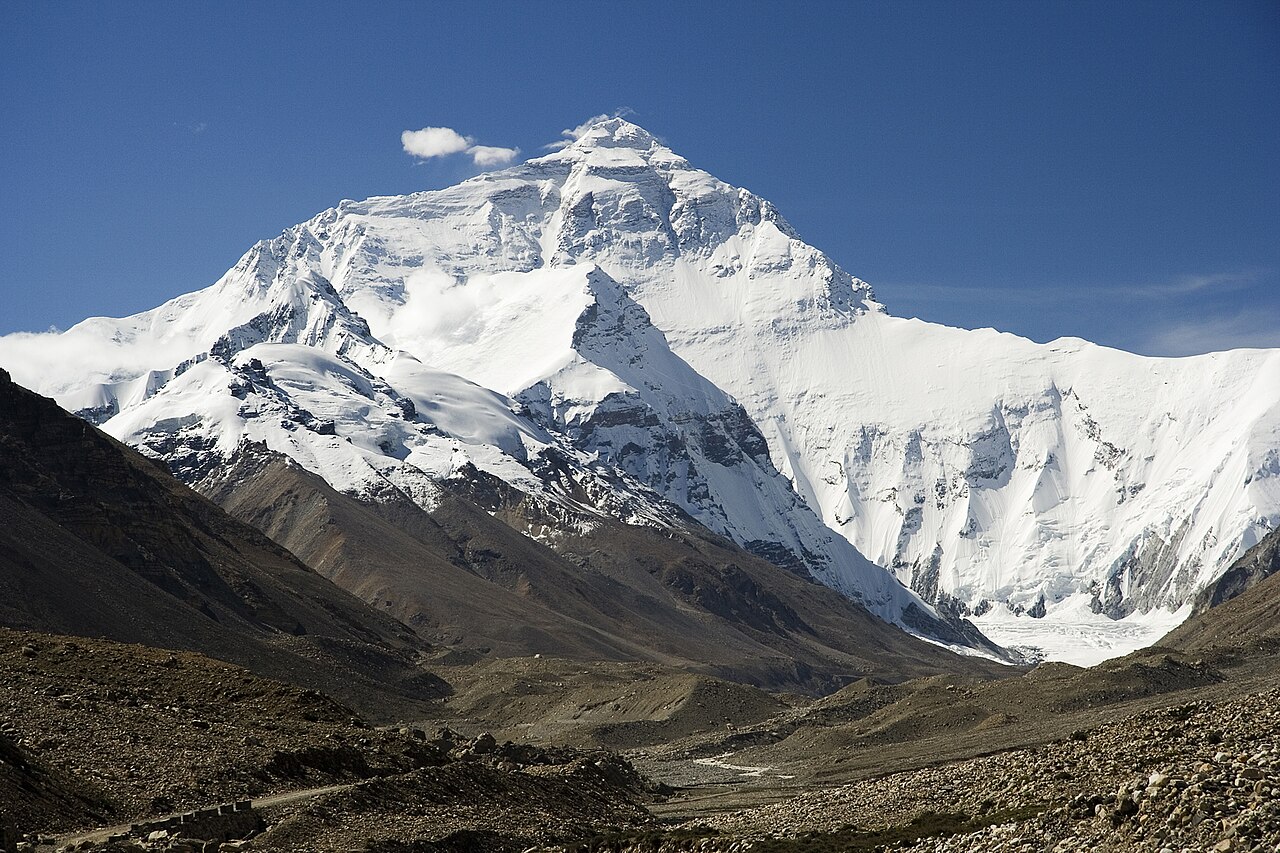
K2 is a steeper and more uniform pyramid that drops away sharply on almost every side. Its north face rises more than 3,200 m above the K2 Glacier in only 3,000 m of horizontal distance. There is no road to its foot: the approach on the Pakistani side runs from Askole up the Baltoro Glacier to the junction known as Concordia, reached by Martin Conway's British expedition in 1892. Near the top of the standard route, the last major obstacle is the Bottleneck, a narrow couloir that puts climbers directly beneath a wall of seracs, an ice cliff that can break away without warning. The first woman to climb Everest was Junko Tabei of Japan in 1975; on K2 it was Poland's Wanda Rutkiewicz on 23 June 1986, eleven years later.
The oxygen question shows the gap in another way. Reinhold Messner and Peter Habeler made the first ascent of Everest without supplemental oxygen in 1978, and many climbers have followed. When the first winter ascent of K2 was finally made in 2021, only one of the ten summiters climbed without bottled oxygen.
Which Is Deadlier: 340 Deaths on Everest or 96 on K2?
K2, by a wide margin when measured against the number of climbers. Before 2021, roughly one person died on K2 for every four who reached the top, the worst ratio among the five highest mountains. Even after a rise in successful ascents, the toll stood at an estimated 96 deaths against about 800 summiters as of August 2023, or roughly 12 deaths for every 100 summits. Everest, with 340 deaths as of May 2024 against just under 13,000 summits recorded by the Himalayan Database by December 2024, works out at fewer than 3 deaths per 100 summits.
Everest kills more people in absolute terms simply because so many more climb it. Its worst disasters came from avalanches and storms: eight climbers died in the blizzard of 10 and 11 May 1996, sixteen in the ice avalanche of 2014, and at least 24 on 25 April 2015, when the magnitude 7.8 Nepal earthquake sent an avalanche from Pumori into Base Camp. K2's disasters are smaller but strike a far smaller field of climbers: thirteen deaths in the summer of 1986, six in 1995, and eleven in August 2008, when a large piece of falling ice took out the fixed ropes on part of the route and left climbers stranded high on the mountain.
The crowds differ just as sharply. On 23 May 2010, 169 climbers reached Everest's summit in a single day, more than in the 31 years from 1953 to 1983. K2's busiest days are far smaller; in 2023 an estimated 112 people summited during a single weather window on 27 July.
Which Was Climbed First in Winter: 1980 or 2021?
Everest again, and by four decades. A Polish expedition led by Andrzej Zawada put Leszek Cichy and Krzysztof Wielicki on the summit on 17 February 1980, the first winter ascent of any eight-thousander. Polish climbers went on to make ten more first winter ascents of 8,000 m peaks, but K2 turned back every winter team, among them Zawada's own Polish-Canadian-British expedition of 1987–88, a Russian team in the winter of 2011–12 that lost Vitaly Gorelik, and Krzysztof Wielicki's Polish national expedition of 2017–18.
It finally fell on 16 January 2021, when ten Nepalese climbers led by Nirmal Purja and Mingma Gyalje Sherpa reached the top together, making K2 the last of the fourteen eight-thousanders to be climbed in winter. Purja was the only one of the ten without supplemental oxygen. On the same day the Spanish climber Sergi Mingote died lower on the mountain.
Which Is Colder and More Remote: the Khumbu or the Baltoro?
Each has a claim. Everest is higher, which puts its summit into the jet stream: winds of 160 km/h are common, a gust of 280 km/h was recorded at the summit in February 2004, and the average summit temperature in January is around −36 °C. K2 is lower but lies about 8 degrees of latitude further north, at roughly 36° north against Everest's 28°, and that more northern position brings more frequent bad weather, which helps explain its higher death rate.
For remoteness, K2 wins. Everest's south side has an airstrip at Lukla and a well-trodden trail through Namche Bazaar, and its north side has a road to Base Camp. K2 sits at the head of the Baltoro Glacier, a long trek up the glacier from Askole and invisible from the last villages. For the full story of the Karakoram giant, read our profile of K2, the Savage Mountain; for how Everest's 8,848.86 m was arrived at, see how tall Mount Everest is; and for the range around K2, explore the Karakoram mountain range guide.