
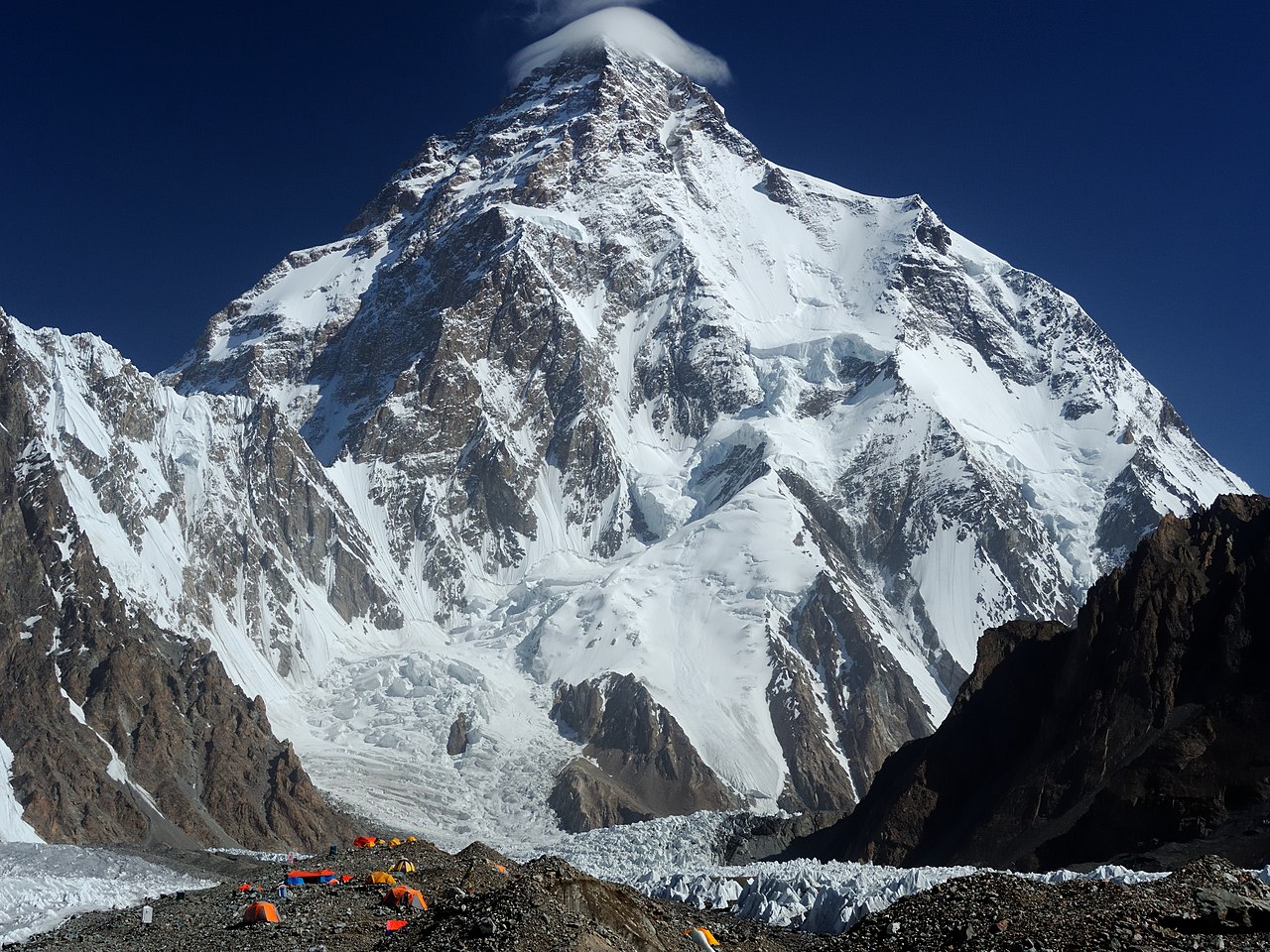
K2 is the second-highest mountain on Earth, rising to 8,611 m (28,251 ft) on the border between Pakistan and China in the Karakoram Range. Nicknamed the "Savage Mountain," it is widely regarded as the most difficult and dangerous of the world's 8,000-metre peaks to climb, with a steeper profile, more technical terrain, and a far higher fatality rate than Everest.
While Everest draws crowds and commercial expeditions, K2 remains the connoisseur's summit, a peak that demands genuine alpine skill rather than money and supplemental oxygen alone. Its near-perfect pyramid shape, ferocious storms, and remote setting deep in the Karakoram have given it a reputation that few other mountains can match. This guide covers everything you need to understand K2: where it sits, how it formed, what makes climbing it so deadly, and why it holds such a powerful grip on the imagination of mountaineers and geographers alike.

Key Facts
- Height: 8,611 m (28,251 ft) — second-highest mountain on Earth
- Location: Pakistan–China border, Gilgit-Baltistan / Xinjiang
- Mountain Range: Karakoram
- Local name: Chogori ("King of Mountains") in Balti
- First ascent: 31 July 1954, by an Italian expedition
- First winter ascent: 16 January 2021, by an all-Nepali team
- Successful summits: roughly 400 people, versus over 6,000 on Everest
Where Is K2 and How Did It Form?
K2 stands at the heart of the Karakoram Range, a heavily glaciated belt of mountains that forms part of the wider Himalayan mountain system stretching across Central and South Asia. The summit lies directly on the international boundary between Pakistan and China: its southern flanks fall into the Gilgit-Baltistan region of Pakistan, while its northern side descends toward China's Xinjiang autonomous region. The mountain rises dramatically above the Baltoro Glacier, one of the longest glaciers outside the polar regions, which feeds meltwater into the Indus River system.
Like the rest of the Himalaya and Karakoram, K2 was thrust skyward by the collision of the Indian tectonic plate with the Eurasian plate, a slow-motion crash that began roughly 50 million years ago and continues today. This ongoing compression is why the region is still seismically active and why the peaks remain among the fastest-rising on the planet. K2 itself is built largely of metamorphic gneiss, which gives its faces their characteristic steep, solid, almost architectural appearance.
The Shape and Faces of K2
One of K2's most striking features is its symmetry. From several vantage points the mountain forms a near-perfect pyramid, rising abruptly with four distinct sides: the North, South, East, and West faces. Unlike many Himalayan giants that sit on broad plateaus, K2 soars steeply on every side, so climbers are exposed to avalanches and rockfall no matter which route they choose.
K2 does not stand alone. It anchors a cluster of colossal peaks that makes the Karakoram one of the most concentrated high-altitude regions on Earth. Within a short distance rise Broad Peak (8,051 m) and the Gasherbrum group, including Gasherbrum I and II, both exceeding 8,000 metres. Four of the world's 14 "eight-thousanders" sit in this compact area, drained by the same glacial network that surrounds K2.
Why Climbing K2 Is So Dangerous
K2 combines every hazard that makes high-altitude climbing lethal: extreme elevation, sustained technical difficulty, and notoriously unstable weather. The result is a death rate of roughly one fatality for every four successful summits — dramatically higher than Everest. There is no "easy" route to the top; even the most popular line demands serious mountaineering ability.
The most feared section is the Bottleneck, a steep, narrow couloir at around 8,200 metres that sits directly beneath an enormous overhanging serac — a cliff of glacial ice that can collapse without warning. Many of K2's worst tragedies, including the 2008 disaster that killed eleven climbers in a single push, occurred at or near this point. Other dangers include:
- Violent storms that can trap climbers high on the mountain for days.
- A very short summer climbing window, typically just a few weeks in July and August.
- Remoteness, with rescue almost impossible above the lower camps.
- Sustained steep ground with little respite, unlike Everest's more gradual upper slopes.
The Abruzzi Spur on the southeast side is the most frequently attempted route, named after the Italian Duke of the Abruzzi who explored it in 1909. The mountain resisted all winter attempts until January 2021, when a team of Nepali climbers made the first successful winter ascent — one of the last great unclaimed prizes in mountaineering.
Wildlife and Ecology Around K2
The immediate environment of K2 is a world of rock, ice, and thin air that supports almost no life. But the broader Karakoram valleys below the glaciers are surprisingly rich. Snow leopards prowl the slopes in search of prey, hunting wild mountain goats such as the markhor — Pakistan's national animal — and ibex. Himalayan brown bears roam the region, and golden eagles ride the thermals above the glaciers. In summer, alpine meadows lower down burst into bloom with wildflowers, drawing insects and migratory birds to an otherwise austere landscape.
Cultural Significance and the Name "K2"
The name "K2" is unusually clinical for such a celebrated mountain. It comes from a surveyor's notation made during the British Great Trigonometric Survey of India in the 1850s, when peaks in the Karakoram were simply labelled K1, K2, K3, and so on — "K" for Karakoram. K2 was the second peak measured, and the placeholder name stuck because the mountain was so remote that it had no widely used local name. It was first photographed in 1856 during that survey.
To the Balti people of northern Pakistan, the mountain is known as Chogori, meaning "King of Mountains." K2's reputation as the "mountaineer's mountain" reflects the pure skill its slopes demand, a contrast to the more commercialised experience on Everest. For many climbers, reaching its summit represents the ultimate expression of alpinism. To learn more about the countries that share this extraordinary peak, see our Pakistan country guide and China country guide.
Interesting Facts About K2
- K2's name is a survey code — it is the only one of the major Karakoram peaks to keep its original numerical designation in common use.
- The mountain lies more than 200 km from the nearest village, making it one of the most isolated of the eight-thousanders.
- K2 has still never been summited via a route entirely on the Chinese (northern) side in winter.
- Despite being lower than Everest, K2 is widely judged the harder and deadlier climb.
- The Baltoro Glacier trek to K2 Base Camp is considered one of the most spectacular high-altitude treks in the world.
Frequently Asked Questions
How tall is K2 and where does it rank?
K2 stands 8,611 m (28,251 ft) tall, making it the second-highest mountain on Earth after Mount Everest. It is the highest peak in the Karakoram Range and the highest point in both Pakistan's Gilgit-Baltistan region and the wider Karakoram.
Why is K2 called the "Savage Mountain"?
The nickname comes from the brutal combination of steep technical terrain, violent and unpredictable weather, and an exceptionally high death rate. Roughly one climber dies for every four who reach the summit, and there is no straightforward route to the top, earning K2 a fearsome reputation among mountaineers.
Is K2 harder to climb than Everest?
Yes. Although K2 is about 237 metres shorter than Everest, it is considered significantly more difficult and dangerous. Its slopes are steeper and more sustained, the weather is harsher, the summit window is shorter, and far fewer people have ever reached the top — around 400 on K2 compared with more than 6,000 on Everest.
When was K2 first climbed?
K2 was first summited on 31 July 1954 by an Italian expedition, with climbers Achille Compagnoni and Lino Lacedelli reaching the top via the Abruzzi Spur. The first successful winter ascent did not come until 16 January 2021, when an all-Nepali team completed the last unclimbed-in-winter eight-thousander.