
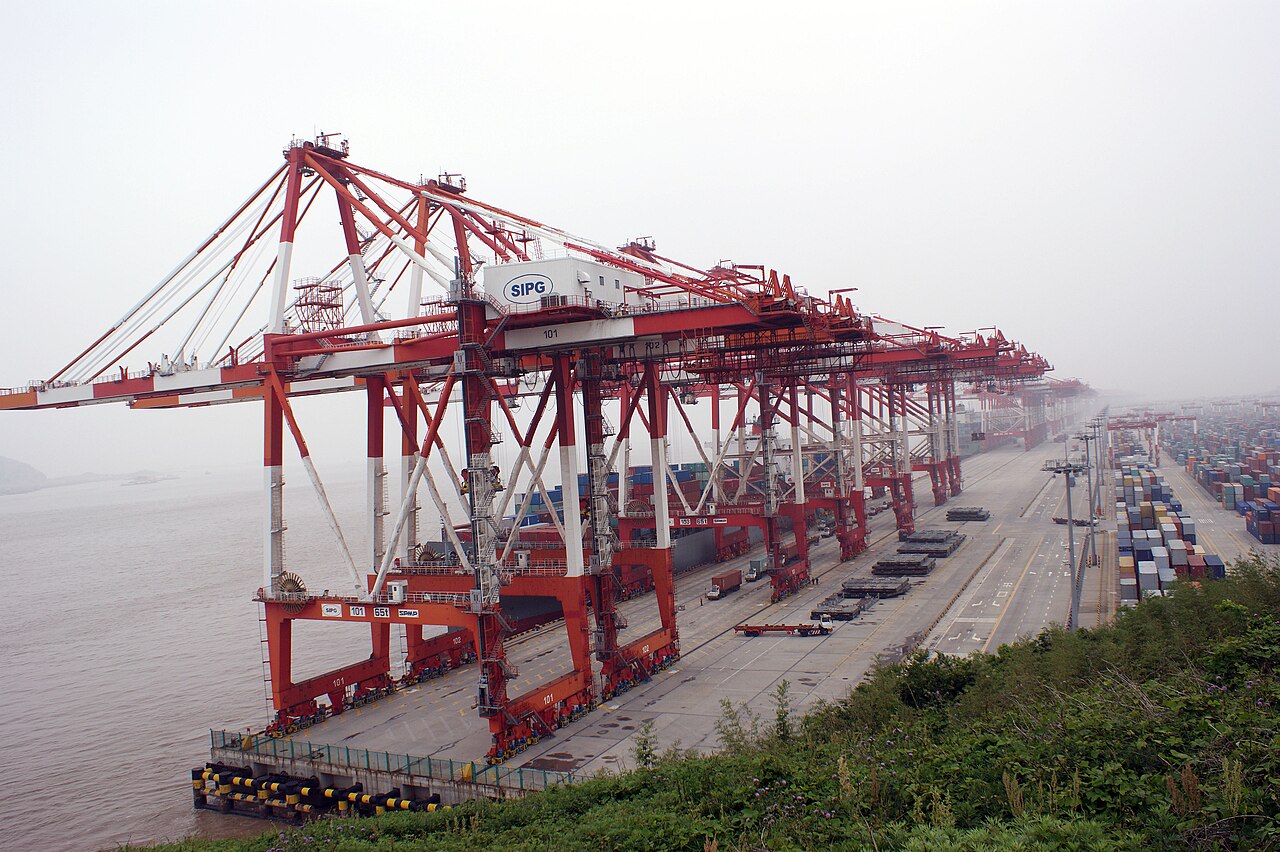
The Port of Shanghai has held the title of the world's busiest container port since 2010, processing a staggering 49 million TEU in 2023. Located where the Yangtze River meets the East China Sea, it serves as the primary maritime gateway for China's most productive economic region.
Introduction
Shanghai's port history stretches back over a thousand years, but its modern transformation into a global shipping giant accelerated dramatically after the construction of the Yangshan Deep-Water Port, an audacious engineering project that created an entirely new deep-water facility on islands 30 kilometers offshore.

Geographic Location
- Location: Yangtze River Delta, East China Sea coast
- Coordinates: 31.23°N, 121.47°E (city); 30.63°N, 122.07°E (Yangshan)
- Water Depth: 15.5 meters (Yangshan berths)
The Port of Shanghai is uniquely positioned at the mouth of the Yangtze River, China's longest waterway at 6,300 kilometers. This location provides dual access: oceangoing vessels reach the port from the East China Sea, while river barges connect to the vast interior of China via the Yangtze and its tributaries, serving a hinterland of over 400 million people.
The port complex spans two main areas. The older Waigaoqiao terminals line the southern bank of the Yangtze estuary, while the newer Yangshan Deep-Water Port sits on the Yangshan Islands in Hangzhou Bay, connected to the mainland by the 32.5-kilometer Donghai Bridge—one of the world's longest cross-sea bridges.
Port Infrastructure
- Deep-Water Berths: 50+ at Yangshan and Waigaoqiao combined
- Yangshan Phase IV: World's largest fully automated container terminal
- Bridge Connection: 32.5 km Donghai Bridge to mainland
Yangshan Deep-Water Port Phase IV, which opened in 2017, is the world's largest fully automated container terminal. Operated by Shanghai International Port Group, it uses automated guided vehicles, unmanned cranes, and artificial intelligence to handle containers with minimal human intervention, achieving remarkable efficiency.
The Waigaoqiao terminals, located along the Yangtze estuary, handle a significant portion of container traffic and are better suited for vessels that also need river access. Together, the two port areas provide flexibility for different vessel types and trade routes, from massive trans-Pacific container ships to smaller feeder vessels and river barges.
Trade & Shipping
- Container Volume: 49.2 million TEU (2023)
- Cargo Tonnage: 590+ million tonnes annually
- Liner Routes: 300+ international routes
Shanghai's port handles the enormous export output of the Yangtze River Delta, China's most industrialized region and home to cities like Suzhou, Nanjing, and Hangzhou. Electronics, textiles, machinery, and consumer goods flow outward to every continent, while raw materials, energy products, and components arrive for China's manufacturing sector.
The port maintains direct liner services to every major trading region, including multiple weekly sailings to Europe, North America, Southeast Asia, and the Middle East. Its dominance in container throughput reflects China's position as the world's largest exporter by value.
Economic & Strategic Impact
- Hinterland Population: 400+ million people in the Yangtze Delta
- Free Trade Zone: Shanghai Pilot Free Trade Zone (est. 2013)
- Employment: Supports millions of direct and indirect jobs
The Port of Shanghai is the economic engine of the Yangtze River Delta, one of the world's largest urban agglomerations. The Shanghai Pilot Free Trade Zone, established in 2013 around the port area, has served as a testing ground for economic reforms including simplified customs procedures and liberalized financial regulations.
Shanghai's maritime prominence has broader strategic implications for China's Belt and Road Initiative, which seeks to strengthen trade connections across Asia, Africa, and Europe. The port serves as the anchor of the Maritime Silk Road, with investments in partner ports from Pakistan to Greece designed to strengthen supply chain links radiating from Shanghai.
Key Facts
- Shanghai has been the world's busiest container port since 2010
- Yangshan Deep-Water Port Phase IV is the world's largest fully automated container terminal
- The 32.5 km Donghai Bridge connects Yangshan to the mainland
- The port processes over 49 million TEU annually
- It serves a hinterland of 400+ million people along the Yangtze River
Fun Facts
- The Yangshan Deep-Water Port was built on small rocky islands that had to be dramatically expanded with reclaimed land
- Shanghai's name literally means "upon the sea" in Chinese, reflecting its maritime heritage
- The port handles more containers in a single day than many national ports handle in an entire year
Final Thoughts
The Port of Shanghai embodies China's rise as a manufacturing and trading superpower. Its combination of river access, deep-water offshore terminals, and cutting-edge automation positions it to maintain its status as the world's busiest container port well into the future.
Test Your Knowledge!
Think you know the world's great harbors and ports? Try our geography quiz games!
Play Geography Games →