

Only 4,118 people lived in the City of San Marino in January 2025, yet this walled hilltop town, known locally as Città, is the capital of the Republic of San Marino. It sits on the western slopes of Monte Titano, the roughly 740-metre limestone ridge at the heart of the republic, and is one of the country’s nine castelli, or municipalities. That population makes it one of the least populated national capitals in the world and only the third-largest castello in its own country. It is the capital because it is the original San Marino: the community on the mountain that, by its own account, was founded in 301 and gradually gathered the rest of the country around it. Its three medieval towers, one on each summit of Titano, appear on the national flag, and since 2008 the historic centre and the mountain have formed a UNESCO World Heritage Site.
Saint Marinus and the Community on Monte Titano
San Marino’s own history begins with a stonemason. According to accounts first written down centuries later, Marinus left the island of Rab, in present-day Croatia, with his friend Leo, and worked in Rimini until the persecutions under Diocletian drove him to Monte Titano, where he built a small church. The republic dates its founding to 301 and on that basis claims to be the world’s oldest surviving republic. Historians treat the legend with caution: the earliest evidence of a community on the mountain comes from the monk Eugippius, whose documents, going back to 511, report that another monk lived there.
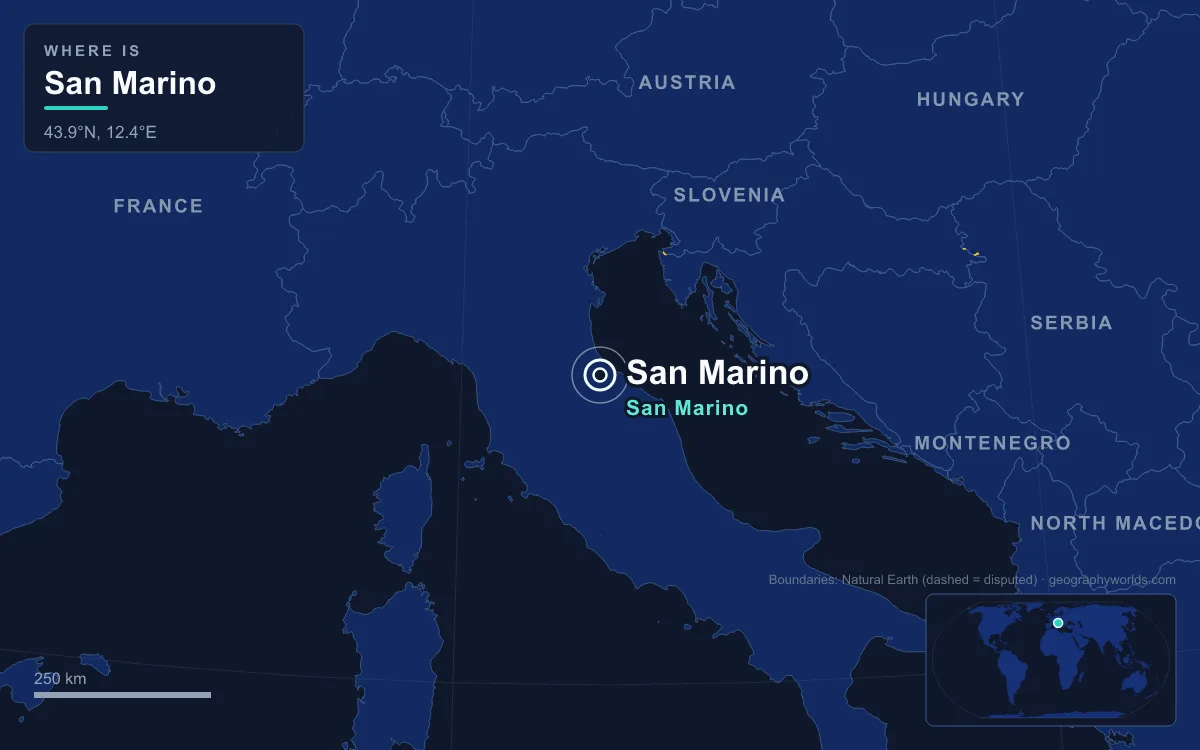
Whatever the exact date, the choice of site explains why the capital sits where it does. Titano rises out of the Apennine foothills about 10 kilometres from the Adriatic coast, a rugged limestone outcrop whose isolation gave the community the seclusion it needed to survive as a republic. The community that grew up beside the church governed itself through the Arengo, an assembly of the heads of each family and the first attested form of government on the mountain. There was no rival town to become the capital; the mountaintop community simply was the state, and every later piece of territory was added to it.
The Basilica of San Marino, on the northeastern edge of the old town, still marks the heart of that community. A church stood on the site from early times; the first document naming the parish church dates from 31 July 1113. The present Neoclassical basilica, with a portico of eight Corinthian columns, was designed by the Bolognese architect Achille Serra, begun in 1826 and consecrated on 5 February 1838. It holds the relics of Saint Marinus.
Three Towers, Tax Disputes and the Castelli of 1320 and 1463
The town became a fortress in stages, and those stages are still visible on the skyline. The Guaita, the oldest tower, was built in the 11th century on the first summit and was long reputed to be impregnable; it reached its current form in the 15th century, during wars with the Malatesta of Rimini. The Cesta followed in the 13th century on the highest summit, on the remains of an older Roman fort, and now houses a museum of more than 1,550 weapons. The Montale, on the smallest summit, was added in the 14th century; its only entrance is a door about seven metres above the ground, a typical prison design, and it is still closed to visitors.
Walls protected the town; lawyers protected its independence. In 1291 San Marino appealed to the Bishop of Arezzo against tribute demands from the vicar of Montefeltro, and the jurist Palamede of Rimini ruled in its favour. In 1296 it appealed again, this time to Pope Boniface VIII, and after a long hearing of witnesses the republic apparently won, since it never paid tribute to Montefeltro afterwards. The first two known consuls, forerunners of today’s Captains Regent, the paired heads of state, were elected by the Grand and General Council on 12 December 1243.
The rest of the country grew around the capital by agreement rather than conquest. Chiesanuova chose to join in 1320. In 1463, after San Marino joined an alliance against Sigismondo Pandolfo Malatesta of Rimini, Pope Pius II rewarded it with new territory, and Faetano, Fiorentino, Montegiardino and Serravalle were added; the borders have not changed since. Borgo Maggiore, the market settlement at the foot of the mountain, had belonged to the town since the 12th century, and Acquaviva since 1243. Today each castello has its own elected council and its own capoluogo, but the institutions of the republic never left the summit where they began.
Titano’s isolation helped the town survive a string of near misses. Cesare Borgia occupied the republic for six months in 1503 until Pope Julius II restored its independence. On 4 June 1543 an attack by Fabiano di Monte San Savino failed when his troops got lost in fog. Cardinal Giulio Alberoni occupied the country on 17 October 1739, and Pope Clement XII restored its freedom on 5 February 1740, Saint Agatha’s day. In 1797 the regent Antonio Onofri won the goodwill of Napoleon, who even offered more land; the regents declined, fearing retaliation later. During Italian unification the town sheltered Giuseppe Garibaldi, and in 1862 San Marino signed a Convention of Friendship with the new Kingdom of Italy.
Palazzo Pubblico and the Institutions on the Summit
Being the capital today means housing almost the whole machinery of the state in a few streets. The Statutes of 1600, still at the core of the constitution, let the Grand and General Council choose its own members by co-optation, which concentrated power in the richest families. On 25 March 1906 the Arengo met, with 805 of 1,477 heads of family present, and voted for reforms that led that June to the first political elections in San Marino’s history. The Council now has 60 members elected for five years.
All of these bodies meet in the Palazzo Pubblico on Piazza della Libertà. It stands on the site of the 14th-century Domus Magna Comunis and was designed by the Roman architect Francesco Azzurri; building began on 17 May 1884 and it was inaugurated on 30 September 1894. With its battlements, corbels and clock tower it resembles a small version of the Palazzo Vecchio in Florence. The architect Gae Aulenti led a restoration completed in 1996. Inside, the Captains Regent, the Grand and General Council, the Council of Twelve and the Congress of State all sit, and a painting by Guercino of Saint Marinus blessing the city hangs in the chamber of the Council of Twelve.

Twice a year, on 1 April and 1 October, the square fills for the investiture of new Captains Regent. The Council chooses them in pairs, and they serve concurrently with equal status. The office opened to women after a 1973 law; Maria Lea Pedini became the first female Captain Regent on 1 April 1981, and in 2017 Vanessa D’Ambrosio and Mimma Zavoli became the first pair of women to hold the post together. Governing from a town of barely 4,000 people, the capital is also the headquarters of the Sammarinese Christian Democratic Party and the terminus of seven of the country’s eight bus lines.
A Capital Above Its Larger Neighbours: Railway, Cable Car and Dogana
What the town lacks is space, and modern San Marino has grown mainly in the valleys below it. Its steep approach puts the old centre beyond the reach of the San Marino Highway, which ends at Borgo Maggiore, and cars are barred from much of the centre. From 1932 to 1944 an electric narrow-gauge railway climbed 31.5 kilometres from Rimini to the capital. On 26 June 1944 RAF bombers dropped 263 bombs on the capital, wrongly believing that German forces were using San Marino; later raids that summer hit the railway, and the line never reopened. Its tunnels sheltered refugees during the fighting that followed, when San Marino, with around 15,000 residents, took in roughly 100,000 people fleeing the front. In 2012 an 800-metre stretch was restored as a heritage line in the capital, running through the 502-metre Montale tunnel.
Today the link to the valley is the Funivia, a cable car that runs every fifteen minutes and takes two minutes to drop from the northern end of the old town to Borgo Maggiore, the old Mercatale and still the country’s chief market town.

The largest settlement in the republic is not the capital at all but Dogana, in the castello of Serravalle on the Italian border, where the highway continues to Rimini. The chart shows how far the capital has been overtaken by the lowland municipalities.
The capital’s economy was once built on quarrying and carving Titano’s stone; now it runs on visitors, commerce and the sale of postage stamps, which San Marino has issued in its own name since an 1877 postal agreement. More than three million people visit the town each year, about 85% of them Italian, and it has more than a thousand shops. The castello also takes in seven outlying curazie, including Murata, Casole and Montalbo, and is twinned with Rab, Marinus’s home island, since 1968. San Marino joined the Council of Europe in 1988 and the United Nations in 1992 without ever moving its government off the mountain. It shares the rare distinction of being entirely surrounded by one other country with Vatican City and Lesotho, and the republic beyond the walls is covered in the San Marino country guide, while its place among Europe’s other tiny states is explained in the microstates of Europe.
Quick Facts About San Marino
- Country: San Marino
- Continent: Europe (Southern Europe)
- Country population: approximately 34 thousand
- Capital city status: San Marino is the capital of San Marino, the seat of national government, and the location of foreign embassies, parliament, and the head of state's official residence.
Frequently Asked Questions
What is the capital of San Marino?
The capital of San Marino is San Marino. San Marino is the seat of national government, hosts most foreign embassies and consulates, and is typically where the head of state and parliament are located.
What continent is San Marino in?
San Marino, the capital of San Marino, is located in Europe, in the Southern Europe region. As San Marino's capital, San Marino serves as the country's primary connection to the broader Europen political, economic, and cultural sphere.
Why is San Marino the capital of San Marino?
San Marino was chosen as the capital of San Marino for reasons that typically combine geography, history, and politics. Capital city selections often reflect a desire for centrality (being accessible from across the country), historical importance (being a longstanding seat of government or culture), or neutrality (being acceptable to multiple regions or ethnic groups within the country). The specific reasons for San Marino's designation are detailed in the city's history above.
What is San Marino known for?
As the capital of San Marino, San Marino is best known for housing the country's central government institutions — parliament, presidential or royal residences, supreme court, and key ministries. It is also typically a major cultural and economic center within San Marino, hosting national museums, embassies, and signature monuments. The introduction and history sections above provide detailed coverage of the city's specific notable institutions and landmarks.
Related Pages
- San Marino Country Guide — full geography, climate, economy, and culture overview
- Flag of San Marino — meaning, history, and design of San Marino's national flag