
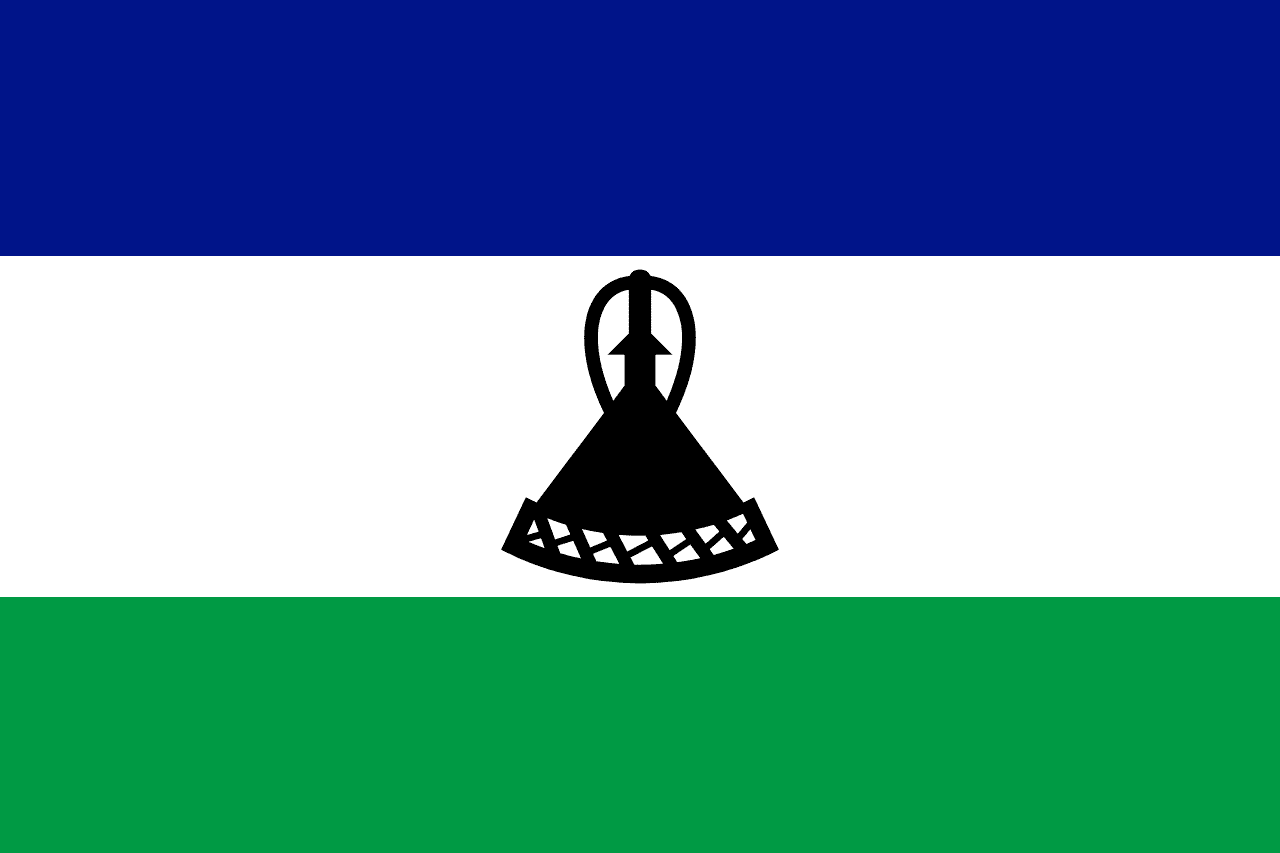
Most national flags lean on stars, crosses, or heraldic beasts. Lesotho went a different way. At the center of its flag sits a hat — specifically the mokorotlo, the conical straw headpiece traditionally worn by Basotho men and so closely tied to the nation that its silhouette appears on everything from license plates to government letterheads. The choice was deliberate. When Lesotho redesigned its flag in 2006, it wanted a symbol of peace rather than the warlike imagery it had carried before, and a hat woven from grass made the point better than any weapon could.
The result is a calm, confident banner: three horizontal bands of blue, white, and green, with a single black emblem resting on the central stripe. It is one of the few flags in the world to feature an item of clothing, and arguably the only one built around a piece of indigenous headwear. To understand why, it helps to look at the colors, the design, and the somewhat restless history that led Lesotho through four flags in just over four decades.
What the Colors Mean
Lesotho's flag works with four colors, three of them in the bands and one in the central emblem. Each carries a specific, plainly stated meaning rather than a layered metaphor.
- Blue sits at the top and represents the sky and, crucially, rain. In a mountainous, landlocked country where water is a defining resource, rain is not a casual symbol — it is livelihood.
- White occupies the middle and stands for peace. Its placement at the heart of the flag, directly beneath the emblem, underlines the country's stated desire to present itself as a peaceful nation.
- Green anchors the bottom and represents the land — the soil, the prosperity drawn from it, and the agricultural life of the Basotho people.
- Black appears only in the central hat. It represents the Basotho nation itself, the people of Lesotho, placed front and center as the defining identity of the flag.
There is a tidy logic to the arrangement. Sky above, land below, peace in between, and the people — symbolized by their most recognizable cultural object — sitting calmly in the middle of it all.
The Design and Its Layout
Structurally, the flag is a horizontal triband: three stripes of equal-ish proportion running left to right, blue on top, white in the center, green at the base. The central white band is given the most visual weight because it carries the emblem.
That emblem is the mokorotlo, rendered in black and placed in the middle of the white stripe. The hat's distinctive shape — a wide, slightly flared base rising to a pointed top, often described as resembling a conical mountain — is instantly readable even at a distance or at small sizes. Some interpretations note that the hat's silhouette echoes the form of Mount Qiloane, a landmark associated with Basotho heritage, giving the design a quiet double meaning. Whether read as headwear or as a mountain, the shape ties the flag firmly to Lesotho's landscape and its people.
The overall effect is uncluttered and modern. There is no coat of arms, no shield, no text — just three colors and one strong, simple form.
A Flag That Kept Changing
Lesotho is unusual for how often it has revised its flag. The 2006 design is the fourth since the country gained independence from Britain in 1966, and each change reflected the political mood of the moment.
The earliest post-independence flag also featured the mokorotlo, signaling from the very beginning that the hat would be central to national identity. Later designs shifted toward different colors and incorporated more assertive imagery, including elements evoking weaponry — a knobkerrie and shield — that conveyed a more martial tone during a period of political tension and military involvement in government.
By the mid-2000s, with the country marking forty years of independence, there was an appetite to move on from that imagery. The flag adopted in 2006 deliberately replaced the weapons with the peaceful hat and settled on the blue-white-green palette. The message was intentional: Lesotho wanted to be seen as a nation at peace, defined by its culture and land rather than by conflict.
Cultural Significance and National Identity
Few national symbols are as inseparable from everyday culture as the mokorotlo is to the Basotho. The hat is genuinely worn, not merely depicted — it appears at ceremonies, festivals, and as a marker of Basotho identity both inside Lesotho and across the wider region where Sesotho-speaking people live. Putting it on the flag was less an act of invention than of recognition: it took something already understood as a national emblem and made it official.
This grounding in living tradition is part of what makes the flag feel authentic rather than abstract. The blue, white, and green communicate values, but the hat communicates a specific people with a specific heritage. For a small, proud, mountainous kingdom often overshadowed by its much larger neighbor, that distinctiveness matters. If you want the broader context of the country's geography, monarchy, and culture, the lesotho country guide fills in the picture beyond the flag.
The Flag in Modern Life
Today the flag flies over government buildings in Maseru, the capital, and is raised on national occasions including Independence Day, celebrated each October. It accompanies Lesotho's athletes at international events and appears wherever the kingdom represents itself abroad. Because the design is so clean and the emblem so recognizable, it reproduces well at any scale, from a stadium banner to a lapel pin.
The hat motif extends well beyond the flag, reinforcing the symbol's reach. The same conical silhouette shows up in tourism branding, on souvenirs, and in the visual identity of the country generally, so that the flag's central image feels familiar even to first-time visitors.
Quick Facts
- Lesotho's current flag was adopted in 2006, the fourth design since independence in 1966.
- It is one of the very few national flags to feature an item of clothing — the mokorotlo straw hat.
- The hat is black and represents the Basotho nation; the bands of blue, white, and green stand for rain/sky, peace, and land.
- The 2006 redesign deliberately replaced earlier weapon imagery with the peaceful hat.
- Lesotho is a landlocked kingdom in southern Africa, entirely surrounded by South Africa.
Frequently Asked Questions
When was the flag of Lesotho adopted?
The current flag was adopted in 2006, timed around the fortieth anniversary of independence. It replaced an earlier design and became the fourth flag the country has used since gaining independence in 1966.
What do the colors of the Lesotho flag mean?
Blue represents the sky and rain, white represents peace, and green represents the land. The black hat in the center represents the Basotho nation — the people of Lesotho — making identity the literal centerpiece of the design.
What is the hat on the Lesotho flag?
It is the mokorotlo, a conical straw hat traditionally worn by Basotho men and recognized as a national symbol. Its shape is sometimes also read as echoing a local mountain, tying the flag to both the people and the landscape.
What continent is Lesotho on, and is the flag similar to any other?
Lesotho is in southern Africa, completely enclosed by South Africa. Its flag is distinctive and not easily confused with others, largely because the central hat emblem is unique — most tricolor flags rely on stars, crosses, or coats of arms rather than headwear.