
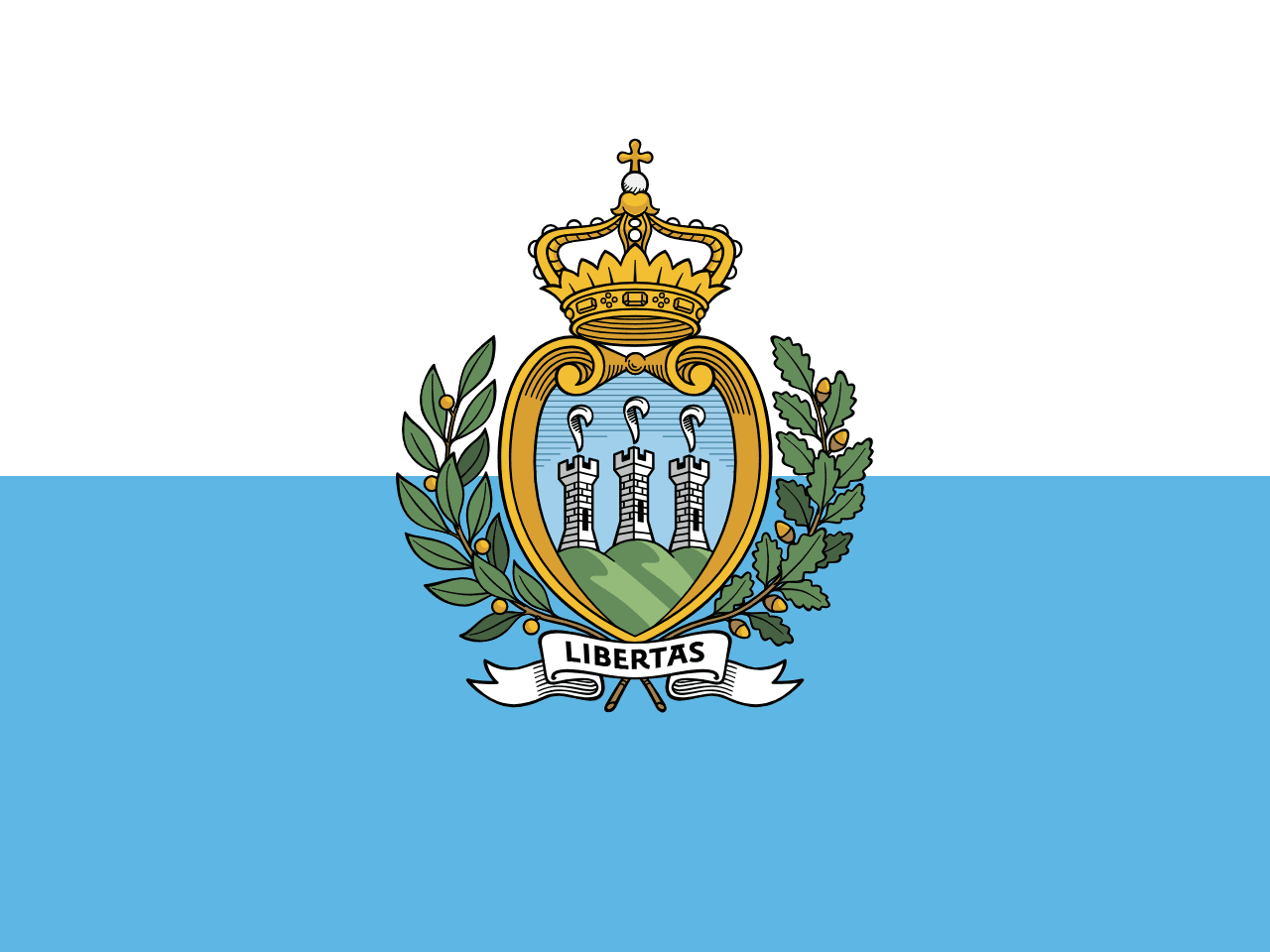
Tucked into the rugged slopes of Monte Titano, the tiny enclave of San Marino flies one of Europe's most quietly distinctive flags: a clean horizontal band of white above a band of light blue, crowned at the center by an elaborate coat of arms. It is a banner that feels almost serene at first glance, yet it belongs to a state that proudly claims to be the oldest surviving republic on Earth. The combination of soft colors and an intricate emblem tells a story that stretches back centuries, weaving together legends of mountain refuge, civic pride, and an unbroken tradition of self-governance that few nations can match.
For a country smaller than many cities, San Marino has held tightly to its identity, and its flag is the most visible expression of that endurance. Adopted in its current form in 1862, the design has remained remarkably stable while the world around this microstate transformed beyond recognition. Understanding the flag means understanding how a community of a few tens of thousands of people on a single craggy peak has managed to remain independent while empires, kingdoms, and republics rose and fell all around it.
The Meaning Behind the White and Blue
The two colors of the Sammarinese flag carry meanings that reflect both the landscape and the values of the republic. The white band is traditionally read as a symbol of peace, an apt choice for a state that has survived precisely by avoiding entanglement in the conflicts of its larger neighbors. The light blue below it represents the sky and, by extension, liberty and freedom, the principles upon which the republic was founded and which it has guarded with stubborn pride for generations.
There is also a more grounded, almost poetic interpretation. The pale blue echoes the open air that surrounds Monte Titano, while the white recalls the clouds that drift across the mountain's three peaks. Together they evoke the experience of standing atop the republic's defining feature and looking out across the surrounding Italian countryside. The colors were not invented arbitrarily; they are drawn directly from the historic coat of arms, anchoring the flag in the deep symbolic vocabulary of the state.
Reading the Design and Layout
Structurally, the flag is a horizontal bicolor, the simplest and most ancient of flag formats. Two equal stripes of color, white on top and light blue beneath, form the field. What lifts it out of the ordinary is the coat of arms placed at the center, which transforms a plain bicolor into something unmistakably Sammarinese.
The emblem is rich with detail. At its heart sit three towers, each topped with a silver ostrich feather, representing the three fortresses that crown the summits of Monte Titano: Guaita, Cesta, and Montale. These towers are not decorative invention but real medieval structures that still stand watch over the country today. Surrounding the shield are branches of laurel and oak, traditional symbols of victory and strength, and above it rests a crown that signifies the sovereignty of the republic. A scroll bearing the word Libertas, the Latin for "liberty," completes the composition and states the nation's guiding ideal in a single word.
It is worth noting that San Marino, like a number of states, maintains two versions of its flag. The state flag carries the full coat of arms and is used for official and governmental purposes, while a plainer civil version is sometimes flown without the emblem. The version most people recognize, and the one most closely associated with the country, is the white-and-blue field bearing the crest.
Historical Roots and How the Flag Took Shape
San Marino traces its origin to a legend dating to the early fourth century, when a Christian stonemason named Marinus is said to have fled persecution and established a small community on Monte Titano. From that humble beginning grew a self-governing settlement that gradually formalized into a republic, developing its own statutes, councils, and traditions long before the modern nation-state existed.
The colors and symbols that would eventually define the flag emerged from the republic's coat of arms, which itself evolved over centuries of civic life. The flag as it is officially recognized today dates to 1862, a period when many European states were codifying their national symbols amid the broader currents of nationalism and unification sweeping the continent. While Italy was being forged into a single kingdom around it, San Marino held firm to its independence and formalized the banner that expressed its distinct identity. The essential design has endured ever since, with only minor refinements to the rendering of the coat of arms over the years.
How It Compares to Similar Flags
White-and-blue horizontal bicolors are not unique to San Marino, which makes the central emblem all the more important for distinguishing it. Flags such as those of Argentina or, in different arrangements, the historic banners of various maritime and Mediterranean states share a comparable palette of pale blue and white. Without its coat of arms, the Sammarinese field could easily be confused with one of these look-alikes.
The crest is therefore the decisive feature. Where Argentina places a golden sun of May at its center, San Marino plants three feathered towers and the word Libertas. The light, almost pastel shade of blue also sets it apart from flags that use a deeper navy or royal blue. Among microstates, San Marino's banner sits alongside other emblem-bearing European flags, but its specific imagery of mountain fortresses is found nowhere else. Travelers curious about how this fits into the wider story of the country can explore the san marino country guide for deeper context on its geography and history.
Cultural Significance and National Identity
For Sammarinese citizens, the flag is inseparable from a fierce sense of continuity. In a republic that has governed itself for the better part of seventeen centuries, the banner is less a marker of a modern state than a living thread connecting present-day residents to the medieval mountain community that founded the place. The word Libertas is not a hollow slogan but a summary of the entire national myth: a refuge for those seeking freedom, a community that never bent the knee to surrounding powers.
The three towers depicted on the flag also appear throughout Sammarinese visual culture, on coins, official seals, and tourist imagery. They serve as a kind of shorthand for the nation itself. When the flag is raised during civic ceremonies, it affirms a remarkable historical claim: that this small place on a single peak has remained free and self-ruling while the map of Europe was redrawn around it again and again.
The Flag in Modern Life
Today the flag appears in the everyday rhythms of the republic. It flies over the government palace in the City of San Marino, accompanies state ceremonies, and is hoisted during the twice-yearly investiture of the Captains Regent, the two heads of state who jointly govern in a tradition reaching back to medieval times. National holidays and commemorations bring it out in force.
Internationally, the flag travels with San Marino's small but enthusiastic presence in world events. Sammarinese athletes carry it at the Olympic Games and other competitions, and the national football team, however modest its record, takes the field beneath the white and blue. For a country with so few residents, these moments of visibility on a global stage carry outsized meaning, reminding the world that the ancient republic still stands.
- San Marino claims to be the world's oldest surviving republic, with roots traced to the year 301.
- The current flag was officially adopted in 1862.
- The three towers on the coat of arms represent the real fortresses of Guaita, Cesta, and Montale atop Monte Titano.
- The motto Libertas sits on a scroll within the emblem, declaring the republic's founding ideal.
- The country is entirely landlocked, surrounded on all sides by Italy.
- A simpler civil version of the flag exists without the coat of arms.
Frequently Asked Questions
When was the flag of San Marino adopted?
The flag in its official modern form was adopted in 1862. Its colors and symbols, however, derive from the republic's much older coat of arms, giving the design historical roots that reach back well before that date.
What do the colors of the San Marino flag mean?
The white band represents peace, while the light blue band symbolizes the sky as well as liberty and freedom. Both colors are taken directly from the national coat of arms, tying the flag to centuries of Sammarinese tradition.
What continent is San Marino on?
San Marino is located in Europe. It is a landlocked microstate entirely surrounded by Italy, perched on and around the slopes of Monte Titano near the country's Adriatic coast.
How is the San Marino flag different from similar white-and-blue flags?
Several flags use a white-and-blue palette, but San Marino's is distinguished by its central coat of arms featuring three feathered towers and the word Libertas. The pale shade of blue and the mountain-fortress imagery set it apart from look-alikes such as Argentina's sun-bearing flag.
