
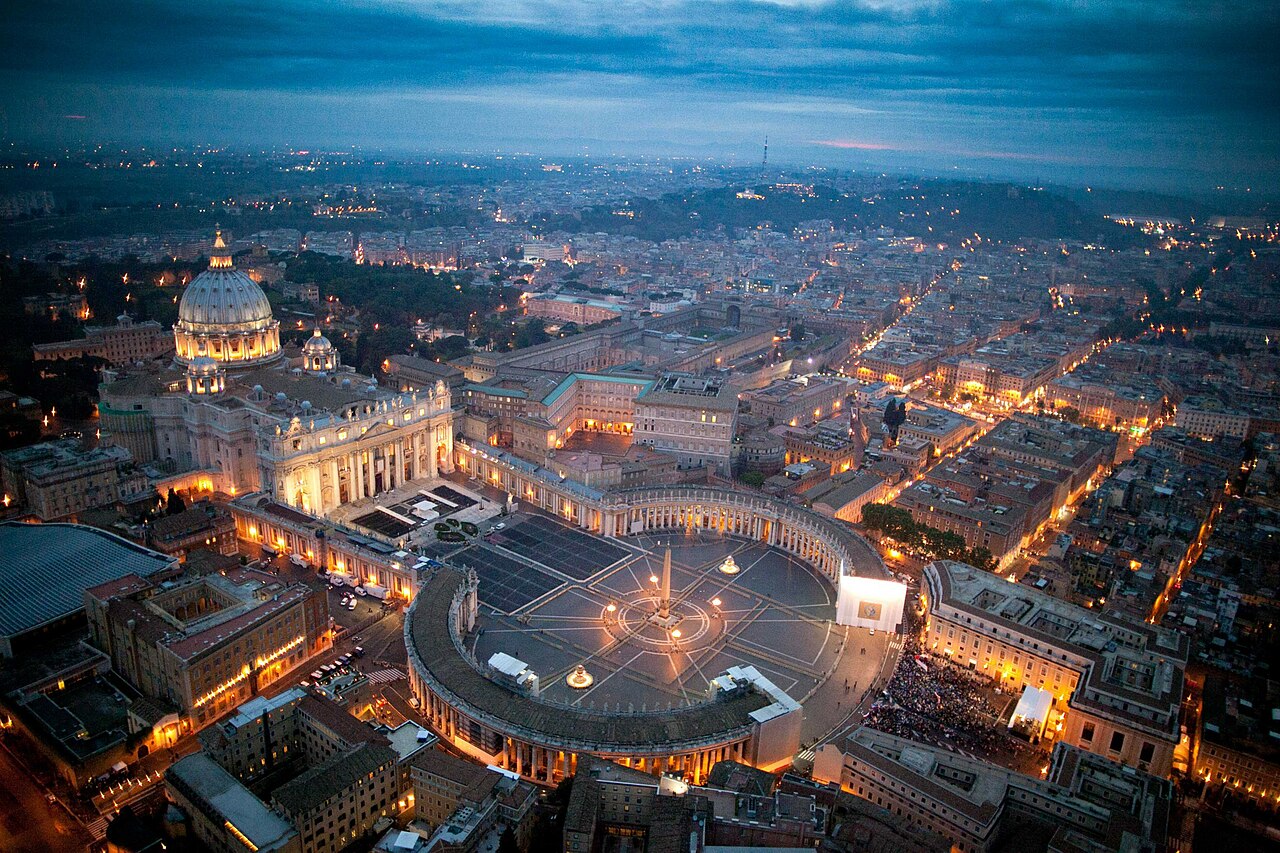
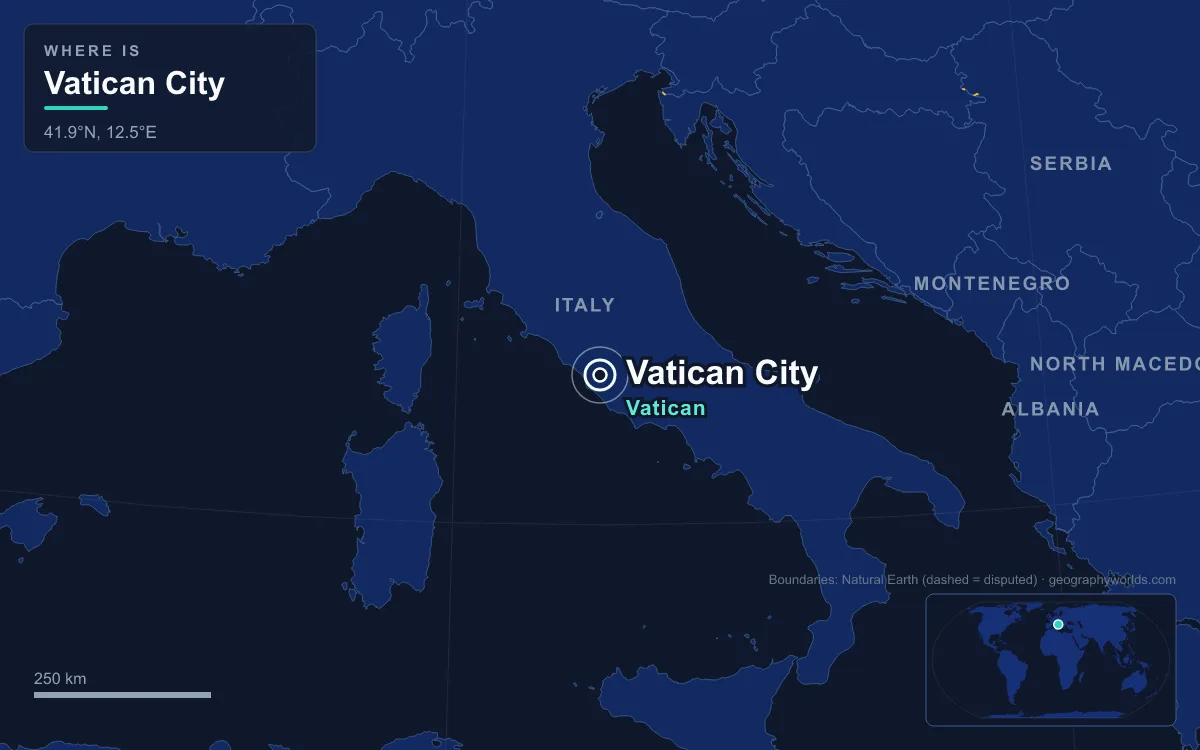
Vatican City is the capital of Vatican City: the state and its capital are the same 44-hectare walled territory on the west bank of the Tiber, entirely surrounded by the Italian city of Rome. It had about 882 residents in 2024, which makes it the smallest country in the world by both area and population, and the only one with fewer than 1,000 people. What defines it is its purpose. Vatican City exists so that the pope, as head of the Holy See and of the Catholic Church, governs from sovereign ground rather than as a guest of Italy, an arrangement fixed by the Lateran Treaty signed on 11 February 1929. Because the whole capital can be crossed on foot in a few minutes, the easiest way to understand it is building by building.
St Peter’s Square and the White Line on the Italian Border
Most visitors enter the country without noticing. There are no passport checks between Rome and Vatican City, and the frontier across the mouth of St Peter’s Square is marked only by a white line on the paving where the square meets Piazza Pio XII, which is Italian. The approach to it, the straight Via della Conciliazione running from near the Tiber, was cut through the old Borgo district on Mussolini’s orders after the 1929 treaty.
The square itself is older and far more deliberate. Gian Lorenzo Bernini redesigned the open space in front of the basilica between 1667 and 1676 for Pope Alexander VII, so that the largest possible crowd could see the pope give his blessing from the church façade or from a window of the papal palace. His colonnades, four columns deep in the plain Tuscan order, curve out from the church in what Bernini called the maternal arms of Mother Church. At the centre stands the Vatican obelisk, brought from Heliopolis in Roman Egypt by the emperor Caligula for the circus he began in his mother Agrippina’s gardens. It is the last visible piece of that Circus of Nero, where tradition holds that Saint Peter was crucified. Pope Sixtus V had it moved to its present spot in 1586 using a method devised by the architect Domenico Fontana.

The square is also where two police forces meet. Under the Lateran Treaty, Italian police normally keep order across the square up to the foot of the basilica steps, even though the ground is Vatican territory. When the Holy See holds a major ceremony, Italian officers withdraw behind the outer line of the colonnades and the Vatican Gendarmerie takes over.
St Peter’s Basilica, Raised Over a Roman Cemetery Between 1506 and 1626
Across the Via Cornelia from Nero’s circus lay a cemetery of tombs, mausoleums and pagan altars. The emperor Constantine built a basilica there in 326 over what was believed to be Peter’s grave, and the building drew people to a hill the Romans had long considered marshy and unhealthy. Work on its replacement began on 18 April 1506 and ended on 18 November 1626. Donato Bramante, Michelangelo and Carlo Maderno shaped most of the design, and Bernini added the piazza and many of the fittings inside.
The result is the largest church in the world by interior measure, with a dome that still dominates Rome’s skyline. It is not a cathedral, though: the seat of the Bishop of Rome is the Archbasilica of Saint John Lateran across the city, which ranks first among the four major papal basilicas. What St Peter’s holds is the tomb itself, directly below the high altar. Pope Pius XII ordered the necropolis beneath the church to be excavated systematically between 1939 and 1941, and papal liturgies in the basilica and square draw anywhere from 15,000 to more than 80,000 people. The full story of the building is told in our guide to St Peter’s Basilica.
The Apostolic Palace and the Sistine Chapel
For about a thousand years the popes did not live here. Their usual home was the Lateran Palace on the far side of Rome, and from 1309 to 1377 they lived in Avignon in France. After returning they settled at the Vatican, moved to the Quirinal Palace from 1583, and came back for good in 1870, when Italian troops captured Rome and the king took the Quirinal as his royal palace. Pius IX and his successors refused to recognise the Italian state and never left the Vatican walls, earning the label “prisoner in the Vatican”. That standoff, known as the Roman Question, lasted until the 1929 treaty created the present state.
Inside the Apostolic Palace, the pope’s official residence, is the room most associated with the papacy. Pope Sixtus IV had the Sistine Chapel built between 1473 and 1481 on the site of an older, crumbling Cappella Maggiore, to a design by Baccio Pontelli. Botticelli, Perugino, Ghirlandaio and others painted its walls with scenes from the lives of Moses and Christ, and the first mass was celebrated there on 15 August 1483. Michelangelo painted the ceiling between 1508 and 1512 for Pope Julius II and returned between 1535 and 1541 to paint The Last Judgment on the altar wall. The chapel is still where cardinals gather in conclave to elect a new pope.
The Vatican Museums: One Statue in 1506, 6.8 Million Visitors in 2024
The museums began with a single purchase. On 14 January 1506 a marble group of the Trojan priest Laocoön and his sons being attacked by serpents was dug up in a vineyard near Santa Maria Maggiore. Julius II sent Michelangelo and Giuliano da Sangallo to examine it, bought it on their advice and put it on display at the Vatican a month later. Today the collection holds roughly 70,000 works, of which about 20,000 are on show across 24 galleries, and the museums employ around 640 people. The visitor route ends in the Sistine Chapel.

In 2024 the museums had 6.8 million visitors, second only to the Louvre among art museums worldwide. That is roughly 7,700 visitors for every person who lives in the country. Admission fees, along with donations from Catholics, postage stamps, souvenirs and publications, are what fund the state, which levies no taxes.
The year 1506 left a second mark on the capital. Julius II founded the Pontifical Swiss Guard that same year, and it still protects the pope and the Apostolic Palace. Recruits must be unmarried Swiss Catholic men aged 19 to 30, at least 174 centimetres tall, who have completed Swiss military training. Guardsmen and their families form part of the resident population alongside clergy and lay staff, and in 2019 about 20 children of Swiss Guards lived inside the walls. Another 372 Vatican citizens, mostly diplomats and cardinals living in Rome, reside outside the territory.
The Leonine Wall and the Frontier Drawn in 1929
The shape of the country on a map comes from a ninth-century emergency. After raiders sacked Old St Peter’s in 846, Pope Leo IV enclosed the Vatican Hill with a wall built between 848 and 852, the only extension ever made to the walls of Rome. It ran for about three kilometres from the riverbank at Hadrian’s Mausoleum, now Castel Sant’Angelo, up and around the basilica, with 44 towers along its length. Later popes, Paul III, Pius IV and Urban VIII among them, rebuilt and extended the fortifications in the sixteenth and seventeenth centuries.
When the negotiators of 1929 drew the border, they largely followed that loop of walls. Where there was no wall, the line of existing buildings served, and a short stretch of new wall was built. Everything outside went to Italy, including the Borgo district the area had belonged to. Some Holy See property elsewhere, such as the papal palace at Castel Gandolfo and the major basilicas in Rome, was given extraterritorial status similar to an embassy but is not part of the state.
Inside those walls, about 23 hectares, roughly half the country, is garden. The Vatican Gardens spread across the west of the territory, rising to the highest point at about 60 metres above sea level, and contain Vatican Radio and the Governor’s Palace. Pope Nicholas III first walled an orchard, a lawn and a garden here after moving to the Vatican in 1279. Pope Francis opened the gardens to guided public visits in 2014. For how the Vatican compares with the rest of the list, see our look at the smallest country in the world.
Vatican Railway Station and 300 Metres of Track
The last landmark is the most unexpected. Pope Gregory XVI, who died in 1846, had blocked railways in the Papal States altogether. The Lateran Treaty reversed that: Article 6 guaranteed the new state a station and a link to the Italian network. Pius XI insisted that the station building match the dignity of the city, and the line was in use by 1934.

The whole line is 1.27 kilometres long, but only 300 metres of it lie inside Vatican City, which makes it the shortest national railway in the world. An iron gate in the city wall opens only when a train passes, and on the Italian side trains cross the Gelsomino Viaduct to Roma San Pietro station. No pope used it until John XXIII in 1962, and once the papal plane could make long journeys the line was of little use for papal travel. Its main job became bringing freight in from Italy, with the occasional pilgrimage, until 2015, when a weekly tourist train began running to Castel Gandolfo. That journey takes about an hour, of which roughly 30 seconds is on Vatican track, and it uses Trenitalia trains because the state has never owned rolling stock.
Stepping off that train at the gate, or back across the white line on St Peter’s Square, puts a visitor straight into the Italian capital that surrounds it, whose own layers are traced in our article on Rome, the capital of Italy.
Quick Facts About Vatican City
- Country: Vatican City
- Continent: Europe (Southern Europe)
- Country population: approximately 506
- Capital city status: Vatican City is the capital of Vatican City, the seat of national government, and the location of foreign embassies, parliament, and the head of state's official residence.
Frequently Asked Questions
What is the capital of Vatican City?
The capital of Vatican City is Vatican City. Vatican City is the seat of national government, hosts most foreign embassies and consulates, and is typically where the head of state and parliament are located.
What continent is Vatican City in?
Vatican City, the capital of Vatican City, is located in Europe, in the Southern Europe region. As Vatican City's capital, Vatican City serves as the country's primary connection to the broader Europen political, economic, and cultural sphere.
Why is Vatican City the capital of Vatican City?
Vatican City was chosen as the capital of Vatican City for reasons that typically combine geography, history, and politics. Capital city selections often reflect a desire for centrality (being accessible from across the country), historical importance (being a longstanding seat of government or culture), or neutrality (being acceptable to multiple regions or ethnic groups within the country). The specific reasons for Vatican City's designation are detailed in the city's history above.
What is Vatican City known for?
As the capital of Vatican City, Vatican City is best known for housing the country's central government institutions — parliament, presidential or royal residences, supreme court, and key ministries. It is also typically a major cultural and economic center within Vatican City, hosting national museums, embassies, and signature monuments. The introduction and history sections above provide detailed coverage of the city's specific notable institutions and landmarks.
Related Pages
- Vatican City Country Guide — full geography, climate, economy, and culture overview
- Flag of Vatican City — meaning, history, and design of Vatican City's national flag