
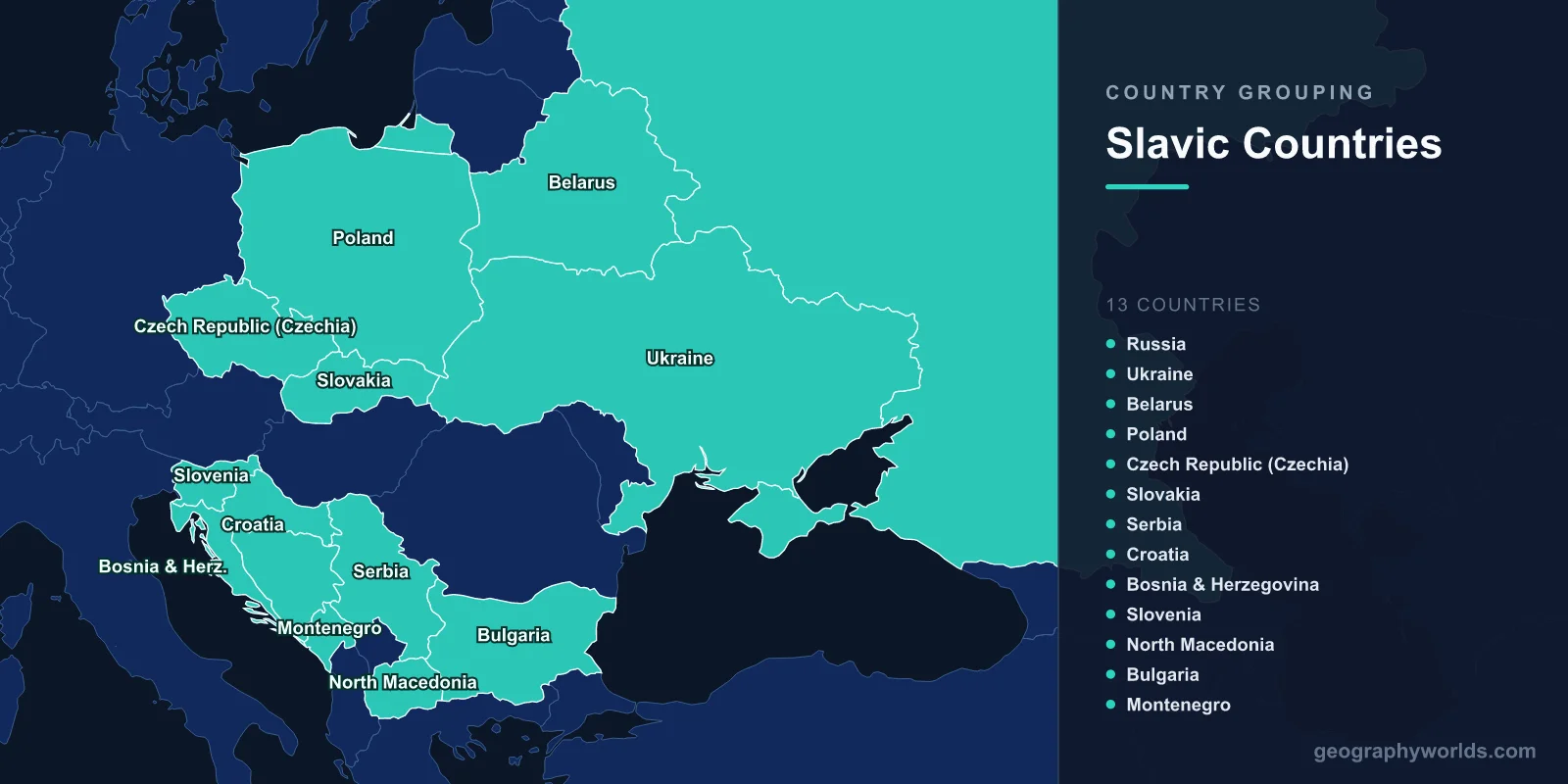
There are 13 Slavic countries in the world, home to approximately 360 million people. They are divided into three linguistic and cultural branches: East Slavic (3 countries), West Slavic (4 countries), and South Slavic (6 countries).
What Are Slavic Countries?
Slavic countries are nations where a Slavic language is the primary or official language and where Slavic ethnic groups form a significant part of the population. The Slavic peoples share a common linguistic ancestor — Proto-Slavic — spoken roughly 1,500 years ago. Over centuries, migrations, empires, and religious influences split the Slavic world into three distinct branches, each with its own languages, alphabets, and cultural traditions.
The division between Slavic countries is not just linguistic. Religion played a major role: the East and most South Slavic nations adopted Eastern Orthodox Christianity and the Cyrillic alphabet through Byzantine influence, while the West Slavic nations and some South Slavic nations (Croatia, Slovenia) adopted Roman Catholicism and the Latin alphabet through Western European influence. Bosnia and Herzegovina has significant Muslim populations due to Ottoman rule.

East Slavic Countries (3 Nations)
The East Slavic countries are the largest by area and population. They share roots in the medieval state of Kievan Rus' and predominantly use the Cyrillic alphabet.
1. Russia
- Capital: Moscow
- Population: ~144 million
- Language: Russian
- Area: 17,098,242 km²
- Religion: Predominantly Russian Orthodox
Russia is the world's largest country by area, spanning 11 time zones from Eastern Europe to the Pacific coast. Russian is the most widely spoken Slavic language, with about 258 million speakers worldwide. Russia's cultural influence on the broader Slavic world has been enormous through literature, music, and political history.
2. Ukraine
- Capital: Kyiv
- Population: ~37 million
- Language: Ukrainian
- Area: 603,628 km²
- Religion: Predominantly Orthodox Christian
Ukraine is the second-largest country in Europe by area. Ukrainian is a distinct East Slavic language with approximately 40 million native speakers. The country considers itself the cultural heir of Kievan Rus', the medieval state that also gave rise to Russia and Belarus.
3. Belarus
- Capital: Minsk
- Population: ~9.2 million
- Language: Belarusian and Russian (both official)
- Area: 207,600 km²
- Religion: Predominantly Orthodox Christian
Belarus is a landlocked country between Russia and Poland. While Belarusian is an official language, Russian is more widely spoken in daily life. The country's landscape is dominated by flat plains, forests, and marshlands, including the Białowieża Forest — one of Europe's last primeval forests.
West Slavic Countries (4 Nations)
The West Slavic countries use the Latin alphabet and are predominantly Roman Catholic. They are the most economically integrated with Western Europe, with three of the four being EU members.
4. Poland
- Capital: Warsaw
- Population: ~38 million
- Language: Polish
- Area: 312,696 km²
- Religion: Predominantly Roman Catholic
Poland is the largest West Slavic country and the fifth-most populous EU member state. Polish is the second most-spoken Slavic language after Russian. Poland's history has been shaped by its position between Germany and Russia, including partitions and occupations.
5. Czech Republic (Czechia)
- Capital: Prague
- Population: ~10.8 million
- Language: Czech
- Area: 78,871 km²
- Religion: Majority irreligious/secular
Czechia is notable as one of the least religious countries in the world despite its Catholic heritage. Prague is one of Europe's most visited cities, famous for its medieval architecture. Czech and Slovak are mutually intelligible, a legacy of their shared history in Czechoslovakia (1918-1993).
6. Slovakia
- Capital: Bratislava
- Population: ~5.4 million
- Language: Slovak
- Area: 49,035 km²
- Religion: Predominantly Roman Catholic
Slovakia became independent in 1993 after the peaceful dissolution of Czechoslovakia (the "Velvet Divorce"). The country is known for its mountainous terrain, including the High Tatras, and its numerous medieval castles.
South Slavic Countries (6 Nations)
The South Slavic countries are located in the Balkans. They are divided by religion and alphabet: some use Cyrillic, others use Latin, and several use both. Most of these nations emerged from the breakup of Yugoslavia in the 1990s.
7. Serbia
- Capital: Belgrade
- Population: ~6.6 million
- Language: Serbian (uses both Cyrillic and Latin scripts)
- Area: 88,361 km²
- Religion: Predominantly Serbian Orthodox
Serbia is a landlocked country in the central Balkans. It was the largest republic of the former Yugoslavia and the last to dissolve its union (with Montenegro in 2006). Belgrade, at the confluence of the Danube and Sava rivers, is one of Europe's oldest continuously inhabited cities.
8. Croatia
- Capital: Zagreb
- Population: ~3.9 million
- Language: Croatian (Latin script)
- Area: 56,594 km²
- Religion: Predominantly Roman Catholic
Croatia joined the European Union in 2013 and adopted the Euro in 2023. Its position places it among the Balkan countries, a regional label that overlaps the South Slavic branch without matching it. Its Adriatic coastline, with over 1,200 islands, makes it one of Europe's most popular tourist destinations. Dubrovnik, Split, and Plitvice Lakes are among its most famous attractions.
9. Bosnia and Herzegovina
- Capital: Sarajevo
- Population: ~3.2 million
- Language: Bosnian, Croatian, Serbian
- Area: 51,197 km²
- Religion: Mixed (Bosniak Muslim, Orthodox, Catholic)
Bosnia and Herzegovina is unique among Slavic countries for its significant Muslim population — a legacy of centuries of Ottoman rule. The country has a complex political structure established by the 1995 Dayton Agreement, dividing it into two entities.
10. Slovenia
- Capital: Ljubljana
- Population: ~2.1 million
- Language: Slovenian (Latin script)
- Area: 20,273 km²
- Religion: Predominantly Roman Catholic
Slovenia was the first Yugoslav republic to declare independence (1991) and joined the EU in 2004. It is the most prosperous of the former Yugoslav states, known for Lake Bled, the Julian Alps, and an excellent quality of life.
11. North Macedonia
- Capital: Skopje
- Population: ~1.8 million
- Language: Macedonian (Cyrillic script)
- Area: 25,713 km²
- Religion: Predominantly Macedonian Orthodox
North Macedonia changed its name from "Macedonia" in 2019 under the Prespa Agreement with Greece, ending a decades-long naming dispute. The country is a candidate for EU membership and joined NATO in 2020.
12. Bulgaria
- Capital: Sofia
- Population: ~6.5 million
- Language: Bulgarian (Cyrillic script)
- Area: 110,879 km²
- Religion: Predominantly Bulgarian Orthodox
Bulgaria is the birthplace of the Cyrillic alphabet, developed in the First Bulgarian Empire in the 9th century by disciples of Saints Cyril and Methodius. It is an EU member since 2007 and is known for its Black Sea coast, rose oil production, and ancient Thracian heritage.
13. Montenegro
- Capital: Podgorica
- Population: ~620,000
- Language: Montenegrin (Latin and Cyrillic)
- Area: 13,812 km²
- Religion: Predominantly Serbian Orthodox
Montenegro is the newest Slavic country, having gained independence from Serbia in 2006 after a referendum. Its name means "Black Mountain." The Bay of Kotor, a stunning Adriatic fjord-like inlet, is a UNESCO World Heritage Site and top tourist destination.
Slavic Peoples Without a Country
The count of 13 covers sovereign states, not Slavic peoples, and several sizeable Slavic communities have no state of their own.
The Sorbs are West Slavic, living in Lusatia in eastern Germany — the last remnant of the Slavic populations that once reached to the Elbe before German eastward settlement absorbed them. Upper and Lower Sorbian are the smallest surviving Slavic languages, with something like 30,000 speakers between them, and both are recognised minority languages in Saxony and Brandenburg with bilingual signage and schooling.
The Kashubians of northern Poland speak a West Slavic language distinct enough from Polish to be classified separately, with roughly 100,000 speakers around Gdansk. The Rusyns are an East Slavic group spread across the Carpathians in Slovakia, Ukraine, Poland and Serbia, recognised as a national minority in some of those states and as a subgroup of Ukrainians in others — a disagreement that is political rather than linguistic. And the Silesians of southern Poland number in the hundreds of thousands by self-identification in the census, though whether Silesian is a language or a Polish dialect remains contested.
Two Alphabets, One Origin
The Cyrillic-Latin split is the most visible division in the Slavic world, and it is younger than the languages themselves.
In the 860s the Byzantine missionaries Cyril and Methodius devised an alphabet for Slavic speech in order to translate scripture for Great Moravia. That first script was Glagolitic, not Cyrillic — an entirely original set of letters bearing no resemblance to Greek. Cyrillic came a generation later, developed by their students at the Preslav Literary School in the First Bulgarian Empire, built on Greek uncial letters with extra characters added for Slavic sounds Greek had no symbol for. It was named in Cyril's honour rather than by him.
Which script a nation ended up with followed the religious boundary. Lands that took Christianity from Constantinople kept Cyrillic; lands that took it from Rome adopted the Latin alphabet. That line still runs through the Balkans today. Serbia uses both officially, and Serbian is the clearest case in Europe of a language with complete digraphia — the same text, letter for letter, can be written in either script with no ambiguity.
Countries People Wrongly Assume Are Slavic
Several of the usual suspects are not Slavic at all, and the confusion is geographic rather than linguistic.
- Romania and Moldova speak Romanian, a Romance language descended from Latin — closer to Italian than to any Slavic tongue, despite centuries of Slavic loanwords and a period of Cyrillic writing under Russian influence.
- Hungary speaks Hungarian, which is Uralic and related to Finnish and Estonian, not Indo-European at all.
- Lithuania and Latvia speak Baltic languages. These are the Slavic languages' closest living relatives — the two branches are usually grouped as Balto-Slavic — but they are a separate branch, not part of it. Estonia is Uralic, like Hungary and Finland.
- Albania and Greece each speak a language forming its own branch of Indo-European, surrounded by Slavic neighbours.
- Austria and eastern Germany sit on land that was Slavic-speaking in the early medieval period; Berlin, Leipzig and Dresden all carry Slavic place names, but the populations were assimilated centuries ago.
Taken together, the Slavic languages are the largest ethno-linguistic grouping in Europe by number of speakers, ahead of both the Germanic and Romance families on the continent itself.
Whether Serbo-Croatian Counts as One Language or Four
Any list of 13 has to make a judgement call in the Balkans. Serbian, Croatian, Bosnian and Montenegrin are mutually intelligible to a degree that linguists generally treat them as one pluricentric language with four national standards — the same relationship British and American English have, rather than the relationship Czech has to Polish.
During Yugoslavia the language was officially Serbo-Croatian. After the wars of the 1990s each successor state standardised its own variant, adopted its own name for it, and in some cases legislated differences into existence. The 2017 Declaration on the Common Language, signed by hundreds of writers and academics from all four countries, argued that they remain one language; it changed no policy. Counting countries, as this list does, sidesteps the question — but it is why the South Slavic branch has six states and rather fewer than six distinct languages.
All 13 at a Glance
| Country | Branch | Script | EU |
|---|---|---|---|
| Russia | East | Cyrillic | No |
| Ukraine | East | Cyrillic | Candidate |
| Belarus | East | Cyrillic | No |
| Poland | West | Latin | Yes |
| Czechia | West | Latin | Yes |
| Slovakia | West | Latin | Yes |
| Serbia | South | Both | Candidate |
| Croatia | South | Latin | Yes |
| Bosnia and Herzegovina | South | Both | Candidate |
| Slovenia | South | Latin | Yes |
| North Macedonia | South | Cyrillic | Candidate |
| Bulgaria | South | Cyrillic | Yes |
| Montenegro | South | Both | Candidate |
Bulgaria is the only Slavic country that is an EU member while using Cyrillic, which is why Cyrillic became an official EU script when it joined in 2007 — and why the euro banknotes carry EBPO alongside EURO and the Greek form. Readers following the regional groupings from here often move on to the list of Eastern European countries, which overlaps this one without matching it.