
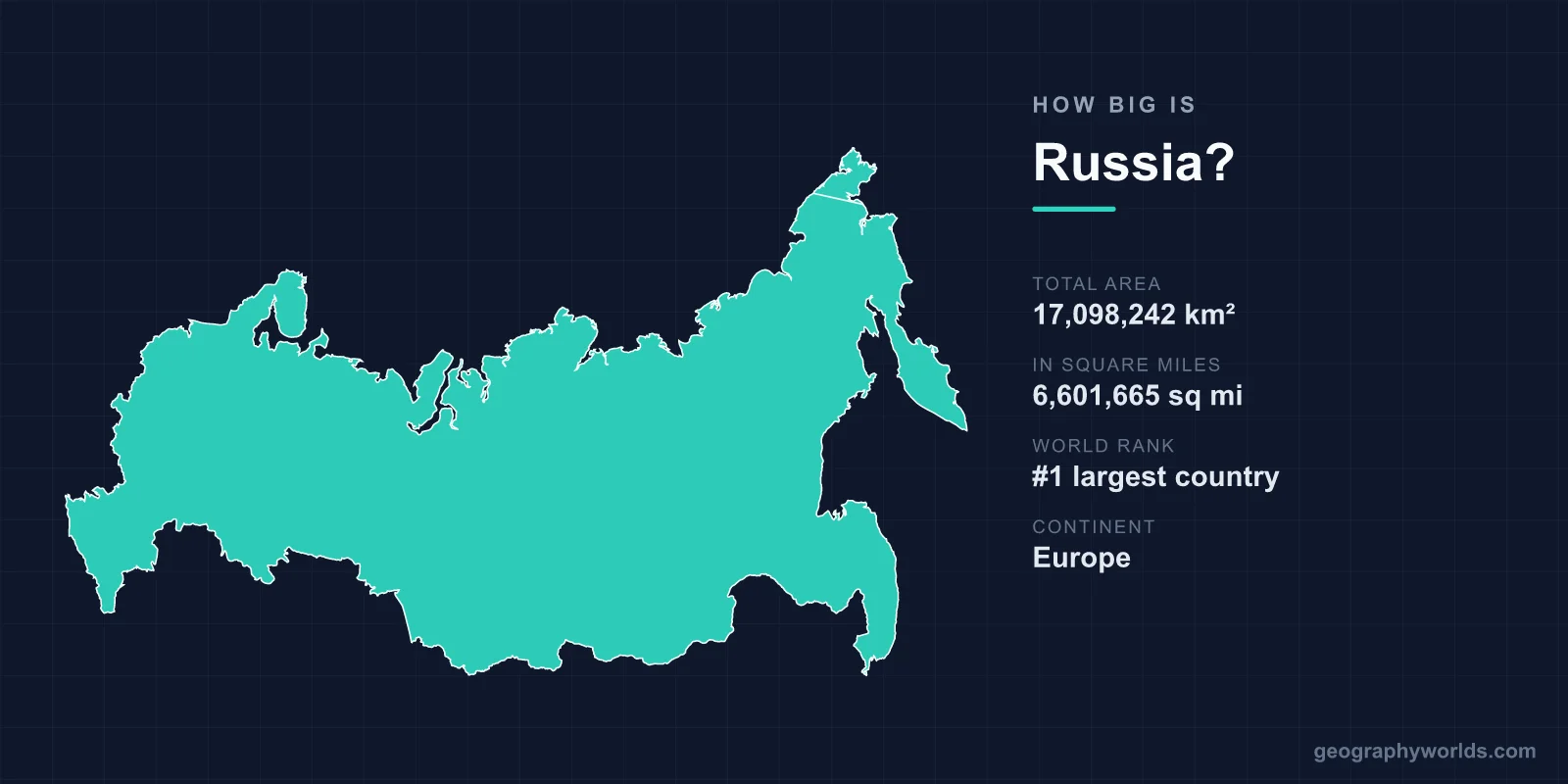
Russia covers an area of 17,098,242 km² (6,601,665 sq mi), making it the largest country in the world by total area — nearly twice the size of Canada, the second-largest nation. No other country comes close: Russia accounts for roughly 11.5% of the entire planet's land surface, sprawling across two continents and eleven time zones.
Just How Big Is 17 Million Square Kilometres?
Russia's total area of 17,098,242 km² is so vast that ordinary comparisons start to break down. The country occupies about 11.48% of all the land on Earth, more than any other single nation. Stretched out, Russia measures roughly 10,000 km from its western border with the Baltic states to the Pacific coast in the east, and about 4,000 km from the Arctic tundra in the north to the Caucasus Mountains in the south.
To make that figure tangible: you could fit the entire United Kingdom (243,610 km²) inside Russia around 70 times. Russia's surface area is even larger than that of the dwarf planet Pluto. Its forests alone cover more ground than the entire contiguous United States, and its Asian region — Siberia — is by itself larger than the whole of the European Union.
One Country, Eleven Time Zones
Few statistics capture Russia's scale better than its time zones. The country spans 11 of them, more than any other nation on Earth. When office workers in Kaliningrad on the Baltic coast are starting their morning, residents of the Kamchatka Peninsula in the Far East are already winding down their evening. The straight-line distance between these two extremes is greater than the distance from London to Tokyo.
The famous Trans-Siberian Railway, which runs 9,289 km from Moscow to the Pacific port of Vladivostok, crosses seven of these time zones. A single end-to-end journey takes about a week, offering one of the clearest illustrations of just how far Russia extends from west to east.
How Russia Compares to Other Giants
Russia sits at the top of the global size rankings, and the gap behind it is enormous:
- Russia: 17,098,242 km² — nearly double the runner-up.
- Canada: about 9,985,000 km² — the second-largest country.
- United States and China: each roughly 9,600,000 km².
- Brazil: about 8,516,000 km², rounding out the top five.
Put another way, Russia is larger than the combined area of the next two countries on the list would be if you stacked a good chunk of one on top of the other. It is the only country that meaningfully straddles both Europe and Asia, with the Ural Mountains traditionally marking the dividing line between the two continents.
The Landscapes That Fill the Map
A country this size inevitably contains a remarkable range of terrain and climate. Vast plains dominate European Russia in the west, giving way to the seemingly endless taiga forests of Siberia and the frozen tundra of the Arctic north. The continental and subarctic climates produce dramatic swings, from below -50°C in Siberian winters to summer highs above 30°C in the south. Only the Black Sea coast enjoys a mild, almost subtropical climate.
Russia's highest point is Mount Elbrus in the Caucasus, rising to 5,642 m (18,510 ft) — also the highest peak in Europe. Its 37,653 km coastline touches the Arctic and Pacific Oceans and several seas. Among its natural wonders is Lake Baikal, the world's deepest and oldest freshwater lake, which holds roughly 20% of all the unfrozen freshwater on the planet. The volcanic Kamchatka Peninsula, home to Eurasia's tallest active volcano, marks the country's dramatic eastern edge. For a fuller picture of the country's regions, climate and culture, see our russia country guide.
A Nation Defined by Its Borders
Russia's enormous footprint also gives it an exceptional number of neighbours. It shares land borders with 14 countries — tied with China for the most of any nation in the world. These range from Norway and Finland in the northwest to Kazakhstan, Mongolia, and China across its long southern frontier, and even a short maritime proximity to the United States across the Bering Strait. Managing borders of this length across such varied terrain is a logistical challenge unmatched anywhere else.
Frequently Asked Questions
Is Russia the biggest country in the world?
Yes. At 17,098,242 km², Russia is comfortably the largest country on Earth by total area — about 70% larger than Canada, which ranks second. It has held the top spot throughout modern history.
How does Russia compare to Canada in size?
Russia is nearly twice the size of Canada. Canada covers roughly 9,985,000 km², while Russia covers more than 17 million km², a difference of over 7 million km² — itself larger than the entire area of Australia.
How many time zones does Russia have?
Russia spans 11 time zones, more than any other country in the world. The full breadth means the sun can be rising in one part of the country while it is already setting in another.
Is Russia in Europe or Asia?
Both. Russia is a transcontinental country. The smaller western portion lies in Europe, while the larger eastern portion — Siberia and the Far East — lies in Asia. The Ural Mountains are the conventional boundary between the two.