

Germany is called Germany because English took its name from the Latin Germania, the word Julius Caesar put into writing in the 50s BC for the peoples living east of the Rhine; the Romans probably borrowed Germani from the Gauls, and what the word originally meant is disputed. Germans themselves never used it. Their own name, Deutschland, comes from Old High German diutisc, "of the people", and the neighbours who met different tribes at different borders produced a set of names for one country that is wider than for any other European nation: Allemagne in French, Saksa in Finnish, Niemcy in Polish and Vokietija in Lithuanian.
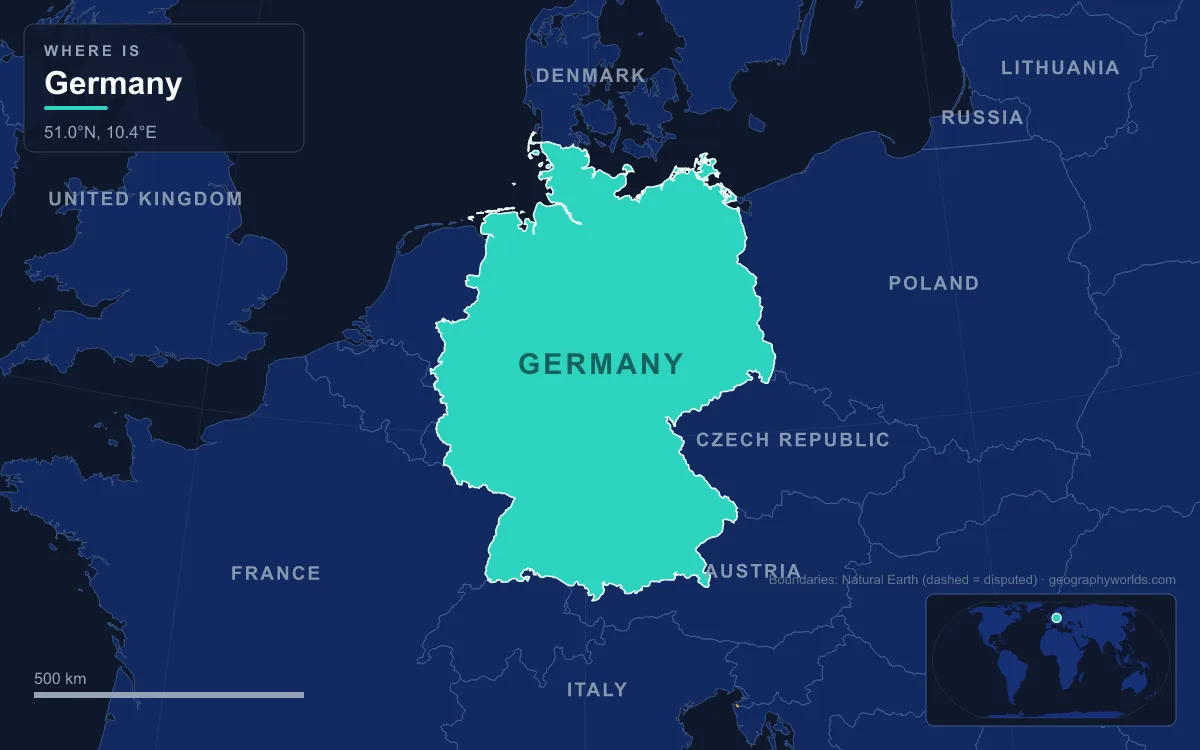
The variety has a simple cause. A single German nation-state only existed from 1871, and for most of the two thousand years before that the land between the Rhine and the Oder was a patchwork of tribes, duchies and principalities. Each neighbour named the whole country after the group it happened to know best, and those first encounters stuck in the language long after the political map changed. The list below works outward from the name Germans use, through the Latin name English inherited, to the names given by the French, the Finns, the Slavs, the Balts and finally the languages of East Asia.
Deutschland: the name Germans gave themselves
The endonym starts with a Proto-Germanic word, *þiudiskaz, meaning "of the people". It was built on *þeudō, "people" or "folk", which goes back to the Proto-Indo-European *tewtéh₂-; the same root survives in Lithuanian and Latvian tauta and Old Irish tuath. The adjective was first used to tell the everyday speech of ordinary people apart from Latin and the Romance dialects that grew out of it.
Historians think the word was coined among the West Franks in what is now northern France. Until the 8th century the Franks called their own language frengisk, but once Frankish rulers sat among Latin speakers that label became ambiguous, and a new word was needed for the Germanic tongue. It survives only in its Latinised form, theodiscus. Further east, in the lands that became Germany, people adopted the word slowly, and only from about the 10th century did forms such as diutsch appear as a description of themselves.
One early example comes from the Sachsenspiegel, the law book compiled by Eike of Repgow between about 1220 and 1235 and the first comprehensive law code written in Middle Low German rather than Latin. It declares that "every German land" (iewelk düdesch lant) has its own count palatine, naming Saxony, Bavaria, Franconia and Swabia. The country name came from the phrase diutisciu land, "the German lands", plural, which reflects that patchwork. A related spelling, Teutschland, stayed in use in some areas until the 19th century before the modern Deutschland settled into place.

Neighbours who borrowed this word did not always apply it to Germany. Italian uses tedesco for "German" while calling the country Germania. English took a cousin of the word, Dutch, and over time narrowed it to people from the Netherlands. Swedish, Danish and Norwegian Tyskland and Dutch Duitsland belong to the same family. The tribe called the Teutoni probably shares the root, which is how English acquired "Teuton" (first recorded in 1530) and the Teutonic Knights.
Germania: Caesar's word for the peoples beyond the Rhine
The English name has a different origin. The Germanic tribes did not call themselves Germani; the word was most likely applied by the Gauls to people who had crossed to the east of the Rhine, and the Romans picked it up. Julius Caesar is the first writer known to use it, in his Commentarii de Bello Gallico. He records that four northern Belgic tribes, the Condrusi, Eburones, Caeraesi and Paemani, were collectively known as Germani. In AD 98 the historian Tacitus wrote the ethnographic work now called the Germania, and claimed instead that the name was first given to the Tungri tribe.

Nobody knows for certain what Germani meant. The Oxford English Dictionary records several Celtic theories. The historian and Celtic philologist Johann Zeuss linked it to gair, "neighbour" (Old Irish has gair in that sense). Johann Wachter and Jacob Grimm preferred gairm, "battle-cry". Others suggested ger, "spear", a theory the etymologist Eric Partridge called obsolete; he proposed *gar, "to shout", which would make the Germani the noisy people. None of these has won general agreement. The word is also unrelated to the English adjective "germane", which comes from Latin germanus, "having the same parents".
English was slow to adopt it. Until the 16th century the usual words were "Almain" and "Alman", borrowed from French. "German" is first attested in 1520 and gradually replaced them, perhaps because "Dutch" was increasingly reserved for the people of the Low Countries. Russian and Bulgarian also use Germaniya for the country, as do Italian and Romansh.
Allemagne and Alemania: the Alemanni of the upper Rhine
France met a different group first. The Alemanni were a Suebic tribe or confederation living in what is now Alsace, parts of Baden-Württemberg and Switzerland, directly across the Rhine from Gaul. French Allemagne, Spanish Alemania, Portuguese Alemanha and Turkish Almanya all descend from their name, and the Arabic name for Germany also comes from either the Latin Germania or the Alemanni.
English carried both traditions for a while. In Othello, written about 1603, Shakespeare has Iago boast in a single speech that the English outdrink both "your German" and "your Almain". The Alemannic name also left the dance called the allemande and the Almain rivet. Today Alemannic German is a group of dialects spoken by about ten million people in six countries. French colonial contact took the name further: in the Anishinaabe languages of North America, the most common word for a German is Aanimaa, originally Aalimaanh, from French Allemand.
Saksa and Saksamaa: the Saxons seen from across the Baltic
For Finns and Estonians, the Germans they met first were Saxons, a tribe associated with the region between the valleys of the Elbe and the Weser. Finnish calls Germany Saksa and Estonian Saksamaa, "Saxon land". Over the centuries, words that once applied only to the ancient Saxons widened in both languages to cover the whole country and all its people. The tribal name, Proto-Germanic *sakhsan, is usually tied to the seax, a single-edged knife, making a Saxon literally a swordsman, though a link to the word "axe" has also been proposed.
The same tribe gave Celtic languages their words for the English, because the Saxons who crossed the North Sea in the 5th century became part of the English nation. Scottish Sassenach, Welsh Sais, Cornish Sows and Breton Saoz all mean English, not German. The English county names Essex, Sussex, Wessex and Middlesex preserve the same word. A single tribal name therefore points to Germany from Helsinki and to England from Cardiff.
Niemcy and Németország: the Slavic name for "the mutes"
Slavic speakers chose a name that describes language rather than a tribe. Proto-Slavic němьcь, plural němьci, comes from the adjective němъ, "mute", and meant people who could not speak intelligibly. In early sources it covered Scandinavians, Finnic peoples and Romance speakers as well as Germans before narrowing to Germans alone. The Danish Slavicist John H. Lind suggested it began with a 9th-century quarrel in which Frankish clergy refused to pray in any language except Hebrew, Greek and Latin, earning themselves the label "mutes". A link to the Rhineland tribe called the Nemetes is considered unlikely for phonological reasons.
The results differ from language to language. Polish uses a plural of people, Niemcy, as the country name; Czech says Německo and Ukrainian Nimechchyna. Russian keeps nemetskiy for the adjective but calls the country Germaniya. Hungarian borrowed the Slavic word to form Németország, "Német land", and Romanian uses neamț alongside the official german. The word reached Arabic as an-Nimsā, which today means Austria, not Germany, because Arabs long regarded Austria as the land of the German people; Ottoman Turkish Nemçe followed the same path.
Vokietija, Doitsu and Déguó: Baltic puzzles and East Asian borrowings
The Baltic names are the least settled. Latvian Vācija and Lithuanian Vokietija contain a root vāca or vākiā. The Lithuanian linguist Kazimieras Būga connected it to the Vagoths, a Swedish tribe named in a 6th-century chronicle, which would mean the word first referred to Scandinavians. The Latvian linguist Konstantīns Karulis proposed a derivation from Indo-European *wek, "speak", describing neighbours whose speech was loud or incomprehensible, much like the Slavic idea.
East Asia borrowed the German endonym itself, but by two different routes. The Chinese name 德国 (Déguó) combines 德, short for 德意志 (déyìzhì, an approximation of Deutsch), with 国, "country"; Vietnamese Đức is the Sino-Vietnamese reading of the same character. Japanese ドイツ (Doitsu) is an approximation of the Dutch adjective duits, and South Korean 독일 (Dogil) is the Korean reading of the old Japanese characters 獨逸. North Korea now uses toich'willandŭ, which imitates the German pronunciation of Deutschland.
A few names stand outside every group: Navajo calls Germany "Metal Cap-wearer Land", after the steel helmets of German soldiers, and Kinyarwanda Ubudage is thought to come from the greeting guten Tag. Taken together, the names record which Germans each neighbour met first, which is why the story belongs alongside how the Franks gave their name to France and the similar spread of names explained in why Russia is called Russia. Many of those first meetings happened on the frontiers traced in the countries that border Germany, from the Alemannic Rhine to the Slavic east.