

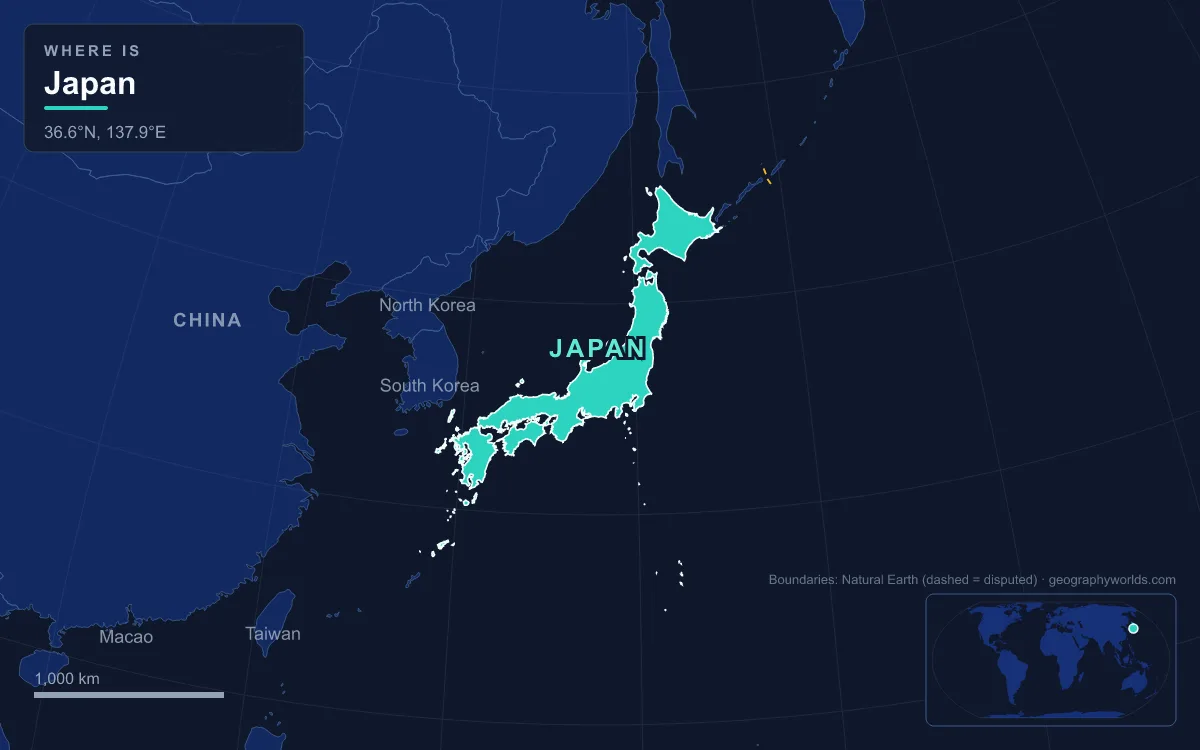
Japan is called Japan because European traders heard a Chinese pronunciation of the country’s own name, 日本, “origin of the sun”: the characters that Japanese reads as Nihon or Nippon were recorded by Marco Polo as Cipangu around 1300, picked up by Portuguese merchants in 16th-century Malacca from Malay Jepang and Jipang, and first written in English in 1577 as Giapan. So the English word and the Japanese one are, at bottom, the same two characters pronounced in different languages. The way each version arose says a good deal about who was trading with whom. Below, the Japanese name comes first, then the names given by China, by medieval travellers, by the Portuguese, and by Japan’s neighbours today.
Nihon and Nippon: How 日本 Became the Endonym
The name Japan uses for itself is written 日本. The first character, 日, means “sun” or “day”; the second, 本, means “base” or “origin”. Together they mean “the sun’s origin”, the place where the sun comes up, which is the source of the English phrase “Land of the Rising Sun”. The idea makes sense only from the west: seen from China, the sun rises over the islands.
The compound began as a native Japanese phrase, hi no moto, “the sun’s origin”, which scribes wrote with those two characters. Over time the characters were read with Sino-Japanese pronunciations instead. In Middle Chinese the final consonant of the first syllable was unreleased in compounds, so 日本 came out as Nippon or Jippon. Nihon developed later, probably in the Kantō region during the Edo period, when the separate pronunciation of 本 was reintroduced into the compound. The Japanese government has rejected several attempts to choose one reading and treats both as correct.
In practice there are habits rather than rules. Nippon tends to be used for official purposes, including banknotes, stamps and international sport, where crowds cheer Ganbare Nippon! The banknotes read NIPPON GINKO, though the media usually say Nihon Ginkō for the Bank of Japan. Nihon is normal in Nihongo (the Japanese language), Nihonjin (Japanese people) and Nihon-kai (the Sea of Japan). In 2016 element 113 was named nihonium after its discovery at the RIKEN institute in 2004. Place and company names show the same split. Nihonbashi, written 日本橋, is a bridge in Tokyo, while the shopping district written with exactly the same characters in Osaka is Nipponbashi. The ancient chronicle 日本書紀 is always the Nihon Shoki, never the Nippon Shoki, but All Nippon Airways, Nippon Steel and Nikon, a contraction of Nippon Kōgaku Kōgyō, use the other reading. Japan Airlines is Nihon Kōkū in Japanese. The formal name is Nippon-koku or Nihon-koku, “State of Japan”; in English the country is simply “Japan”, one of the few states with no long-form name. Under the Meiji constitution it had been Dai Nippon Teikoku, the Empire of Great Japan. The sun in the name is echoed by the red disc on the national flag, described in our article on the history and meaning of the flag of Japan.
Wa and Yamato: The Name China Gave First
Before 日本, the oldest written name for Japan was a Chinese exonym. Early Chinese histories call the people of the archipelago, perhaps of Kyūshū, Wa (倭), and the country Wakoku (倭國). The origin of the word is uncertain. The scholar Carr surveyed the proposals in 1992, ranging from a transcription of Japanese first-person pronouns such as waga, “our”, to readings of the character as “submissive” or “dwarf”. The “submissive” sense goes back to the Shuowen Jiezi dictionary of 121 CE, which defines 倭 as “obedient appearance”; Carr argued that the “little people” reading was a later development.
Chinese, Korean and Japanese scribes all wrote the name with 倭 until the 8th century, when Japanese writers objected to its connotations and replaced it with the homophone 和, meaning “harmony” or “peace”. Combined with 大, “great”, it gave 大和, read Yamato. That reading cannot be built from the characters’ sounds: Yamato was the name of a place in Japan, possibly meaning “mountain place”, and the characters were simply assigned to it. The alternative Sino-Japanese reading of 大和, Daiwa, is still widely used in company names.
The switch to 日本 came out of diplomacy with China. In 607, according to the official history of the Sui dynasty, Prince Shōtoku sent a letter addressed from “the Son of Heaven of the Land where the Sun rises” to “the Son of Heaven of the Land where the Sun sets”. The earliest physical example of 日本 is an epitaph of a man named Yegun from Paekche, believed to date from about 678 and discovered in 2011; some historians, including Haruyuki Tono, argue that in that text the word referred to Paekche rather than Japan. The Old Book of Tang, compiled in 945, records that a Japanese envoy disliked the name Wa and changed it to 日本, and it has been suggested that the change in Japan took place between 665 and 703, with Empress Wu Zetian accepting it in China after a Japanese delegation asked for it in 703. Another 8th-century chronicle, the True Meaning of Shiji, tells the story the other way round, saying that Wu Zetian herself ordered a Japanese envoy to change the name. China’s own very different naming history is told in our article on why China is called China.
Cipangu: Marco Polo and the Fra Mauro Map
The European chain begins with a traveller who never went to Japan. Around 1300 Marco Polo described an island he called Cipangu, based on a Chinese pronunciation of 日本國, “sun-origin country”, probably from early Mandarin or from Wu Chinese. Earlier still, in 1076, the Turkic scholar Mahmud al-Kashgari had listed the country as Jabarqa in his dictionary Dīwān Lughāt al-Turk.

Polo’s Cipangu was said to be fabulously rich in gold and silver, a reputation that was not far wrong by medieval standards, because volcanic geology put precious ores close to the surface. The name first appears on a European map in the Fra Mauro map, made in Venice around 1450, though Chinese and Korean maps such as the Gangnido had shown the islands much earlier. In modern Japanese the word comes back as a borrowing, ジパング, Jipangu or Zipangu, used as a fashionable alternative name in films, anime and video games.
Jepang, Giapan and Iapam: The Malay and Portuguese Route
The form that actually produced the English word came by sea. Southern Chinese languages pronounce 日本 with a sound close to the old Japanese reading: Shanghainese says Zeppen, Hokkien Ji̍tpún, Cantonese Yahtbún. Malay traders borrowed these as Jepang, Jipang and Jepun. In the 16th century Portuguese merchants in Malacca, on the Malay Peninsula, heard those words and are thought to have been the first to bring the name to Europe. English recorded it in 1577, spelled Giapan.
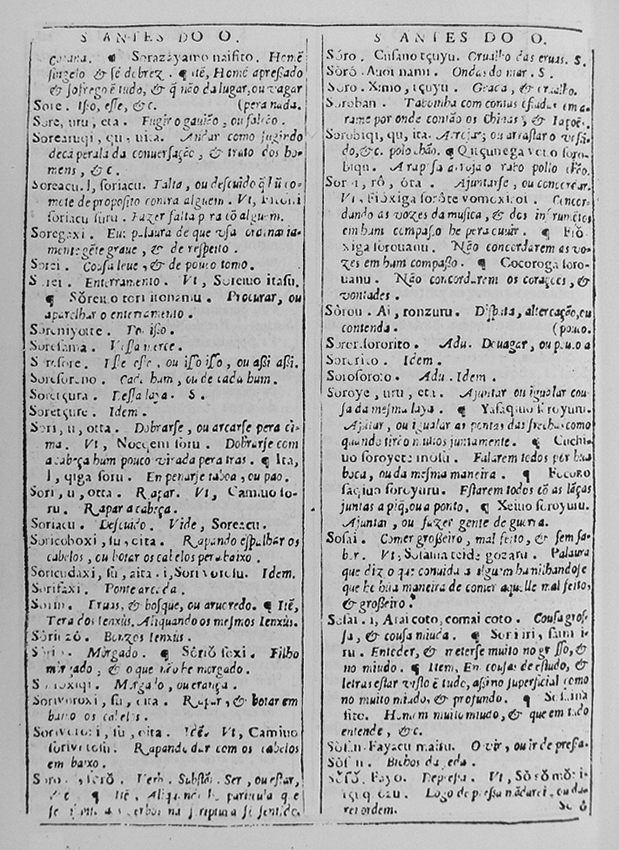
The Portuguese then arrived in Japan itself and recorded the native forms too. Jesuit missionaries compiled brief grammars and dictionaries of Middle Japanese for the purpose of trade, and the Vocabvlario da Lingoa de Iapam, published in 1603–1604, has two entries for the country: nifon and iippon. The spelling nifon preserves a stage in the history of Japanese sound: the consonant now written h was originally p, weakened to an f-like sound, and only later became h. The dictionary’s own title shows that by then the Portuguese name for the country was Iapam, and that is the form, via Portuguese, behind the European “Japan”.
Ilbon, Nhật Bản and Rìběn: Japan’s Name Across East Asia
Japan’s neighbours mostly kept the characters and changed the sounds. Korean reads 日本 as Ilbon (일본), Vietnamese as Nhật Bản, and Mandarin as Rìběn. Thai has Yipun (ญี่ปุ่น), influenced by southern Chinese pronunciations, and Mongolian has Yapon. In Malay the country is Jepun, while Jepang survives mainly in Indonesian; during the Japanese occupation of 1942–1945 the occupiers promoted Nippon and Dai Nippon in Indonesia, but Jepang remained more common. The old exonym also lingers: older Hokkien speakers recorded Ue-kok (倭國), and Korea once said Waeguk.
Japan also has a stock of classical names used in poetry and mythology. Ōyashima, “Great Country of Eight Islands”, refers to the islands created by the gods Izanagi and Izanami. The eight were Awaji, Iyo (later Shikoku), Oki, Tsukushi (later Kyūshū), Iki, Tsushima, Sado and Yamato (later Honshū); Hokkaidō and Okinawa were not part of Japan in ancient times, and the north of the archipelago was home to the Ainu. Akitsushima can be read as “Dragonfly Island”, since akitsu is an archaic word for dragonfly, and Shikishima began as the name of a district of Yamato Province where early emperors lived before it was extended, in poetry, to the whole country. Mizuho no kuni means “country of lush ears of rice”, and Fusō was a mythical land east of China that became a poetic name for Japan. Chinese writers still sometimes use Dōngyíng, “Eastern Ocean”, as a positive poetic name.
Today the English word has even come home. Japanese companies seeking an international image use the katakana ジャパン, as in the Japan Cup and Japan Net Bank. The name has thus made a full circle: a Japanese phrase written in Chinese characters, read aloud in Chinese, borrowed by Malay, spelled by the Portuguese, adopted by English and borrowed back into Japanese. For how the two countries at either end of the chain compare today, see our China vs Japan comparison.