
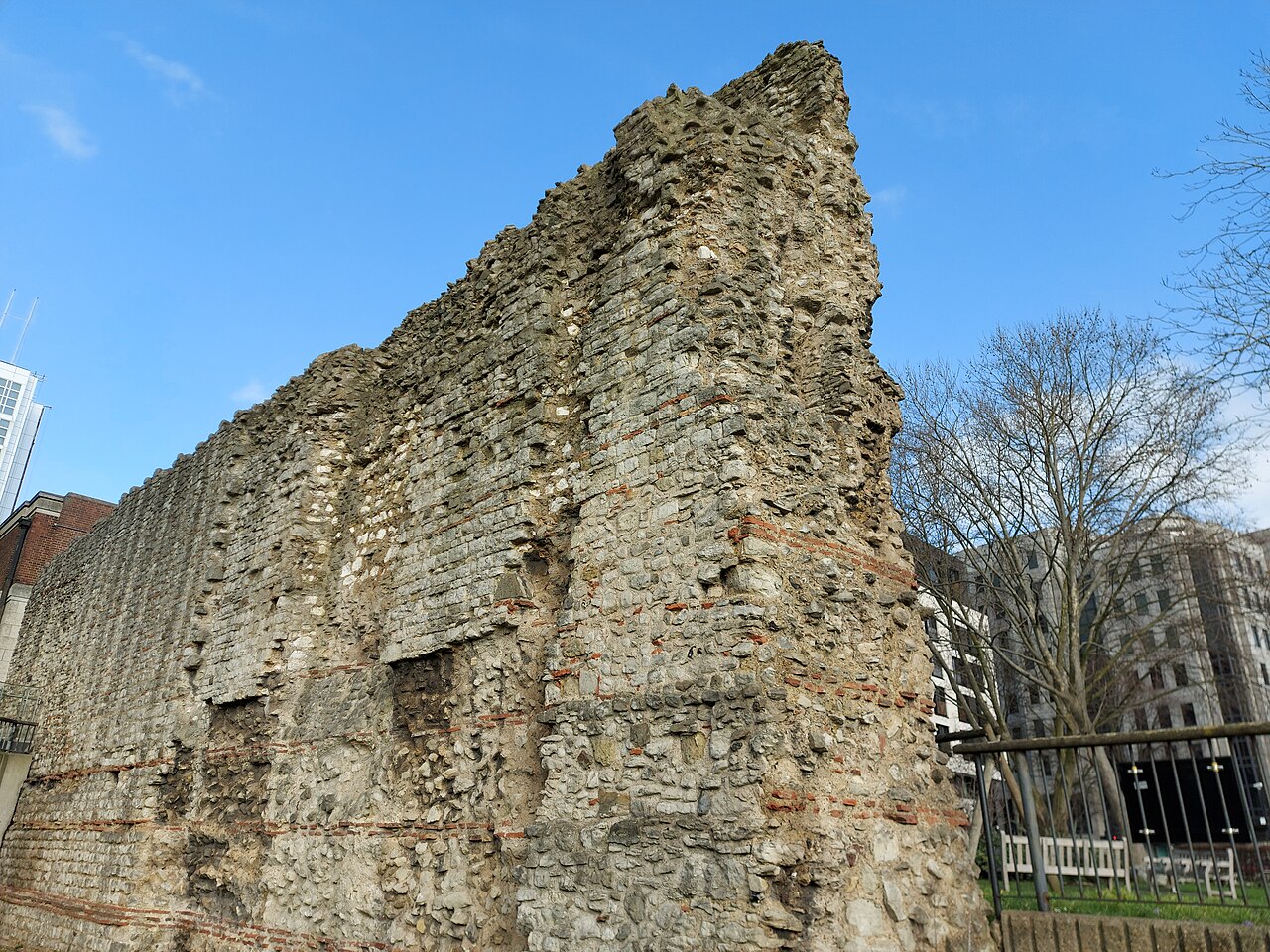
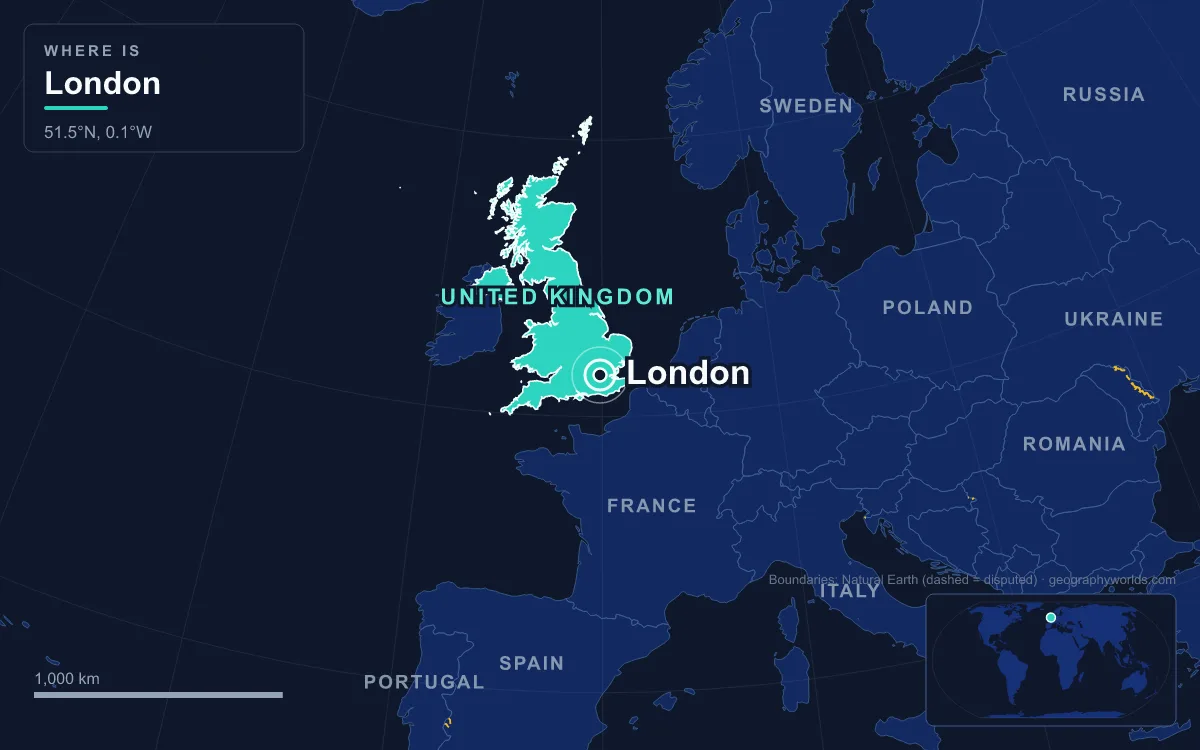
London takes its name from the Latin Londinium, which the Romans borrowed from an older Brittonic (Celtic) place name reconstructed as *Londinjon or *Londonjon. What that word meant is genuinely disputed. Recent scholarship leans towards a Brittonic origin, and one prominent reading, put forward by the linguist Peter Schrijver in 2013 and paralleled by Theodora Bynon in 2016, derives it from a Celtic root meaning "to sink", giving roughly "the place that floods", a fitting name for a tidal crossing on the Thames. The popular story that the city is named after a King Lud has no linguistic basis. The name has passed through at least five recorded forms in nearly two thousand years, and each layer tells part of the story.
Londinio, AD 65–80: the oldest written form, from the Bloomberg dig
The oldest surviving use of the name was not found in a book but in the mud of the Walbrook, the buried stream that once ran through the Roman town. Between 2010 and 2013, archaeologists excavating the site of the Bloomberg building in the City of London recovered 405 wooden writing tablets, preserved because the waterlogged ground kept oxygen away from the wood. They date from roughly AD 50 to 80, which makes them the earliest written documents found in Britain, older than the Vindolanda tablets from Hadrian's Wall.
One of them, dated AD 65–80 and made public in 2016, carries an address: Londinio Mogontio, "In London, to Mogontius". That single word, Londinio, is a Latin locative form of Londinium scratched by a writer who lived in the town within a generation of its founding. Most historians now place that founding at around AD 47–50, shortly after the Claudian invasion of 43; the earliest securely dated structure is a timber drain from AD 47. The settlement grew at a ford on the Thames, and a port was built between 49 and 52, so the name was in daily commercial use almost from the start.
Londinium and Λονδίνιον: the name in Tacitus and the Greek sources
Before that find, the earliest known mention was in the historian Tacitus, writing in the early 2nd century about the revolt of Boudica, queen of the Iceni, in AD 60 or 61. He described Londinium as not a formal colony but a place "much frequented by a number of merchants and trading vessels". Boudica's army burned it; the Romans rebuilt it, and by about AD 100 its population may have reached between 30,000 and 60,000, making it the largest town in Britannia and, in all likelihood, the provincial capital in place of Camulodunum (Colchester).
The linguist Richard Coates, in a 1998 article, collected every known occurrence of the name up to about the year 900 in Greek, Latin, British and Anglo-Saxon sources. Most of the older ones begin with Londin-: Greek Λονδίνιον (Londínion), Latin Londino and Londinium, with a few in Lundin-. Coates argued that the vowels in these early spellings were long, and that the Latin ending -inium, which appears in every source before 600, points back to a British double suffix -in-jo-n. That suffix is the first clue that the Romans were not inventing a name but writing down one that local Britons already used.

Augusta, by AD 368: the Roman rename that did not last
For a period in the 4th century, London officially had a different name. After the reforms of Diocletian around 300, the town became the seat of the diocesan vicar and of one of the provincial governors, and by 368 it had been renamed Augusta, an honorific epithet commonly given to provincial capitals. When the Great Conspiracy of 367 brought Picts, Gaels and Saxons into Britain together, the general Count Theodosius used Londinium, then known as Augusta, as his base to restore order.
The new name was imperial branding rather than a replacement in everyday speech, and it vanished with Roman rule. By the middle of the 5th century Roman administration had collapsed, and by about 457 the walled town appears to have been almost completely abandoned. Yet Londinium, not Augusta, is what survived, which suggests the native name never stopped being used by the people who lived in and around it. The 9th-century Historia Brittonum, in its list of the 28 cities of Britain, records the place in Old Welsh as Cair Lundem or Lundein.
Lundenwic and Lundenburh: the Saxon names, 670s to 886
The Anglo-Saxons who settled the Thames valley at first avoided the ruined Roman town. By the 670s they had built a trading port about a mile to the west, around today's Covent Garden and north of the Strand. They called it Lundenwic, adding the Old English suffix wic, "trading town", to the inherited name. In the early 8th century the scholar Bede called it "a mart of many peoples coming by land and sea". Kings of Mercia controlled it from about 670, and in 604 Mellitus had been consecrated as the first Bishop of London of the Saxon period; he founded the first St Paul's Cathedral inside the old walls.
Viking raids from the 830s changed the map. A Viking army is believed to have wintered inside the Roman walls in 871, and when Alfred the Great re-established English control in 886 he repaired those walls and recut the ditch. The population moved back into the defended Roman city, which now became Lundenburh, with burh meaning a fortified town. That move is usually counted as the start of the history of the City of London as a distinct place. The abandoned trading settlement to the west became known as Ealdwic, "old settlement", a name that survives as Aldwych, the crescent of road at the eastern end of the Strand.
London with an o: Lunden, Llundain and Lunnon
Every Anglo-Saxon example in Coates's list is spelled Lunden- with various endings, and the Welsh name is Llundain. These forms raise a puzzle. If the Britons had really said *Londinjon, the regular sound changes of each language should have produced Old English *Lynden (through a process called i-mutation) and Welsh *Lunnen. Neither form exists. Coates tentatively accepted an older argument by the Celticist Jackson (1938) that the British form had -on-jo-n rather than -in-jo-n.
Schrijver offered two other explanations in 2013. Either a local Lowland British dialect of Celtic had already changed the sounds to something like Lundeinjon, or the Latin spoken by Romanised Britons had shifted Londinium to Lundeiniu and then Lundein, in the same way that Latin developed in Gaul. In both cases the Welsh and English names were borrowed from that local pronunciation rather than from textbook Latin. The modern spelling with an o is a much later accident: Coates notes that medieval scribes avoided writing u next to letters made of short vertical strokes, called minims, because a run of them was hard to read.
Other languages took the name in their own direction. French, Spanish and Portuguese say Londres, Italian Londra, Czech and Slovak Londýn, Polish Londyn, and Scots Lunnon, while Welsh keeps Llundain. All of them descend from the same Roman-era name.
From *Londinjon to *Plowonida: what the root might mean
The Celtic readings
Surveys of the specialist literature find that, as of 2017, the trend in scholarly publications supports a Brittonic origin. Within that consensus there are rival meanings. In 1899 the French scholar Henri d'Arbois de Jubainville proposed "the fortress of Londinos", from a Celtic word *londo-, "fierce". Coates objected that no such personal name is recorded and that the vowel in *londo- is short. Schrijver revived the root in 2013 with a different sense: the Proto-Indo-European *lendh-, "to sink", which gave the Celtic noun *londos. Adding the suffix *-injo- yields *londinjon, "a place that floods periodically or tidally". Bynon reached a similar Celtic etymology in 2016 and showed that the name passed into the West Germanic ancestor of Old English before Old English itself existed.
Coates's own 1998 theory is the most ambitious. He reconstructed a Brittonic *Lōondonjon and traced it to a pre-Celtic river name, *Plowonida, applied to the stretch of the Thames near London where the river becomes too wide to ford. Its roots would be the Indo-European *plew-, "to flow, swim", and *nejd-, "to flow". A settlement on that stretch would then be *Plowonidonjon, which Insular Celtic, having lost the initial p, would render as *Lowonidonjon. Coates admitted that compound river names are rare in Indo-European, and Lacey Wallace, author of The Origin of Roman London (2014), has called the derivation "somewhat tenuous".

Two non-Celtic proposals have had less success. Giovanni Alessio suggested in 1951 a Ligurian root *lond-, "mud" or "marsh", but there is no evidence that Ligurian was ever spoken in Britain. Jean-Gabriel Gigot proposed a Germanic root *lohna in 1974, comparing the French village of Saint-Martin-de-Londres, but most specialists reject a Germanic origin. What the serious theories share is the river: whether the name means a flooding place or a wide stretch of water, it points to the tidal Thames that made the site worth settling. Our guide to the River Thames follows that river from its source in the Cotswolds to the estuary.
King Lud and other folk etymologies
The oldest explanation is also the least reliable. In his 12th-century Historia Regum Britanniae, Geoffrey of Monmouth claimed that a King Lud seized a city called Trinovantum and renamed it Kaerlud in his own honour, which supposedly wore down to Karelundein and then London. There is no evidence that Lud existed, and the derivation does not fit any sound law.
Later writers added more. The once-popular Welsh Llyn din, "lake fort", fails because llyn comes from British *lind-, which cannot produce the early spellings. William Camden is reported to have suggested lhwn, "grove", giving "city in the grove". Correspondents to Notes and Queries in December 1851 offered "city of the moon" and "temple of Diana", imagining a temple on the site of St Paul's. Some British Israelites read it as Hebrew lan-dan, "abode of Dan", and an 1887 travellers' handbook claimed London shared its origin with Lincoln, Latin Lindum. None of these has support among linguists.
So the layers run from Londinio on a wax tablet to Londinium, Augusta, Lundenwic, Lundenburh and finally London, while the root underneath them stays partly hidden. For how the capital grew from those Roman walls into a modern capital, see our profile of London as the capital of the United Kingdom, and for a Celtic tribal name with a similarly debated meaning on the other side of the Channel, read where the name Paris comes from.