

The River Thames is England's longest river at approximately 346 kilometers, flowing from its source in the Cotswold Hills of Gloucestershire through the heart of London to the North Sea. While modest in size compared to the world's great rivers, the Thames is arguably the most historically and culturally important river in the English-speaking world.
Introduction
For over 2,000 years, the Thames has shaped the history of England and the world. Roman Londinium was founded on its banks, the Tower of London guards its shores, and the Palace of Westminster stands beside it. The Thames is also one of the great ecological comeback stories, having recovered from biological death in the 1950s to support over 125 fish species today.
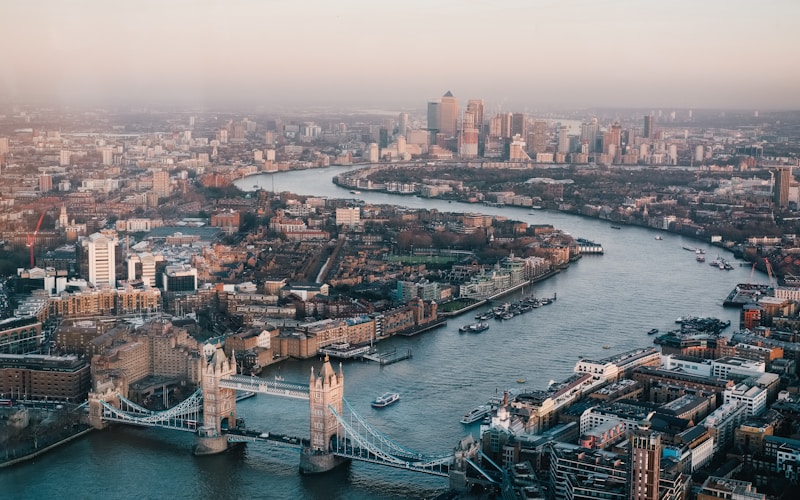
Source to Sea
- Length: ~346 km
- Source: Thames Head, near Kemble, Gloucestershire (~110 m elevation)
- Mouth: North Sea, Thames Estuary
The Thames begins as a seasonal spring at Thames Head in the Cotswolds, though the nearby Seven Springs is sometimes claimed as the true source. The river flows eastward through the English countryside, passing through Oxford, Reading, and Windsor before entering Greater London and reaching the North Sea through the Thames Estuary.
The tidal section of the Thames extends from the estuary upstream to Teddington Lock in southwest London, a distance of about 100 kilometers. The Thames Barrier, completed in 1984, protects London from storm surges. It has been raised over 200 times since its construction, and rising sea levels may eventually necessitate a replacement.
Geography & Course
- Basin Area: ~12,935 km²
- Tidal Reach: Up to Teddington Lock (~100 km from the sea)
- Major Tributaries: Churn, Kennet, Lea, Medway, Cherwell
The Thames Basin covers much of southern England and is the most densely populated river basin in the United Kingdom. The river passes through or near several major towns and cities, including Oxford (where it is known locally as the Isis), Reading, Henley-on-Thames, and Windsor. London, one of the world's great cities, grew up at the lowest point where the Thames could be bridged by the Romans.
The Thames Estuary, where the river meets the North Sea, is a major ecological zone supporting large populations of wading birds and fish. The estuary has important commercial significance, with the Port of London and the Tilbury container terminal handling a substantial portion of the UK's trade.
Climate & Hydrology
- Average Discharge: ~66 m³/s (modest)
- Tidal Range: Up to 7 m at London Bridge
- Flood Risk: Thames Barrier protects London from storm surges
The Thames has a relatively stable, rainfall-fed flow regime typical of southern English rivers. Its discharge is modest — about 66 cubic meters per second on average — making it small compared to continental European rivers. However, its tidal section has a range of up to 7 meters at London Bridge, creating powerful tidal currents.
Climate change is increasing both flood and drought risks on the Thames. Winter rainfall is intensifying, increasing flood risk, while summer flows are projected to decrease by up to 80 percent by 2080 under some scenarios. The Thames Barrier, designed to protect against a 1-in-1,000-year event, may need to be replaced by a new structure further downstream by 2070.
Ecology & Wildlife
- Fish Species: ~125 species now present (up from zero in 1957)
- Seals: Both grey and harbor seals live in the Thames Estuary
- Conservation: One of the world's greatest river restoration success stories
The Thames's ecological recovery is one of the most remarkable in the world. In 1957, the river through London was declared "biologically dead" — no fish, no oxygen, and reeking of sewage. Massive investment in sewage treatment, beginning in the 1960s, has restored the river to health. Today, over 125 fish species have been recorded, including returning seahorses, seals, and even occasional dolphins.
The Thames Estuary supports important populations of wading birds, including avocets, dunlins, and redshanks. Saltmarsh habitats in the outer estuary are being restored and created as part of managed retreat programs. The river's upper reaches provide habitat for otters, water voles, and kingfishers, all of which have returned after decades of absence.
Human Geography & History
- Population in Basin: ~15 million people
- Historical Significance: Roman Londinium, Tower of London, Houses of Parliament
- Cultural Legacy: Dickens, Monet, Wind in the Willows, James Bond
The Thames has been central to English history since the Romans founded Londinium at the first point where the river could be bridged, around 43 CE. The Tower of London, built by William the Conqueror in 1066, has guarded the river for nearly a millennium. The Houses of Parliament, Buckingham Palace, Hampton Court, and Windsor Castle all stand on or near the Thames.
The Thames has inspired some of the greatest works of English literature and art. Charles Dickens set many scenes on its foggy banks, Kenneth Grahame's "The Wind in the Willows" evokes its rural upper reaches, and Claude Monet painted its misty London stretches. The Oxford-Cambridge Boat Race, held annually on the Thames since 1829, is one of the world's oldest sporting events.
Key Facts
- The Thames is England's longest river at approximately 346 km.
- It was declared "biologically dead" in 1957 but now supports over 125 fish species.
- The Thames Barrier has been raised over 200 times to protect London from flooding.
- London was founded by the Romans at the first bridgeable point on the Thames around 43 CE.
- The Thames Basin is home to approximately 15 million people.
Fun Facts
- Grey and harbor seals now live in the Thames Estuary, and dolphins have been spotted near central London.
- The Thames has frozen solid several times in history; "Frost Fairs" were held on the ice, the last in 1814.
- The Thames Tideway Tunnel, a 25-km "super sewer" completed in 2025, diverts sewage overflow from the river.
- The Oxford-Cambridge Boat Race on the Thames has been held since 1829, making it one of the world's oldest sporting events.
Final Thoughts
The River Thames may be small by global standards, but its influence on world history is immeasurable. From Roman Londinium to the British Empire, from Dickens to the Houses of Parliament, the Thames has shaped the English-speaking world. Its ecological recovery from biological death to thriving ecosystem is a beacon of hope for polluted rivers worldwide.
Test Your Knowledge!
Think you know the world's rivers? Test your knowledge!
Play Geography Games →