

Russia is called Russia after the Rus’ (Русь), the Scandinavian Varangians who founded the medieval state of Kievan Rus’; their name most likely comes from an Old Norse word for “the men who row” (rods-), and “Russia” is a Hellenised form of it, taken from Byzantine Greek Rhōsía (Ῥωσία) through Medieval Latin. The Norse derivation is the mainstream view; alternative Slavic and Iranian etymologies exist but are considered unlikely in Western scholarship. The name has also been formally rebuilt many times: the state on Russian soil has officially been the Tsardom of Russia, the Russian Empire, the Russian Republic, the Russian Soviet Federative Socialist Republic, a member of the Soviet Union and, since 25 December 1991, the Russian Federation. This article follows those official names in order, with the date, the document and the people behind each change.
839 to 912: The Rhos, the Rus’ and Oleg’s Treaty
The first time the name appears in a dated source it is attached to Scandinavians, not Slavs. The Annales Bertiniani record that in 839 a Byzantine delegation reached the court of the Frankish emperor Louis the Pious at Ingelheim am Rhein with two men who said they were called “Rhos” (Rhos vocari dicebant). Louis asked about them, learned that they were Swedes, suspected them of spying and had them detained. In the 860s the Byzantine Patriarch Photius also wrote of the “Rhos”, and Arab writers such as Ahmad ibn Fadlan, who met traders he called Rūs on the Volga, used the same name.
The Norse explanation ties the name to the way these people travelled. Rowing was the main way of moving along the rivers of Eastern Europe, and the proposed root rods-, “rowing”, may be linked to Roslagen, a coastal area of Sweden once known as Roden. The strongest support is linguistic: the Finnish, Estonian, Võro and Northern Sami names for Sweden are Ruotsi, Rootsi, Roodsi and Ruoŧŧa, all from the same source, and in the Komi language the matching word Roć has come to mean Russia and Russian instead.
Other explanations were put forward by the “anti-Normanist” school of 19th-century and Soviet historiography, which preferred a native origin. Its candidates included the Ros, a tributary of the Dnieper near Kiev; the Slavic word rusiy, “light-brown”, said of hair; and the Roxolani, an Iranian-speaking Sarmatian people, a link the Russian-American historian George Vernadsky favoured. The Russian linguist Igor Danilevsky argued against all of them: people of the Ros River would have been called Roshane, a hair-colour or tribal name would have ended in a plural such as -ane or -ichi rather than the singular -s’, and in early Slavic an o would never have turned into the u of Rus’.
The Primary Chronicle, a 12th-century text, gives the story the Rus’ told about themselves. Under 862 it describes northern tribes driving the Varangians “back beyond the sea” and then, in the episode known as the calling of the Varangians, inviting Rurik to rule them; and under 912 it preserves a treaty between the Varangian prince Oleg and the Greeks, in which the envoys declare: “We are the Rus’”, and then list names such as Karl, Inegeld, Farlaf and Veremud, which are plainly Norse. The chronicle says the Rus’ took Kiev and that the land, and eventually the local Slavic population, came to be called after them.
1480s to 1515: “Rosiya” Appears in Muscovite Documents
Kievan Rus’ fragmented in the 12th century and fell to the Mongol invasion in the mid-13th. Between the 14th and 16th centuries the Grand Duchy of Moscow united most of the north-eastern principalities, and its rulers began to claim the whole inheritance. Ivan III was the first local ruler to use the title “Grand Prince of all Rus’”, a style already used by the grand princes of Vladimir since the early 14th century.
The new form of the name arrived in writing at the same time. In the 1480s the Muscovite scribes Ivan Cherny and Mikhail Medovartsev wrote Rosia (Росиа), and Medovartsev spoke of “the sceptre of Russian lordship”. The spelling was a Byzantine-influenced form, following the Greek Rhōssía (Ῥωσσία). The older words Rus’ and Russkaya zemlya, “the Russian land”, stayed in use beside it.

By the early 16th century the new name was being carved and painted on public objects. It appears on the icon case of the Theotokos of Vladimir in 1514, on the western portal of the Transfiguration Cathedral in Yaroslavl in 1515, and in the Russian Chronograph written by Dosifei Toporkov in 1516–22.
16 January 1547: Ivan IV and the Tsardom of Russia
The first formal state name came with a coronation. On 16 January 1547 Ivan IV was crowned with the title “Tsar and Grand Duke of all Rus’”, and the coronation document called his realm “the Great Russian Tsardom”. Historians date the Tsardom of Russia from that moment until 1721.
Outside the country, though, Russia was not the only name in use. Much of Catholic Europe kept calling the state Moscovia, Muscovy, after its capital, and maps of the 16th and 17th centuries often hedged with “Russia, or Moscovia”. English writers used both: Giles Fletcher the Elder titled his 1591 book Of the Russe Common Wealth, while John Milton began his Brief History of Moscovia with “The Empire of Moscovia, or as others call it, Russia”. The French captain Jacques Margeret, who served in Russia, complained that foreigners were wrong to call the people Muscovites, because when asked their nation they answered “Russac”. Latin writers had a third form, Ruthenia: Johann Boemus’s 1520 treatise on the customs of all peoples has a chapter titled De Rusia sive Ruthenia, describing a country stretching from the Baltic to the Caspian with Moscow as its capital. The imperial ambassador Sigismund von Herberstein used both Russia and Moscovia, and noted that most people he met believed Russia was a changed form of Roxolania, a view the Muscovites themselves rejected. Inside the country the formal phrase was often “Moscow State”, but in official documents Russia replaced the old name Rus’.
2 November 1721: The Treaty of Nystad and the Russian Empire
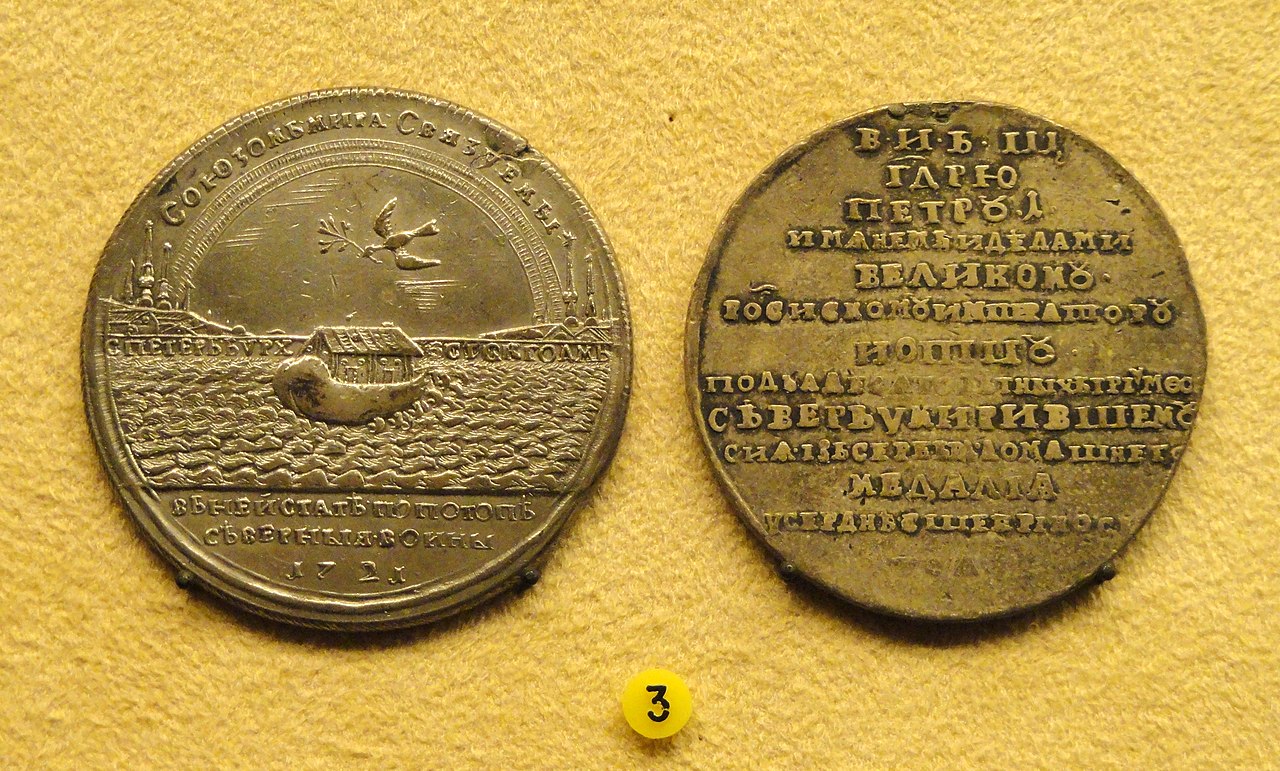
The second formal name came at the end of a war. The Great Northern War against Sweden ended with the Treaty of Nystad (Uusikaupunki, in modern Finland) in 1721, which gave Peter I the Baltic coast he wanted. On 2 November 1721 (22 October Old Style), the day the treaty was announced, the Governing Senate and the Synod gave the tsar the titles Peter the Great, Father of the Fatherland and Imperator of all Russia. That act is taken as the beginning of the Russian Empire.
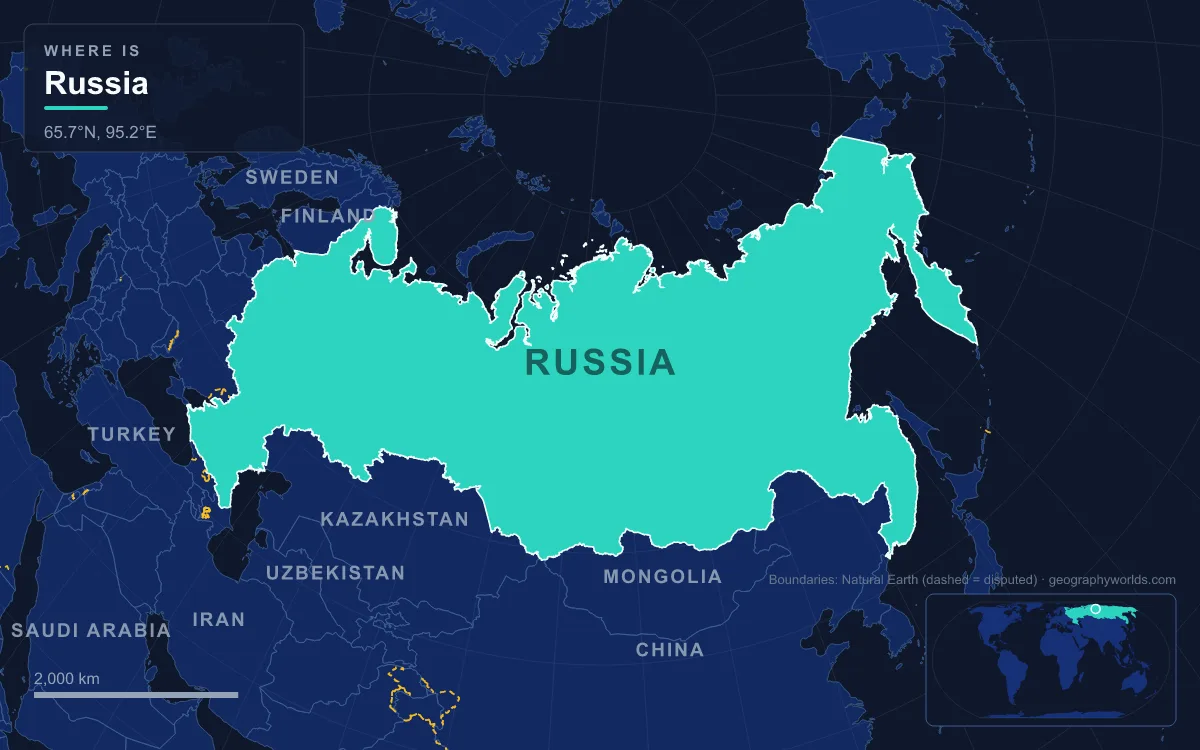
The empire kept the name for nearly two centuries and at its height in the late 19th century covered about 22,800,000 km², roughly a sixth of the world’s land. The 1897 census counted 126 million people. The tricolour that flies over today’s Russian Federation has its own history in this period, told in our article on the flag of Russia.
1 September 1917: Kerensky Proclaims the Russian Republic
The February Revolution of 1917 brought the abdication of Nicholas II on 2 March (Old Style), but it left the form of the state undecided. The Provisional Government did not name the country a republic until 1 September 1917 (14 September New Style), in a decree signed by Alexander Kerensky as Minister-Chairman and Alexander Zarudny as Minister of Justice. The Russian Republic lasted barely two months: the Bolsheviks seized power on 7 November 1917. On 18 January 1918 the newly elected Constituent Assembly proclaimed a “Russian Democratic Federal Republic”, and the Bolsheviks dissolved the assembly the next day and annulled its decrees.
1918 to 1922: The RSFSR and the Treaty Creating the USSR
After the October Revolution the Bolsheviks at first kept using the name Russian Republic. On 25 January 1918 the third All-Russian Congress of Soviets proclaimed the Russian Soviet Republic, and in July 1918 the fifth Congress adopted both a constitution and a new name, the Russian Socialist Federative Soviet Republic. On 30 December 1922 the RSFSR joined the Ukrainian, Byelorussian and Transcaucasian republics in the treaty that created the Union of Soviet Socialist Republics. Russia then existed as a constituent republic rather than an independent state, and the order of its name was changed to Russian Soviet Federative Socialist Republic in the 1936–1937 constitutional reforms.
25 December 1991 and 12 December 1993: The Russian Federation
The current name dates from the collapse of the Soviet Union. On 8 December 1991 the leaders of Russia, Ukraine and Belarus signed the Belovezha Accords, and on 12 December the RSFSR’s Supreme Soviet ratified them. On 25 December 1991, the day Mikhail Gorbachev resigned as Soviet president, the RSFSR was renamed the Russian Federation; the USSR dissolved itself the following day. Russia took over the Soviet Union’s seat at the United Nations, including permanent membership of the Security Council. The wider redrawing of borders that followed is mapped in our article on the dissolution of the Soviet Union.
On 21 April 1992 an amendment to the 1978 constitution named “Russian Federation” and “Russia” as the two official names of the state, and the new constitution, adopted by referendum on 12 December 1993, kept both. So the country now carries, in law, a name in written use since the 1480s alongside one adopted in 1991: “Russia”, the Greek form of a word that Scandinavian travellers, probably rowers, were already using for themselves by 839, more than eleven centuries ago.