
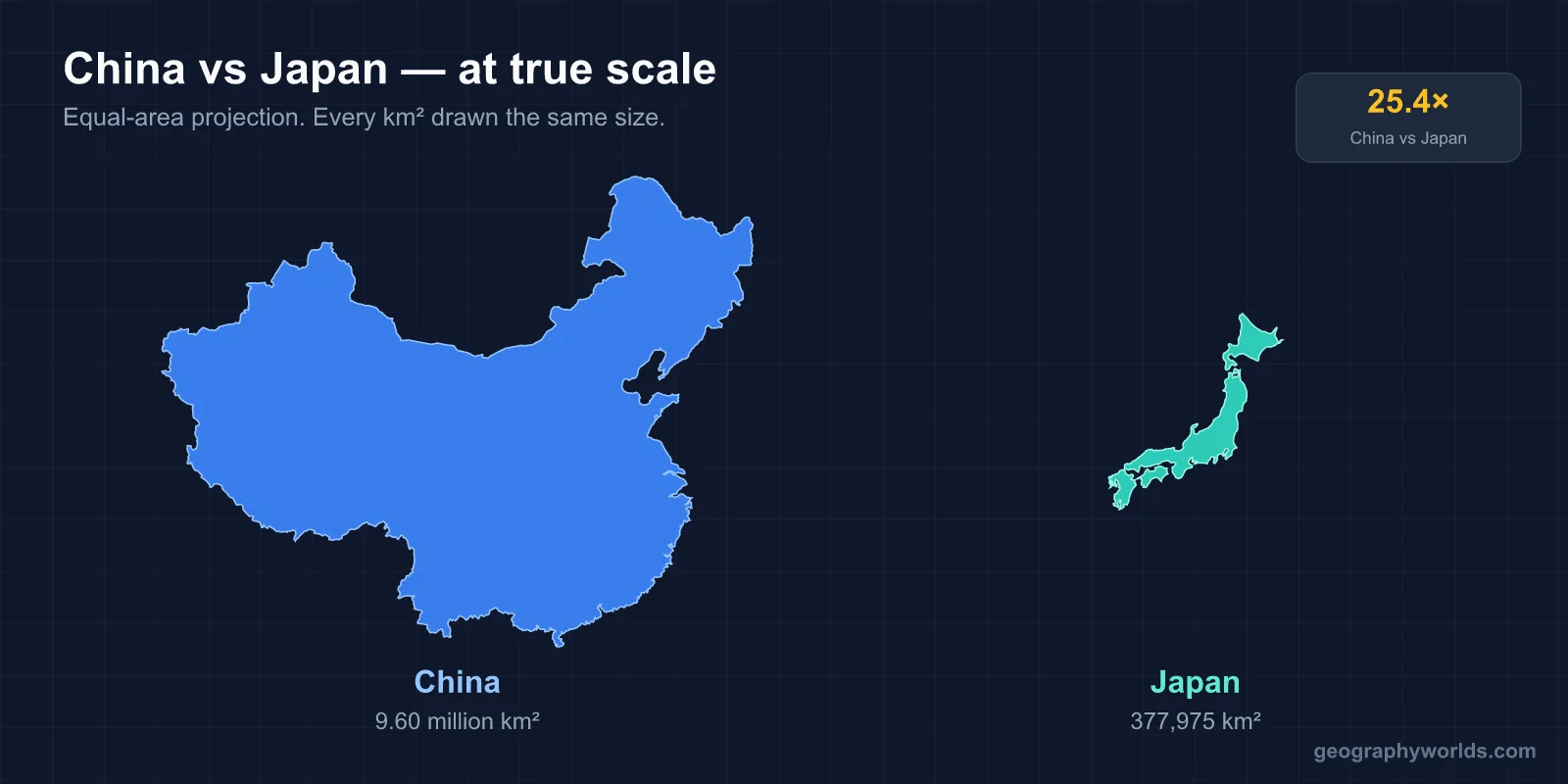
China and Japan are East Asia's two most influential nations, but they could hardly be more different geographically: China spans roughly 9,596,961 km² across a continental landmass with 14 land neighbours, while Japan is a 377,975 km² archipelago of nearly 7,000 islands with no land borders at all. China is about 25.4 times larger and home to 1.41 billion people (around 11.5 times Japan's 122.4 million), yet Japan is far more crowded per square kilometre. This guide compares the two countries across area, population, capitals, climate, natural features, language, currency, and economy.
Size & Geography
| Feature | China 🇨🇳 | Japan 🇯🇵 |
|---|---|---|
| Area | 9,596,961 km² | 377,975 km² |
| Continent | Asia | Asia |
| Region | East Asia | East Asia |
| Land Borders | Russia, Mongolia, Kazakhstan, Kyrgyzstan, Tajikistan, Afghanistan, Pakistan, India, Nepal, Bhutan, Myanmar, Laos, Vietnam, North Korea | None (island nation) |
| Landscape | mountains, plateaus, deserts, and river basins | mountainous islands with narrow coastal plains |
The contrast in scale defines almost everything else about these two countries. China is the world's third- or fourth-largest country by area (depending on how disputed territories are counted) and shares land borders with 14 nations — more than almost any other country on Earth. Its territory sweeps from the towering Himalayas and the Tibetan Plateau in the southwest, across the arid Gobi Desert in the north, to the fertile floodplains of the Yangtze and Yellow Rivers in the east, where most of the population lives.
Japan, by contrast, is a chain of islands stretching roughly 3,000 km from the subtropical south to the snowy north. Four main islands — Honshu, Hokkaido, Kyushu, and Shikoku — account for the vast majority of its land and people. Because mountains cover around three-quarters of the country, Japan's population is squeezed onto narrow coastal plains, a fact that shapes its dense cities and intensive land use. China is approximately 25.4 times larger in area than Japan.
Population & Demographics
| Metric | China 🇨🇳 | Japan 🇯🇵 |
|---|---|---|
| Population | 1.41 billion | 122.4 million |
| Population Density | 147.2 per km² | 323.9 per km² |
China has a far larger population — roughly 11.5 times that of Japan — and for decades was the most populous country in the world before being overtaken by India. Yet measured by population density, Japan is the more crowded of the two, at about 323.9 people per km² versus China's 147.2, a gap of roughly 176.7 people per km². This apparent paradox makes sense once geography is considered: huge swathes of China (the Tibetan Plateau, the western deserts) are nearly empty, concentrating the real population in the eastern third of the country, while almost all of Japan's habitable land is intensively settled.
Both nations now face ageing populations and shrinking workforces. Japan was the first major economy to confront this challenge and has one of the world's oldest populations, while China's population began declining in the mid-2020s following decades of low birth rates. These demographic trends are reshaping labour markets, pension systems, and immigration debates in both countries.
Capital Cities
Beijing serves as the capital of China, while Tokyo is the capital of Japan. Both lie in the temperate northern reaches of their respective countries in East Asia. Beijing is a sprawling political and cultural centre of more than 21 million people, home to the Forbidden City, Tiananmen Square, and the seat of national government. Tokyo, together with its surrounding prefectures, forms the largest metropolitan area on the planet, with well over 37 million residents — a single urban region larger than the entire population of many countries. Where Beijing radiates outward across the flat North China Plain in concentric ring roads, Tokyo presses against Tokyo Bay and the mountains behind it, building upward and densely.
Language, Currency & Culture
| Aspect | China 🇨🇳 | Japan 🇯🇵 |
|---|---|---|
| Languages | Mandarin Chinese (official), Cantonese, Wu, Min, and many regional languages | Japanese (official) |
| Currency | Chinese Yuan Renminbi (CNY) | Japanese Yen (JPY) |
China is linguistically diverse: Mandarin Chinese is the official standard, but Cantonese, Wu (spoken around Shanghai), Min, and dozens of regional varieties are used daily by tens of millions of people. Japan, by contrast, is one of the world's most linguistically uniform nations, with Japanese spoken almost universally. The two writing systems are historically intertwined — Japanese adopted Chinese characters (known as kanji) more than a thousand years ago and pairs them with its own kana syllabaries, while modern Mandarin uses simplified Chinese characters in the mainland.
Culturally, both societies share deep Confucian and Buddhist roots, yet they have evolved distinct identities. China's transactions run on the yuan (renminbi), increasingly through mobile payment apps, while Japan uses the yen, long considered one of the world's major reserve currencies. For a closer look at Japan on its own, see our Japan country guide.
Climate & Natural Features
| Aspect | China 🇨🇳 | Japan 🇯🇵 |
|---|---|---|
| Climate | extremely diverse; tropical to subarctic | ranges from tropical in south to cool temperate in north |
| Key Features | Himalayas, Yangtze River, Gobi Desert, Tibetan Plateau | Mount Fuji, Japanese Alps, 6,852 islands, Pacific Ring of Fire |
| Economy | manufacturing, technology, agriculture, exports | technology, automotive, robotics, electronics |
China's sheer size gives it an extraordinary range of climates, from tropical conditions on Hainan Island to subarctic winters in the far northeast and the cold, high-altitude desert of the Tibetan Plateau. Its defining natural features include the Himalayas along its southwestern frontier, the 6,300-km Yangtze River (the longest in Asia), the Yellow River, the Gobi Desert, and the world's highest plateau.
Japan's climate also varies with latitude — subtropical in Okinawa to the south, with heavy winter snowfall in Hokkaido to the north — but its most distinctive geographic trait is geological. Sitting on the Pacific Ring of Fire, Japan is shaped by volcanism and seismic activity. Mount Fuji, a near-perfect volcanic cone at 3,776 metres, is the country's highest peak and a national symbol, while the rugged Japanese Alps run down the spine of Honshu.
What Makes Each Country Unique
China is internationally renowned for the Great Wall, its ancient civilization stretching back thousands of years, the Forbidden City, and its role as the world's manufacturing hub. The Great Wall stretches over 21,000 km in total — if fully straightened, it would span more than half the circumference of the Earth. China is also a leader in high-speed rail, with the world's largest network connecting nearly every major city.
Japan is best known for cherry blossoms, sushi, its globally influential anime and manga culture, and relentless technological innovation. Japan comprises over 6,800 islands and experiences roughly 1,500 earthquakes per year owing to its position on the Pacific Ring of Fire — which is also why it pioneered earthquake-resistant architecture and high-speed bullet trains, the famous Shinkansen, decades ago.
Key Facts
- Area: China 9,596,961 km² vs Japan 377,975 km² — China is about 25.4x larger
- Population: China 1.41 billion vs Japan 122.4 million — China is about 11.5x more populous
- Population density: Japan (323.9/km²) is far denser than China (147.2/km²)
- Capitals: Beijing (China) vs Tokyo (Japan)
- Currency: Chinese Yuan Renminbi (CNY) vs Japanese Yen (JPY)
- Land borders: China has 14 neighbours; Japan has none as an island nation
- Defining landmarks: Great Wall and Himalayas (China) vs Mount Fuji and 6,852 islands (Japan)
Verdict
China and Japan are East Asian economic titans whose geographies pull in opposite directions. China claims the vast continental land area (25.4x larger) and the larger population (11.5x), yet Japan packs more people into each square kilometre and holds the world's largest metropolitan area in Tokyo. China's identity is rooted in scale and diversity — every climate zone, 14 land borders, and landmarks like the Great Wall and the Himalayas — while Japan's is defined by its island geography, volcanic landscape, and dense, highly urbanised society. Economically, China is built on manufacturing and exports, whereas Japan leads in automotive, robotics, and electronics. Together they illustrate how two neighbouring nations can share a region and a heritage yet remain profoundly distinct.
Frequently Asked Questions
Is China bigger than Japan?
Yes. China covers about 9,596,961 km², making it roughly 25.4 times larger than Japan, which spans 377,975 km². China is one of the largest countries in the world, while Japan is a mid-sized island nation.
Which country has a larger population, China or Japan?
China has a much larger population at about 1.41 billion, compared with Japan's 122.4 million — roughly 11.5 times more people. However, Japan is more densely populated, with about 323.9 people per km² versus China's 147.2.
What are the capital cities of China and Japan?
Beijing is the capital of China, and Tokyo is the capital of Japan. Both are located in the East Asia region, and Greater Tokyo is the most populous metropolitan area in the world.
Why does Japan have so many earthquakes compared to China?
Japan sits directly on the Pacific Ring of Fire, where several tectonic plates meet, producing around 1,500 earthquakes a year and frequent volcanic activity such as Mount Fuji. China experiences earthquakes too, especially near the Himalayas, but its more continental position makes them less frequent than in Japan.
Test Your Knowledge!
Think you know your countries? Try our interactive geography quiz!
Play Geography Games →