
Introduction
How do Argentina 🇦🇷 and Uruguay 🇺🇾 compare? Río de la Plata partners. In this geographic comparison, we examine how these two nations stack up across size, population, capitals, natural features, and more.
Whether you're studying geography, planning travel, or simply curious about how countries differ, this side-by-side comparison of Argentina and Uruguay provides the key facts and figures you need.
Size & Geography
| Feature | Argentina 🇦🇷 | Uruguay 🇺🇾 |
|---|---|---|
| Area | 2,780,400 km² | 176,215 km² |
| Continent | South America | South America |
| Region | South America | South America |
| Land Borders | Chile, Bolivia, Paraguay, Brazil, Uruguay | Argentina, Brazil |
| Landscape | Pampas plains, Andes mountains, Patagonian steppe, subtropical north | mostly rolling plains and low hills; fertile coastal lowland |
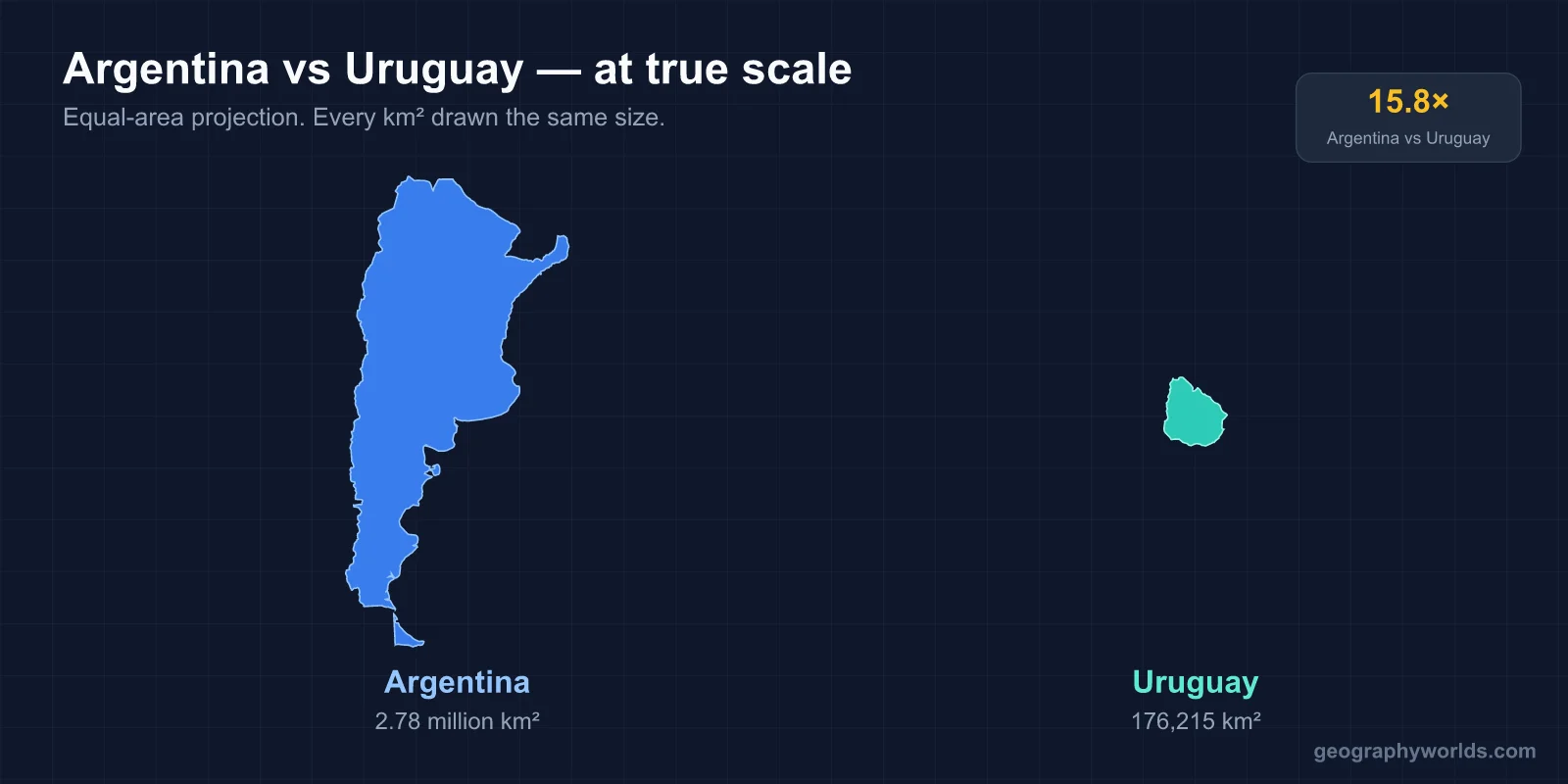
Argentina is approximately 15.8 times larger in area than Uruguay. Argentina features Pampas plains, Andes mountains, Patagonian steppe, subtropical north, while Uruguay is characterized by mostly rolling plains and low hills; fertile coastal lowland.
Population & Demographics
| Metric | Argentina 🇦🇷 | Uruguay 🇺🇾 |
|---|---|---|
| Population | 46.0 million | 3.4 million |
| Population Density | 16.5 per km² | 19.2 per km² |
Argentina has a larger population, approximately 13.6 times that of Uruguay. In terms of population density, Uruguay is more densely populated, with a difference of about 2.6 people per km².
Capital Cities
Buenos Aires serves as the capital of Argentina, while Montevideo is the capital of Uruguay. Both capitals are located in South America, specifically in the South America region.
Language, Currency & Culture
| Aspect | Argentina 🇦🇷 | Uruguay 🇺🇾 |
|---|---|---|
| Languages | Spanish (official) | Spanish (official) |
| Currency | Argentine Peso (ARS) | Uruguayan Peso (UYU) |
In Argentina, Spanish (official) is widely spoken, while Uruguay uses Spanish (official). These linguistic differences reflect each country's unique colonial history, indigenous heritage, and cultural evolution over centuries.
Climate & Natural Features
| Aspect | Argentina 🇦🇷 | Uruguay 🇺🇾 |
|---|---|---|
| Climate | mostly temperate; arid in southeast; subantarctic in southwest | warm temperate; freezing temperatures almost unknown |
| Key Features | Andes, Patagonia, Iguazu Falls, Tierra del Fuego, Pampas | Río de la Plata, Punta del Este, rolling grasslands |
| Economy | agriculture (beef, soy), mining, automotive, IT | agriculture (beef, soybeans), IT, tourism, wind energy |
Argentina has a mostly temperate; arid in southeast; subantarctic in southwest climate, featuring notable landmarks such as Andes, Patagonia, Iguazu Falls, Tierra del Fuego, Pampas. Meanwhile, Uruguay experiences a warm temperate; freezing temperatures almost unknown climate and is known for Río de la Plata, Punta del Este, rolling grasslands.
What Makes Each Country Unique
Argentina is internationally renowned for tango dancing, beef and asado culture, Patagonia, Iguazu Falls, and football legends like Maradona and Messi. Argentina named a glacier (Perito Moreno) that is one of the few in the world still growing — it advances about 2 meters per day.
Uruguay is best known for being one of South America's most progressive nations, Punta del Este beach resort, and mate tea culture. Uruguay hosted and won the first-ever FIFA World Cup in 1930 and was a pioneer in legalizing cannabis nationwide.
Key Differences at a Glance
- Area: Argentina (2,780,400 km²) vs Uruguay (176,215 km²) — Argentina is 15.8x larger
- Population: Argentina (46.0 million) vs Uruguay (3.4 million) — Argentina is 13.6x more populous
- Capitals: Buenos Aires vs Montevideo
- Currency: Argentine Peso (ARS) vs Uruguayan Peso (UYU)
- Continents: South America vs South America
- Density: Uruguay is more densely populated (difference of ~2.6 people per km²)
- Languages: Spanish (official) vs Spanish (official)
Verdict
Argentina and Uruguay — río de la plata partners — each offer unique geographic characteristics that make them fascinating to compare. While Argentina claims the larger land area (15.8x), Argentina leads in population (13.6x), showing how size and population don't always go hand in hand.
Argentina stands out for its mostly temperate; arid in southeast; subantarctic in southwest climate and landmarks like Andes, whereas Uruguay is defined by its warm temperate; freezing temperatures almost unknown climate and features such as Río de la Plata. Economically, Argentina focuses on agriculture (beef while Uruguay drives growth through agriculture (beef.
Both nations contribute uniquely to our world's geographic tapestry. Whether you're planning a visit, studying world geography, or simply satisfying your curiosity, understanding these differences helps build a richer picture of our diverse planet.
Test Your Knowledge!
Think you know your countries? Try our interactive geography quiz!
Play Geography Games →