
Introduction
Indonesia 🇮🇩 and Nigeria 🇳🇬 sit on opposite sides of the planet, one anchoring Southeast Asia and the other West Africa, but they have a striking amount in common: both are tropical giants, both rank among the most populous nations on Earth, and both are dazzlingly diverse in language and culture. This comparison lines them up across land area, population, capitals, climate, and the features that make each one stand out.
Whether you are studying world geography, weighing a trip to either region, or just curious how two of the world's demographic heavyweights compare, the figures below tell the story.
Size & Geography
| Feature | Indonesia 🇮🇩 | Nigeria 🇳🇬 |
|---|---|---|
| Area | 1,904,569 km² | 923,768 km² |
| Continent | Asia | Africa |
| Region | Southeast Asia | West Africa |
| Land Borders | Malaysia, Papua New Guinea, Timor-Leste | Benin, Niger, Chad, Cameroon |
| Landscape | 17,000+ islands; mountains, rainforests, volcanic terrain | tropical forests, savannas, and the Niger Delta |
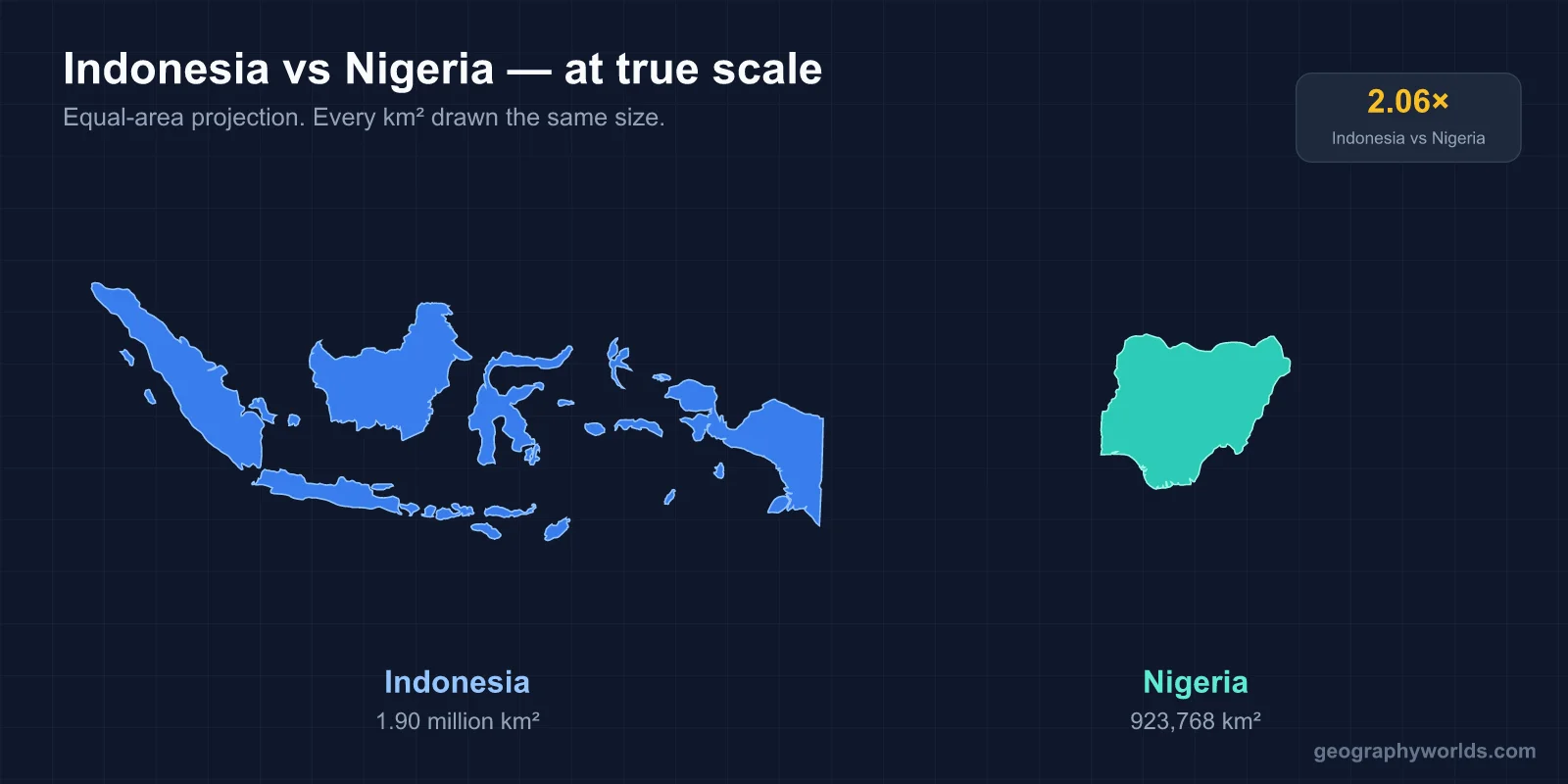
Indonesia is the larger of the two by a clear margin, spanning 1,904,569 km² to Nigeria's 923,768 km² — about 2.1 times the area. Their geographies could hardly be more different in form. Indonesia is the world's largest archipelago, a sprawl of more than 17,000 islands laced with mountains, rainforest, and volcanic terrain, its borders shared with Malaysia, Papua New Guinea, and Timor-Leste. Nigeria is a single contiguous landmass in West Africa, ranging from tropical forest in the south to open savanna in the north and the river-woven Niger Delta along the coast, bordered by Benin, Niger, Chad, and Cameroon.
Population & Demographics
| Metric | Indonesia 🇮🇩 | Nigeria 🇳🇬 |
|---|---|---|
| Population | 287.9 million | 242.4 million |
| Population Density | 151.2 per km² | 262.4 per km² |
This is where the two come closest. Indonesia counts 287.9 million people and Nigeria 242.4 million, so Indonesia is only about 1.2 times more populous — both nations rank among the four or five most populous on the planet. Because Nigeria packs a comparable population into roughly half the land, it is by far the denser of the two, at 262.4 people per km² against Indonesia's 151.2, a difference of about 111.3 people per km². Both also have famously young populations, a demographic feature that shapes their economies and their futures.
Capital Cities
Jakarta is the capital of Indonesia, a vast metropolis on the island of Java in Asia. Abuja serves as the capital of Nigeria, located in Africa. Abuja is a relatively young, purpose-built capital in the center of the country; like several nations that moved their seat of government inland, Nigeria shifted its capital from the older coastal hub of Lagos to a more central location.
Language, Currency & Culture
| Aspect | Indonesia 🇮🇩 | Nigeria 🇳🇬 |
|---|---|---|
| Languages | Indonesian (Bahasa Indonesia, official), plus over 700 regional languages | English (official), Hausa, Yoruba, Igbo |
| Currency | Indonesian Rupiah (IDR) | Nigerian Naira (NGN) |
Both countries are studies in linguistic abundance, but they manage it differently. Indonesia made Indonesian, or Bahasa Indonesia, its official national language to unify a population that speaks over 700 regional tongues. Nigeria took a different route, adopting English as its official language while Hausa, Yoruba, and Igbo serve as major languages of their respective regions. Each carries its own money as well — the Indonesian rupiah and the Nigerian naira — and the differences in language policy reflect distinct colonial histories and the long work of building national identity from extraordinary internal diversity.
Climate & Natural Features
| Aspect | Indonesia 🇮🇩 | Nigeria 🇳🇬 |
|---|---|---|
| Climate | tropical; hot and humid | tropical in the south, arid in the north |
| Key Features | Borneo, Sumatra, Java, Bali, Ring of Fire volcanoes | Niger River, Jos Plateau, tropical rainforests |
| Economy | commodities, manufacturing, palm oil, mining | oil, agriculture, tech startup hub |
Indonesia is uniformly tropical, hot and humid across its islands, which sit along the volcanic Ring of Fire — hence landmarks like Borneo, Sumatra, Java, and Bali. Nigeria spans a sharper gradient, tropical and forested in the south near the Niger River but turning arid toward the north, with the elevated Jos Plateau in between. The economies diverge in emphasis too: Indonesia leans on commodities, manufacturing, palm oil, and mining, while Nigeria is built heavily on oil alongside agriculture and a fast-growing technology startup scene that has made cities like Lagos a hub for African innovation.
What Makes Each Country Unique
Indonesia is internationally renowned for Bali, the Komodo dragons, and an unmatched depth of biodiversity. It is the world's largest archipelago, with more than 17,000 islands — the most of any country — though only about 6,000 of them are inhabited.
Nigeria is best known for Nollywood, one of the most prolific film industries on Earth, along with its beloved jollof rice and vibrant cultural festivals. The country is home to over 500 living languages, making it one of the most linguistically diverse nations anywhere.
Key Differences at a Glance
- Area: Indonesia (1,904,569 km²) vs Nigeria (923,768 km²) — Indonesia is 2.1x larger
- Population: Indonesia (287.9 million) vs Nigeria (242.4 million) — Indonesia is 1.2x more populous
- Capitals: Jakarta vs Abuja
- Currency: Indonesian Rupiah (IDR) vs Nigerian Naira (NGN)
- Continents: Asia vs Africa
- Density: Nigeria is more densely populated (difference of ~111.3 people per km²)
- Languages: Indonesian (Bahasa Indonesia) vs English (official)
Verdict
Indonesia and Nigeria are tropical mega-populations from different continents, and the comparison is unusually close on the metric that matters most for both — people. Indonesia leads on land area at 2.1 times the size, and edges ahead on population by a modest 1.2 times, but Nigeria's far higher density shows how much weight it carries on a smaller footprint.
Their characters part ways once you look past the headline numbers. Indonesia is the hot, humid archipelago of Borneo and the Ring of Fire, its economy rooted in commodities; Nigeria is the climatically split giant of the Niger River and the Jos Plateau, powered by oil and an emerging tech sector. Both, tellingly, are among the most linguistically diverse places on the planet.
Put side by side, they make a compelling pair: two young, populous, endlessly varied nations that anchor their respective regions while taking very different paths to do it.
Test Your Knowledge!
Think you know your countries? Try our interactive geography quiz!
Play Geography Games →