
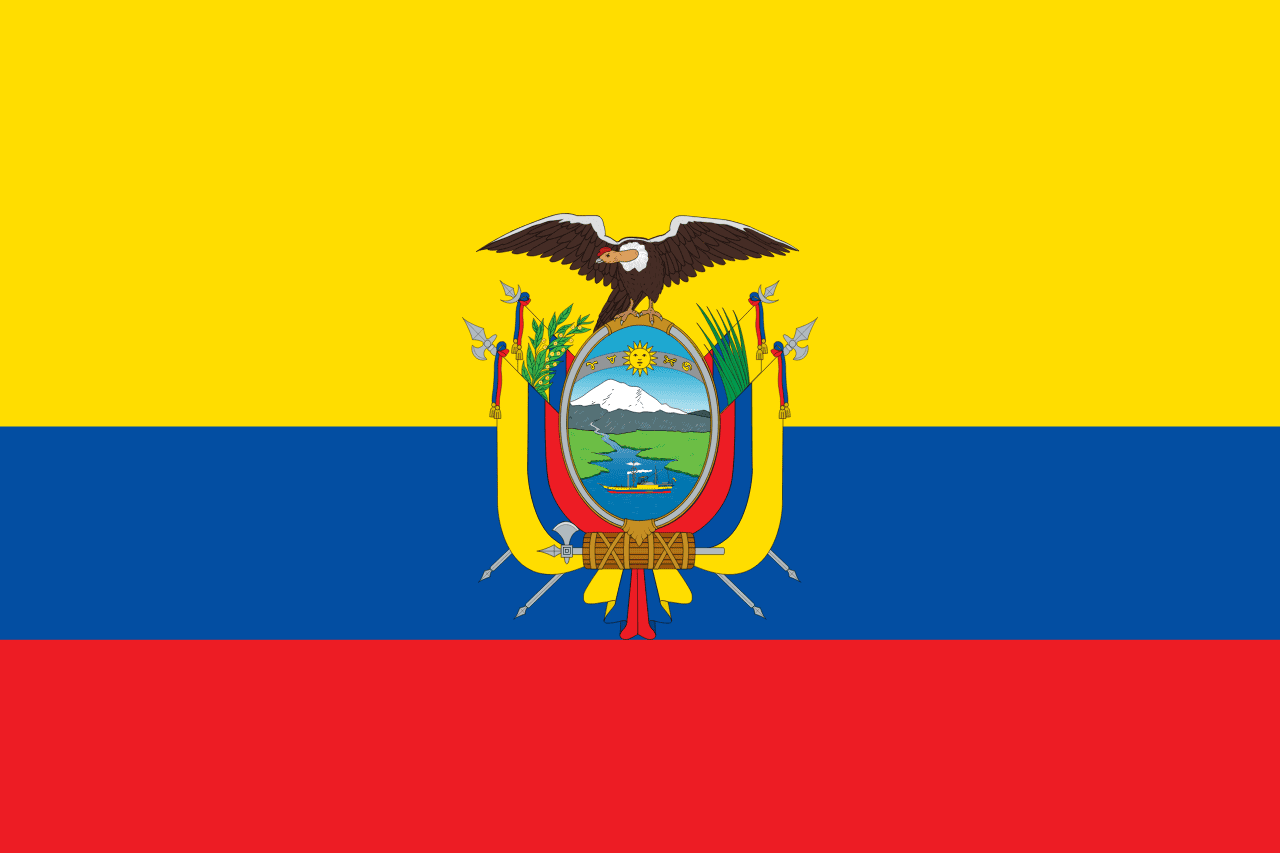
Few flags in the Americas carry as much height, literally, as the flag of Ecuador. A broad band of yellow crowns a slimmer stripe of blue and an equal stripe of red, and at the center sits a busy coat of arms in which an Andean condor spreads its wings above a snow-capped mountain. The result is a banner that feels both bold and intricate, instantly recognizable from across a plaza yet rewarding to study up close. This article walks through what those colors mean, how the design came together, why it looks so much like two of its neighbors, and how Ecuadorians use the flag today.
A Tricolor Built on Three Colors
The Ecuadorian flag is a horizontal triband in yellow, blue, and red. What makes it visually distinctive among tricolors is the unequal proportion of the stripes: the yellow band at the top is twice the height of either the blue or the red beneath it. That oversized top stripe gives the flag a warm, golden dominance that sets it apart from the evenly divided bands you find on most three-color designs.
Each color carries meaning rooted in the country's origins. The yellow is widely understood to represent the abundance of the land, its fertile soil, crops, and natural wealth, while also recalling the gold that drew explorers to the region. The blue stands for the sky and the sea, and by extension the rivers and coast that shape Ecuadorian geography. The red honors the blood of the patriots and soldiers who fought for independence. Together they tell a compact story: a rich land, watched over by open skies, won and defended at great cost.
Reading the Layout and the Coat of Arms
Strip away the emblem and you have a clean civil tricolor; many Ecuadorians fly exactly that version on everyday occasions. The full state flag, however, places the national coat of arms in the center, straddling all three stripes. The arms reward a close look. At the top, a magnificent Andean condor spreads its wings, a bird chosen as a symbol of power, strength, and the soaring spirit of the nation.
Below the condor, an oval scene shows the volcano Chimborazo with a river flowing from its base, a nod to Ecuador's dramatic Andean landscape and to the rivers born in those highlands. A steamship on the water represents commerce and the era of progress in which the design matured. Above the mountain, the sun moves across a band marked with the zodiac signs for the months associated with key moments of the March Revolution. The whole composition is framed by laurel and palm fronds, classic emblems of glory and peace, making the arms a miniature portrait of the country's geography and history.
How the Flag Came to Be
The flag's roots reach back to Gran Colombia, the short-lived republic formed in the wake of independence from Spain that united the territories of present-day Colombia, Venezuela, Ecuador, and Panama. The yellow-blue-red palette belonged to that larger union, and it is usually traced to the banners carried by the revolutionary general Francisco de Miranda. When Gran Colombia dissolved in 1830, Ecuador emerged as an independent state and, like its former partners, kept the colors it had fought under.
Over the following decades Ecuador experimented with different banners, including periods when it flew flags closer to the marine-style designs of the time. The modern arrangement, the yellow-blue-red triband with the double-width top stripe, became firmly established around the turn of the twentieth century. The flag in its current official form was adopted in 1900, consolidating the design that Ecuadorians have flown ever since. Across this evolution the core idea never changed: the country's banner would always echo the colors of the independence struggle and the union from which it was born.
Spot the Difference: Ecuador, Colombia, and Venezuela
Anyone glancing quickly at the flags of Ecuador, Colombia, and Venezuela could be forgiven for mixing them up. All three share the yellow-blue-red sequence inherited from Gran Colombia, with a dominant yellow band on top. The shared heritage is the whole point, a visual reminder that these nations were once a single republic.
The differences, though, are clear once you know where to look. Colombia's flag is the simplest of the trio: just the three colors, no emblem. Venezuela's flag uses an arc of white stars across the blue and a coat of arms in the upper hoist corner. Ecuador's distinguishing mark is its large, centrally placed coat of arms with the condor and Chimborazo. So the rule of thumb is straightforward: plain means Colombia, stars mean Venezuela, and a central condor-topped emblem means Ecuador. The likeness is a feature, not a flaw, celebrating a common origin while each country signs its own name in the center.
The Flag in National Identity
For Ecuadorians, the tricolor is woven into the rhythm of civic life. The country observes a dedicated Day of the National Flag, a moment for schools and public institutions to honor the banner and reflect on what it represents. Students learn the meaning of the colors and the symbolism of the arms early, so the flag functions as a shared shorthand for national values: the wealth of the land, the breadth of the sky and sea, and the sacrifice of those who secured independence.
Beyond formal ceremony, the colors show up wherever Ecuadorians gather. They appear on the jerseys and face paint of fans cheering the national football team, on murals and storefronts, and in the diaspora communities that wave the tricolor at festivals abroad. If you want the wider context of the nation behind the banner, the ecuador country guide is a good next stop. The flag, in all these settings, acts as an emblem of belonging that crosses regional and generational lines.
Interesting Facts at a Glance
- The top yellow stripe is twice as tall as the blue or red bands, an unusual proportion among world tricolors.
- The colors come from the Gran Colombia union and are commonly linked to the banners of Francisco de Miranda.
- The Andean condor atop the coat of arms symbolizes power and strength.
- The arms feature Chimborazo, the volcano whose summit is the farthest point from Earth's center because of the planet's equatorial bulge.
- A plain version without the coat of arms is widely used by civilians, while the version with the arms is the official state flag.
- Ecuador sits in South America, on the equator that gives the country its very name.
Frequently Asked Questions
When was the flag of Ecuador adopted?
The flag in its current official form was adopted in 1900. Its yellow-blue-red colors, however, are much older, dating back to the independence era and the Gran Colombia union of the early nineteenth century, so the 1900 date marks the consolidation of a design that had been evolving for decades.
What do the colors of the Ecuadorian flag mean?
Yellow represents the richness and fertility of the land and its natural resources, blue stands for the sky and the sea, and red honors the blood and sacrifice of those who fought for independence. The three colors together also tie Ecuador to the shared heritage of the Gran Colombia republic.
Why does Ecuador's flag look like Colombia's and Venezuela's?
All three nations were once part of Gran Colombia and kept its yellow-blue-red palette after it dissolved in 1830. They are distinguished by their central elements: Colombia has no emblem, Venezuela adds a star arc and a corner coat of arms, and Ecuador places its condor-topped coat of arms in the middle of the flag.
What continent is Ecuador on?
Ecuador is in South America. It lies on the equator, which is the source of its name, and its territory spans the Pacific coast, the Andes mountains, and part of the Amazon basin, along with the Galapagos Islands far out in the Pacific.