
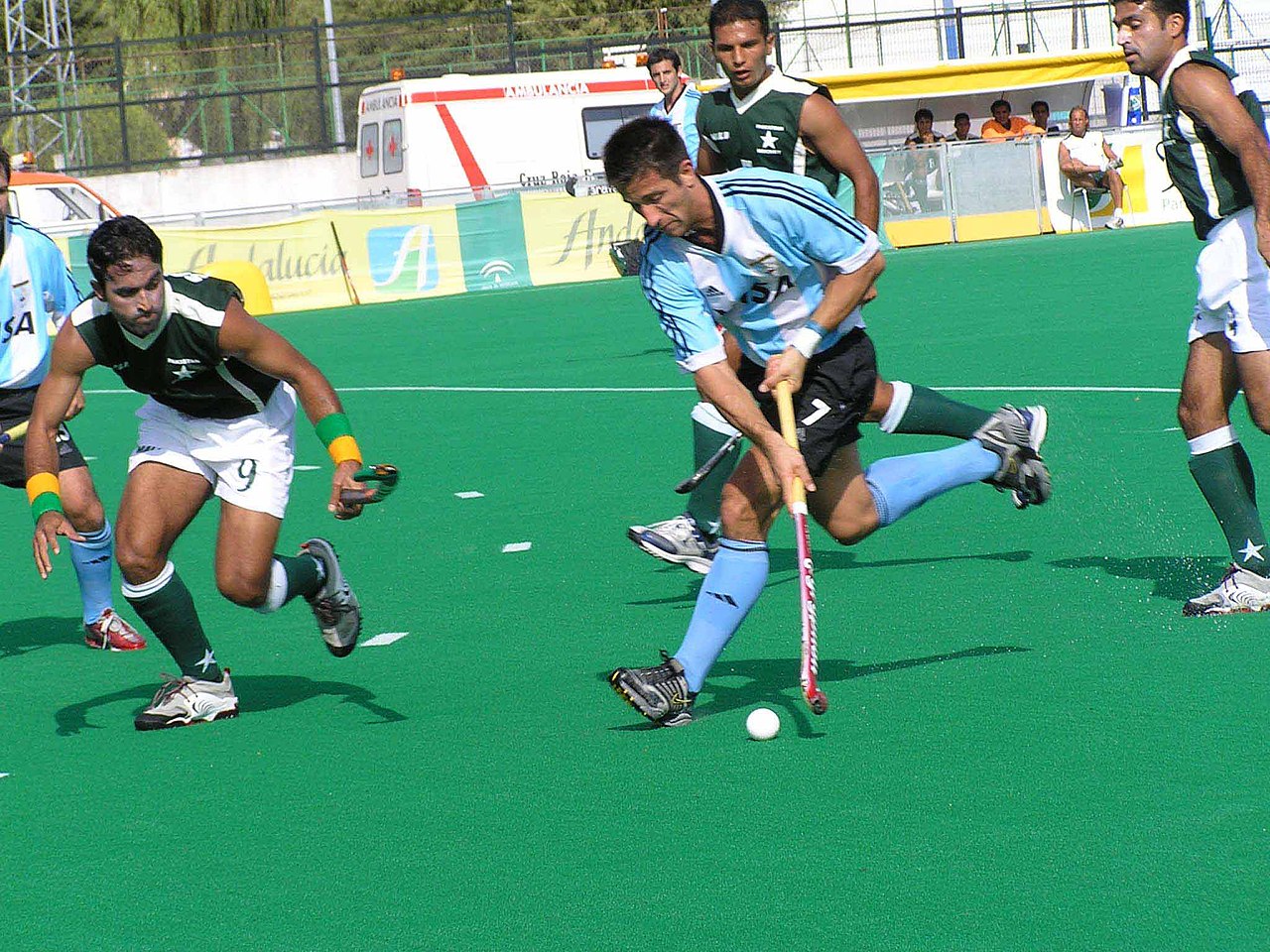
Field hockey is the national sport of Pakistan, while cricket is by far its most popular game. Hockey holds the title because of what the men’s team achieved after independence: three Olympic gold medals (1960, 1968 and 1984), a joint-record four Hockey World Cups (1971, 1978, 1982 and 1994) and eight Asian Games golds, under the Pakistan Hockey Federation founded in 1948. Cricket, run by the Pakistan Cricket Board, fills the stadiums and television schedules and gave the country its most celebrated sporting day, the 1992 World Cup final. Squash, polo and, since Arshad Nadeem’s gold in Paris in 2024, javelin complete the picture. The figures below tell the story one number at a time.
3 Olympic Golds: Rome 1960, Mexico City 1968, Los Angeles 1984
Pakistan’s hockey team played its first international on 2 August 1948 at the London Olympics, beating Belgium 2–1 under its captain Ali Iqtidar Shah Dara. Dara himself had won Olympic gold with British India’s team in Berlin in 1936. The team finished fourth in 1948 and 1952, took silver behind India at Melbourne in 1956, and then broke through in Rome.
The 1960 final, played at the Olympic Velodrome, ended 1–0 to Pakistan with a goal by Naseer Bunda, and it ended India’s run of six successive Olympic hockey titles. The second gold came at Mexico City in 1968, where a side captained by Tariq Aziz won every match and beat Australia 2–1 in the final; it is often described as the best hockey team Pakistan ever fielded. The third came at Los Angeles in 1984 with a final win over West Germany. Between 1956 and 1972 Pakistan reached five Olympic finals in a row, winning two golds and three silvers.

4 Hockey World Cups, Starting in Barcelona in 1971
The first Hockey World Cup was meant to be a home tournament. The International Hockey Federation scheduled the 1971 edition for Pakistan, but protests against India’s participation and the outbreak of the Bangladesh Liberation War led it, in March 1971, to move the event to the Real Club de Polo in Barcelona. Pakistan beat India 2–1 in the semi-final and Spain 1–0 in the final, with Tanvir Dar the top scorer on eight goals.
Titles followed in Buenos Aires in 1978, Bombay (now Mumbai) in 1982 and Sydney in 1994. The 1978 season was the peak: Pakistan won the World Cup, the Asian Games and the first Champions Trophy in the same year, the first time a national team had won three major titles in a single year. Four World Cups is still a joint record, matched only by Germany when it won its fourth in August 2026. Across all competitions the team has won 30 official international titles, including eight Asian Games golds between 1958 and 2010 and three Champions Trophies (1978, 1980 and 1994), more than any other Asian side. The rivalry with India runs through all of it: the two teams have met in 15 major tournament finals, eight of them at the Asian Games, and Pakistan has won nine.
348 Goals: Sohail Abbas and the Drag Flick
Individual records came even as team results faded. Sohail Abbas, born in 1977, scored 348 goals in 315 international matches between 1998 and 2012, most of them from penalty corners with a fast, accurate drag flick. That makes him the highest scorer of the artificial-turf era and second on the all-time list of international hockey goalscorers; he also holds the international record of 21 hat-tricks.
His teammate Waseem Ahmed is the most-capped Pakistani player, with 410 appearances between 1996 and 2013. Both played through the decline that followed: Pakistan failed to qualify for a World Cup for the first time in 2014, missed the Olympics in 2016, 2020 and 2024, and could not reach the 2023 World Cup even though it had expanded to 16 teams. At the 2026 World Cup it finished 11th of 16, its best placing since 2006.
45,000 Seats: The National Hockey Stadium in Lahore
Pakistan’s home of hockey is the National Hockey Stadium in Lahore, often described as the largest international field hockey stadium in the world, with room for 45,000 spectators. It is also the headquarters of the Pakistan Hockey Federation. By 1978 it had become the national team’s main venue, with the Hockey Club of Pakistan in Karachi and the stadium in Faisalabad used when Lahore was unavailable.

Lahore hosted the 1990 World Cup, the only one played in Pakistan, and Pakistan reached the final there before losing 3–1 to the Netherlands. The country also staged the Champions Trophy 11 times between 1978 and 2004 and the 1982 Asia Cup. The domestic game grew up inside institutions rather than clubs. From the 1960s to the 1990s, state employers such as Pakistan International Airlines and WAPDA, along with the armed services, hired hockey players as staff and fielded them in the National Hockey Championship, which has run since 1948. For how Lahore fits among Pakistan’s cities, see our guide to the largest cities in Pakistan.
87,182 at the MCG: Imran Khan’s 1992 Cricket World Cup
Cricket’s claim to be Pakistan’s real national game rests on audiences, and its biggest day came on 25 March 1992 at the Melbourne Cricket Ground. In front of 87,182 spectators, Imran Khan’s team beat England by 22 runs to win the World Cup for the first time. Pakistan had been granted Test status only in 1952, on India’s recommendation.
More trophies followed: the ICC World Twenty20 in 2009 and the Champions Trophy in 2017, which means Pakistan has won every major ICC limited-overs event, and it reached first place in the Test rankings in 2016 under Misbah-ul-Haq. Its bowlers set records too: Wasim Akram took 502 wickets in one-day internationals, second only to Sri Lanka’s Muttiah Muralitharan, and Shoaib Akhtar holds the record for the fastest recorded delivery, 161.3 km/h. Lahore’s Gaddafi Stadium, built in 1959 and now holding 27,000, is the home of the Pakistan Cricket Board and staged the 1996 World Cup final.
The March 2009 attack on the Sri Lankan team’s bus on its way to that stadium, in which six Pakistani policemen and two civilians were killed, closed Pakistan to touring sides for years, and “home” matches moved to the United Arab Emirates. International cricket resumed in Pakistan from 2016, alongside the debut of the Pakistan Super League, a franchise T20 competition founded in 2015 that now has eight city teams, though Test matches were still played in the UAE until 2019. Pakistan co-hosted the ICC Champions Trophy in 2025.
555 Matches Unbeaten: Jahangir Khan and Pakistan’s Squash Dynasty
Squash produced Pakistan’s greatest individual athlete. Jahangir Khan, born in Karachi in 1963 into a squash family whose roots lie near Peshawar, won 555 consecutive matches between 1981 and 1986, which Guinness World Records lists as the longest winning streak by any athlete in top-level professional sport. He won the World Open six times and the British Open ten times in a row, from 1982 to 1991, and later served as president of the World Squash Federation from 2002 to 2008.
His successor as world number one, Jansher Khan, born in 1969, won the World Open eight times and the British Open six times, held the top ranking from January 1988 to January 1998, and went unbeaten for 81 matches between 1990 and 1996. Pakistan also hosted the World Open in 1984, in Karachi in 1993 and in Lahore in 1996 and 2003. Between them, the two men kept the sport’s leading titles in Pakistan for most of two decades.
3,700 Metres: Polo at the Shandur Pass
Polo is the traditional sport of Pakistan’s far north. Every year from 7 to 9 July, teams from Pakistan-administered Gilgit-Baltistan and from Chitral meet at the Shandur Polo Ground, on the boundary of Gupis-Yasin and Chitral districts, for a freestyle tournament. At about 3,700 metres above sea level it is the highest polo ground in the world. The festival is organised and funded jointly by the governments of Khyber Pakhtunkhwa and Gilgit-Baltistan, and around the matches there is folk music, dancing and a temporary camping village.

11 Olympic Medals and Arshad Nadeem’s 92.97 Metres in Paris
Pakistan has won 11 Olympic medals in total, all at the Summer Games, and the breakdown shows why hockey carries the national title. Eight came from the men’s hockey team, which medalled at eight of the nine Games it played between 1956 and 1992. The first non-hockey medal was a wrestling bronze for Muhammad Bashir in Rome in 1960, and the boxer Hussain Shah took bronze at Seoul in 1988.
The eleventh was the most dramatic. At the Paris Olympics in 2024, Arshad Nadeem, born in 1997, threw the javelin 92.97 metres, an Olympic and Asian record, to become Pakistan’s first individual Olympic champion and its first Olympic medallist in athletics. He had already become the first Pakistani to win a World Championships medal, with silver in 2023. It was Pakistan’s first Olympic gold since the hockey team’s win in Los Angeles 40 years earlier, and its first medal of any colour since the hockey bronze at Barcelona in 1992.
So the numbers point two ways: hockey for the titles and history behind the national designation, cricket for the crowds. India settles the same argument another way, as the national sport of India page shows, and the wider rivalry between the two countries is set out in our India vs Pakistan comparison.