
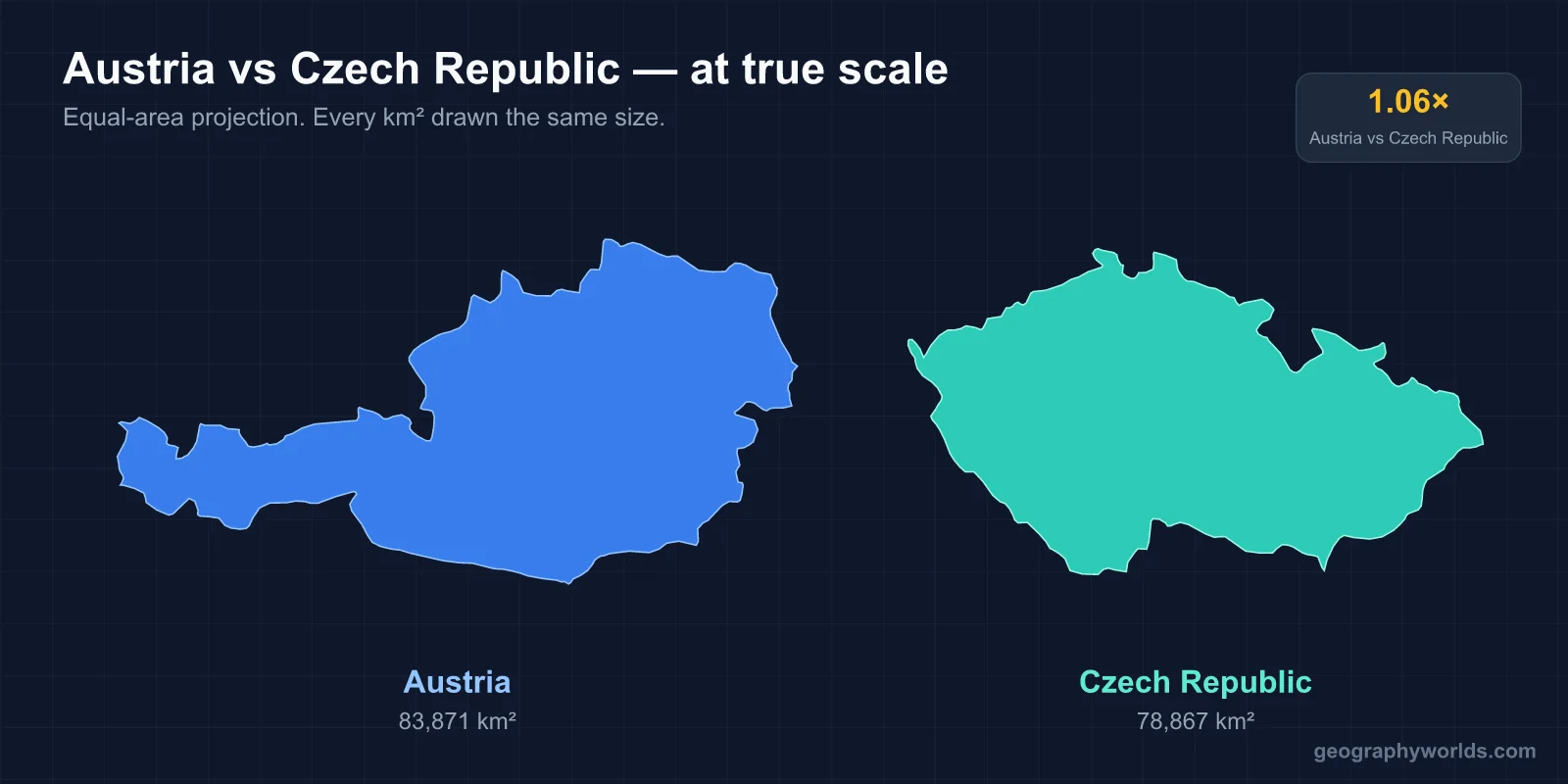
Austria is slightly bigger and markedly richer; the Czech Republic has more people. Austria covers about 83,879 km² to the Czech Republic’s 78,871 km², a difference of roughly 6%, but the Czech Republic had about 10.9 million inhabitants in 2025 against Austria’s 9.2 million in 2026. On IMF estimates for 2026, Austria’s GDP per capita is about US$67,800 and the Czech Republic’s about US$39,800. Prague is the Czech capital and Czech its language; Vienna is Austria’s capital and German its language. The two are also among the most closely entangled neighbours in Europe: they share a border of roughly 400 km, spent almost four centuries under the same Habsburg rulers, and were divided by the Iron Curtain for forty years. Any comparison makes more sense if it starts with how they meet.
Where Bohemia and Moravia Meet Upper and Lower Austria
The border runs along the southern edge of the Czech lands, separating the Czech regions of South Bohemia and South Moravia from the Austrian states of Upper and Lower Austria. Its length is given as 402 km in Austrian geography references and somewhat more in Czech surveys. In the west it crosses the wooded hills of the Bohemian Forest (Šumava); in the east it follows the Thaya, called the Dyje in Czech, through a deep, forested valley. There the Czech Podyjí National Park, 63 km², adjoins Austria’s 13.3 km² Thayatal National Park, and the two are managed together as a cross-border park.
This is some of the emptiest country in either state. Population density in the Czech borderlands with Austria and Germany remains among the lowest in the Czech Republic, largely because of the expulsion of the German-speaking population after the Second World War. In 1948 the Iron Curtain came down along this line, and many road and rail links were cut for decades; passenger trains from Laa an der Thaya to Hevlín and from Fratres to Slavonice were still not running again in 2009. In late 1989 Czechs could enter Austria freely for the first time in forty years, and on the Czech Republic’s entry into the Schengen Area in December 2007 routine border checks ended entirely.
The border has also carried arguments. In the 1990s Austrian environmental campaigners protested against the Temelín nuclear power station, 50 km north of the Austrian border, and in 2000 the two governments signed the Protocol of Melk on nuclear safety standards and prompt cross-border information. Austria generates no nuclear power of its own; Temelín, with 2,180 MW of capacity, became the largest power source in the Czech Republic in 2003.
Habsburg Rule From 1526 to 1918
The two countries were first joined under a Czech ruler: Ottokar II, Duke of Austria from 1251 and King of Bohemia from 1253, ruled both until 1276. The lasting union came in 1526, when, after the Battle of Mohács, Bohemia and the unoccupied part of Hungary passed to the Austrian Habsburgs. For the next four centuries the Czech lands were governed mainly from Vienna; only under Rudolf II, who moved his court to Prague in 1583, did Prague serve as the imperial capital, until 1611.
Czech resistance to that arrangement was crushed at the Battle of White Mountain outside Prague on 8 November 1620, in the early phase of the Thirty Years’ War. Later, when the empire granted Hungary internal autonomy in the Compromise of 1867, the Czechs sought the same for Bohemia and never got it, partly because Germans made up about 37% of Bohemia’s population and 28% of Moravia’s and opposed becoming a minority in a Czech-run parliament. On 2 December 1805 the Czech lands had also hosted one of the empire’s great defeats, when Napoleon beat a Russian and Austrian army at Austerlitz, now Slavkov u Brna near Brno.
Migration ran mostly one way, south to the capital. Between 1870 and 1910 hundreds of thousands of Czechs, many from rural South Moravia, moved to Vienna for work. In 1900, 102,974 of Vienna’s 1,674,957 inhabitants gave Czech or Slovak as their everyday language, and some estimates run to 250,000 or more, making Vienna the city with the second-largest Czech-speaking population after Prague. Vienna also drew Moravian and Bohemian-born professionals, among them Sigmund Freud, born in Příbor, and Gustav Mahler, born in Kaliště. Two presidents of post-war Austria, Karl Renner and Adolf Schärf, were born in South Moravia, in Dolní Dunajovice and Mikulov respectively.
Saint-Germain in 1919, the Sudetenland in 1938 and the Iron Curtain in 1948
When Austria-Hungary collapsed in October and November 1918, Czechoslovakia and the new Republic of German-Austria immediately quarrelled over the German-speaking districts of Bohemia and Moravia, whose more than 3 million inhabitants wanted to join Austria. Czechoslovak troops occupied the districts, and the Treaty of Saint-Germain in 1919 confirmed them as Czechoslovak. Diplomatic relations began on 20 January 1920.
The interwar years reversed the roles. Czechoslovakia remained a parliamentary democracy, and by 1938 it was, with Switzerland, the only democracy left in Central Europe, while Austria moved to dictatorship in 1934. Austrian Social Democrats, including Otto Bauer, took refuge in Brno and printed their banned newspaper, the Arbeiter-Zeitung, there until 1938. Then Nazi Germany annexed Austria on 13 March 1938 and the Czech Sudetenland that September. After 1945, Czechoslovakia expelled nearly all its Germans, some of whom settled in Austria. Austria regained full sovereignty through the State Treaty of 15 May 1955 and declared permanent neutrality that October, while Czechoslovakia, communist from 1948, sat on the other side of the Iron Curtain. After the Warsaw Pact invasion ended the Prague Spring in 1968, many Czechs fled to Austria.
Sněžka at 1,603 m Against the Grossglockner at 3,798 m
Physically the two countries are built differently. The Eastern Alps cover about 62% of Austria, and its highest peak, the Grossglockner in the Hohe Tauern, reaches 3,798 m (12,461 ft). Only in the east does Austria flatten into the Danube valley, the Vienna Basin and the edge of the Pannonian plain. The Czech Republic lies on the Bohemian Massif, a basin ringed by low mountains; its highest point, Sněžka in the Giant Mountains (Krkonoše) on the Polish border, is 1,603 m (5,259 ft), less than half the Grossglockner’s height.

Rivers point in different directions too. Almost all of Austria drains to the Danube and so to the Black Sea. Bohemia drains north through the Vltava and the Elbe (Labe) to the North Sea, Czech Silesia to the Baltic through the Oder, and only Moravia south to the Danube through the Morava, whose lower course forms the Austria–Slovakia border. That is one reason the Czech Republic has long looked north and west towards Germany as well as south towards Vienna.
The settlement pattern follows the terrain and the history. Vienna, with just over 2 million people in the city and nearly 2.9 million in its metropolitan area, holds almost a third of Austria’s population, a legacy of its role as the capital of a multinational empire that shrank to a small republic after 1918. It sits at the country’s far eastern edge, closer to Bratislava than to Salzburg or Innsbruck. Prague, with about 1.4 million people on the Vltava, is less dominant: Brno, Ostrava, Plzeň and Liberec give the Czech Republic a more even spread of industrial cities. Administratively, Austria is a federation of nine states, each with its own parliament, while the Czech Republic is a unitary state divided into thirteen regions plus the capital. The two languages reinforce the divide: Czech is a West Slavic language close to Slovak and Polish, while Austrians speak their own varieties of German, which ties Austrian media and business closely to Germany.
Koruna and NATO in Prague, Euro and Neutrality in Vienna
The two economies are closely linked but still unequal. Austria’s GDP is estimated at about US$624 billion for 2026 and the Czech Republic’s at about US$433 billion, so a smaller population produces a larger economy. Measured at purchasing power parity the gap narrows, since prices are lower in the Czech Republic.
The Czech economy is heavily industrial. Its largest company by revenue in 2018 was the carmaker Škoda Auto, and Czech factories build trams, trucks and aircraft; the country also has the highest beer consumption per person in the world, and pilsner-style lager originated in Plzeň. Austria’s economy leans more on services, including Alpine tourism. The Czech Republic joined NATO in 1999, the EU in 2004 and Schengen in 2007, but it keeps its own currency, the koruna. Austria joined the EU in 1995 and uses the euro, yet has never joined NATO, keeping the neutrality it declared in 1955.
On the Human Development Index both rank very high, at 0.930 for Austria and 0.915 for the Czech Republic in 2023. The historic cores of both capitals are UNESCO World Heritage Sites, and the cities lie a few hours apart by train. Czech foreign minister Karel Schwarzenberg, who lived in Vienna for decades before returning after 1989, argued in 2008, with the diplomat Jiří Gruša, that Czechs and Austrians speak different languages but share the same character. For a closer look at each capital, read our guides to Prague and Vienna, or see how Czechoslovakia itself came apart in the story of the Velvet Divorce.