

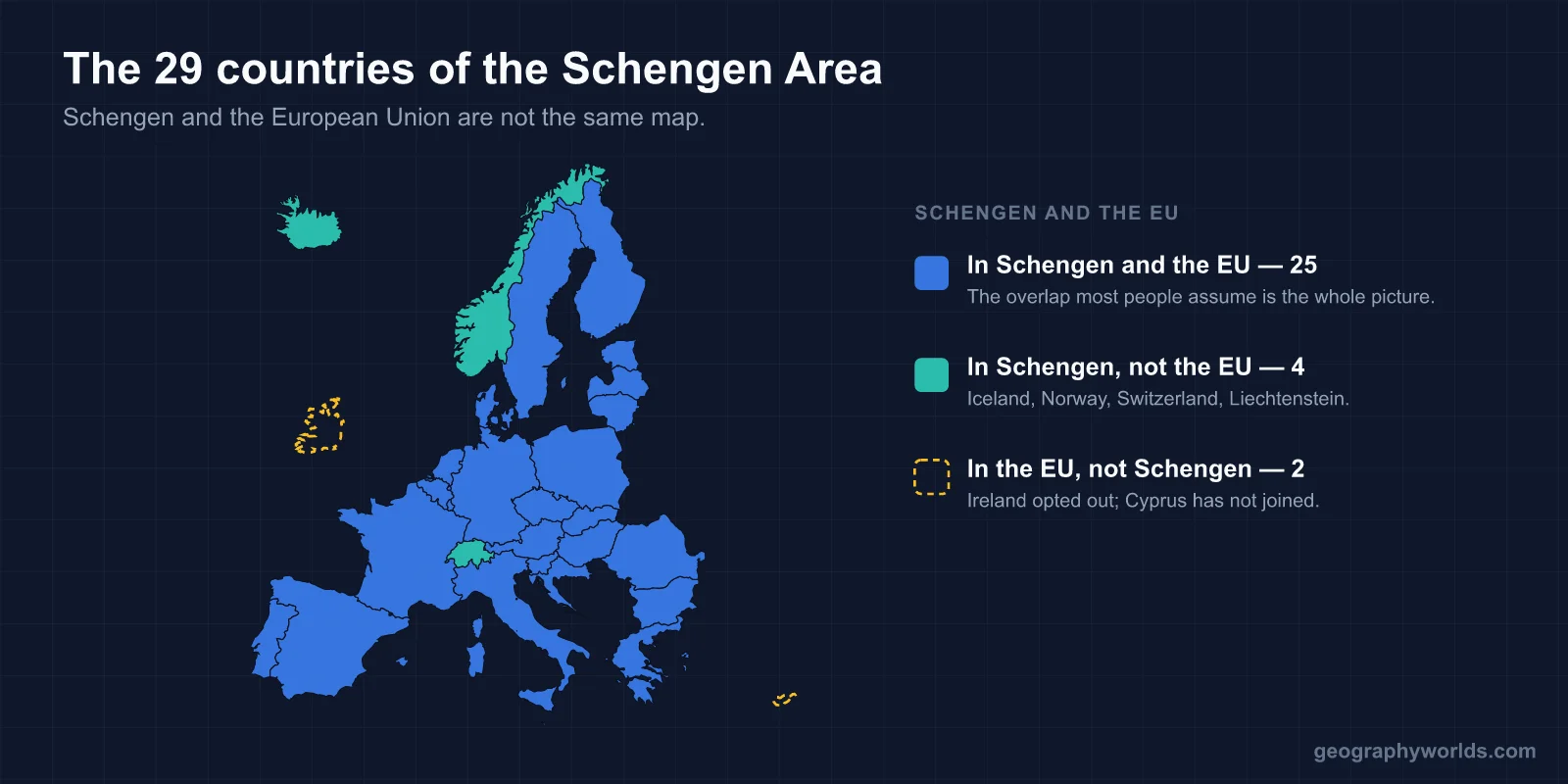
The Schengen Area has 29 members. Twenty-five are EU states and four — Iceland, Liechtenstein, Norway and Switzerland — are not. Bulgaria and Romania completed their accession on 1 January 2025, when land border checks were finally lifted after air and sea controls had already gone the previous March. Inside it, roughly 450 million people can cross internal borders without passport checks.
It Began on a Boat
The agreement is named after Schengen, a village of a few hundred people in Luxembourg, chosen because it sits where Luxembourg, France and Germany meet. On 14 June 1985 representatives of five countries — France, West Germany, Belgium, the Netherlands and Luxembourg — signed it aboard the Princesse Marie-Astrid, a boat moored on the Moselle, precisely so that the signing took place on a river border rather than in any one country.
The agreement sat outside European Community law entirely for its first thirteen years. It was an arrangement among willing governments, not an EU instrument, and it only became part of EU law with the Amsterdam Treaty in 1999. That history is why Schengen membership and EU membership have never matched, and why they still do not.
The 29, and the Four That Are Not in the EU
- EU members in Schengen — 25. Austria, Belgium, Bulgaria, Croatia, Czechia, Denmark, Estonia, Finland, France, Germany, Greece, Hungary, Italy, Latvia, Lithuania, Luxembourg, Malta, the Netherlands, Poland, Portugal, Romania, Slovakia, Slovenia, Spain and Sweden.
- Non-EU members — 4. Iceland and Norway joined through their Nordic Passport Union commitments, which predated Schengen and would otherwise have been broken by it. Switzerland joined in 2008 after a referendum. Liechtenstein followed in 2011.
Two EU countries are outside. Ireland opted out to preserve the Common Travel Area with the United Kingdom, an arrangement dating to 1923 that survives Brexit and lets Irish and British citizens move freely between the two. Cyprus is legally obliged to join eventually but has not, largely because the island's division makes controlling an external border impossible in practice.
The Microstates That Are In Without Joining
Monaco, San Marino, Vatican City and Andorra have never signed the agreement and are not members, yet in practice you can walk into all four without a check. Monaco's borders are administered by France; San Marino and Vatican City are surrounded by Italy and have open borders with it by bilateral arrangement.
Andorra is the partial exception: it maintains customs checks on goods with France and Spain, because it is outside the EU customs union, while performing no systematic passport control on people. So the area has four de facto members that appear in no list of 29, which is one reason published counts of "Schengen countries" sometimes reach 33.
What the Visa Actually Covers
A Schengen visa is issued by one member and valid in all of them, which is the practical point of the whole arrangement for travellers. The standard allowance for visa-exempt nationals is 90 days in any rolling 180-day period across the entire area — not 90 days per country, a distinction that catches a large number of visitors every year.
Applications must go to the country of main destination, or of first entry if there is no single main destination. Roughly ten million applications are processed in a typical year, with France, Spain and Germany issuing the largest share.
The area also operates the Schengen Information System, the largest shared database of its kind in Europe, holding alerts on people and objects that any member's border or police officer can query. It is the machinery that makes removing internal checks politically acceptable: controls did not disappear so much as move to the external frontier and into a shared record.
Schengen, the EU and the Eurozone Are Three Different Things
The three European memberships people most often conflate line up like this:
- In Schengen, not the EU: Iceland, Liechtenstein, Norway, Switzerland.
- In the EU, not Schengen: Ireland and Cyprus.
- In Schengen and the EU but not the euro: Czechia, Denmark, Hungary, Poland, Romania, Sweden and Bulgaria — though Bulgaria has been moving toward adoption.
- Using the euro without being in the EU: Monaco, San Marino, Vatican City, Andorra by agreement, and Montenegro and Kosovo unilaterally.
So Norway has open borders with Germany but no vote on EU law; Ireland has a vote on EU law but a passport check at Frankfurt. Switzerland is in Schengen and in neither the EU nor the European Economic Area, operating instead through more than a hundred separate bilateral agreements — an arrangement Brussels has spent years trying to simplify.
When the Borders Come Back
Free movement inside the area is the default, not a guarantee. The Schengen Borders Code allows a member to reintroduce internal checks temporarily for a serious threat to public policy or internal security, initially for up to 30 days and extendable.
The provision was used rarely until 2015, when the migration crisis prompted Germany, Austria, Sweden, Denmark and Norway to reimpose controls, several of which were then renewed continuously for years. The pandemic in 2020 produced the most complete suspension in the area's history, with most members closing borders within weeks of each other. France has maintained controls on terrorism grounds since the 2015 Paris attacks.
The result is that "no internal borders" describes the legal default rather than the constant reality. A traveller crossing from Germany into Austria may well be checked, and has been, on and off, for a decade.
The Nordic Precedent That Came First
Schengen was not Europe's first passport-free zone. The Nordic Passport Union has allowed citizens of Denmark, Finland, Iceland, Norway and Sweden to cross each other's borders without a passport since 1954 — three decades before the boat on the Moselle, and it still operates alongside Schengen today.
That earlier arrangement is precisely why Iceland and Norway are Schengen members despite staying out of the EU. When Denmark, Finland and Sweden joined Schengen as EU states, the choice was to break the Nordic union or bring the two non-EU Nordics in with them. Europe chose the second, and the result is the clearest case of an older regional arrangement shaping a continental one.
The Common Travel Area between Ireland and the United Kingdom works on the same logic in the opposite direction: it is why Ireland opted out of Schengen rather than accept a hard border with Britain, and it is the reason the Irish border question dominated the Brexit negotiations.
Bulgaria and Romania Waited Fourteen Years
Both joined the EU in 2007 and were judged technically ready for Schengen by 2011. Accession requires unanimity, and they did not get it — the objections centred on judicial standards and corruption, and later on migration, with the Netherlands and then Austria maintaining vetoes for years.
The compromise came in two stages. On 31 March 2024 air and sea borders opened, creating the odd situation of a country being inside the area if you flew and outside it if you drove. Land borders followed on 1 January 2025, completing accession fourteen years after the technical assessment said they were ready.
Croatia had a much shorter wait: it joined the EU in 2013 and Schengen on 1 January 2023, adopting the euro the same day.
What Replaced the Border Posts
Removing checks at internal frontiers required building something in their place, and most of it is invisible to travellers. Alongside the Schengen Information System, the area runs a shared visa database holding biometrics for applicants, and Frontex, the European Border and Coast Guard Agency established in 2004 and given its own standing corps in 2019 — the first uniformed service the EU has ever had.
Two further systems have been in preparation for years: an Entry/Exit System to record every non-EU crossing automatically and replace passport stamping, and ETIAS, a travel authorisation that visa-exempt visitors will need to obtain before arrival, along the lines of the American ESTA. Both have slipped repeatedly.
The underlying trade is the one the 1985 signatories made on the Moselle: internal freedom bought with external hardening and shared data. Every subsequent argument about Schengen — over migration, over Bulgaria and Romania, over reintroduced checks — has really been an argument about whether that trade is holding up.
The Area Is Bigger Than It Looks, and Smaller
Schengen covers about 4.5 million km² and has an external land and sea border running some 50,000 km. Its most remote points are nothing like the popular image of a European travel zone: Norway's Svalbard is excluded from the area despite Norway being a member, and has its own visa-free regime under a 1920 treaty that lets citizens of any signatory state live and work there.
The French overseas departments — Guadeloupe, Martinique, French Guiana, Réunion and Mayotte — are in the EU but outside Schengen, so a flight from Paris to Cayenne is an internal EU journey that still involves a border check. The Canary Islands and Madeira, by contrast, are inside Schengen despite lying off Africa.
Twenty-nine members, four de facto ones, two EU holdouts and a set of territories on both sides of the line is more complicated than the phrase "no borders" suggests; the full count of European countries is the clearest way to see which are in which club.