

Italy's best-known people include Leonardo da Vinci, painter of the Mona Lisa; Dante Alighieri, author of the Divine Comedy; Galileo Galilei, who turned a telescope on Jupiter in 1610; Marco Polo, the Venetian who travelled the Silk Road between 1271 and 1295; Guglielmo Marconi, who shared the 1909 Nobel Prize in Physics for wireless telegraphy; Enrico Fermi, who built the first nuclear reactor; and Maria Montessori, whose teaching method is used in schools worldwide. What sets many Italians apart is that their fame rests on a measurable first or record: a Nobel Prize, a world record, an Olympic medal count or a mountain climbed for the first time. Italians have won the Nobel Prize 21 times, most recently in 2021, and Italian athletes hold several of the most durable records in sport. This guide is built around those firsts and the people behind them.
From Carducci in 1906 to Fo in 1997: Six Nobel Prizes in Literature
The first Italian Nobel laureate was the poet Giosuè Carducci (1835–1907), born in Valdicastello in Tuscany and regarded in his lifetime as modern Italy's national poet. He received the Nobel Prize in Literature in 1906, a few months before his death. Twenty years later Grazia Deledda (1871–1936), from Nuoro in Sardinia, became the first Italian woman to win it and only the second woman after Selma Lagerlöf; the Swedish Academy praised her pictures of life on her native island. She is still the only Italian woman to have won the literature prize.
The prize has gone to four more Italian writers. Luigi Pirandello (1867–1936), a Sicilian who wrote about 40 plays, some in Sicilian, won in 1934 for reviving dramatic and scenic art. The poet Eugenio Montale (1896–1981) won in 1975, and Dario Fo (1926–2016), a playwright and actor described in his time as the most widely performed contemporary playwright in world theatre, won in 1997. Salvatore Quasimodo, honoured in 1959, completes the six.
Golgi, Marconi, Fermi, Rubbia and Parisi: Nobel Prizes in Science
Italy's first science Nobel also came in 1906, when Camillo Golgi (1843–1926) shared the prize in Physiology or Medicine for work on the nervous system. Born in Corteno, near Brescia, a village now renamed Corteno Golgi in his honour, he developed the "black reaction" staining technique in 1873, and the Golgi apparatus of the cell still carries his name. Three years later Guglielmo Marconi (1874–1937), born in Bologna, shared the 1909 physics prize with Ferdinand Braun for wireless telegraphy; he had founded his wireless company in Britain in 1897.
Enrico Fermi (1901–1954), born in Rome, won the 1938 physics prize for work on radioactivity induced by slow neutrons, then emigrated to the United States, where he later took American citizenship. Later Italian winners in physics include Carlo Rubbia (born 1934), from Gorizia on the Slovenian border, who shared the 1984 prize for work at CERN that led to the discovery of the W and Z particles, and Giorgio Parisi (born 1948), a Roman whose 2021 prize, shared with Klaus Hasselmann and Syukuro Manabe, recognised his work on complex systems. Parisi remains the most recent Italian laureate.
Volta's Battery, Galileo's Moons and Fermi's Reactor: Scientific Firsts
Some of the most important Italian firsts predate the Nobel Prize. Galileo Galilei (1564–1642), born in Pisa, built a telescope of about three times magnification in 1609 and improved it to around 30 times. On 7 January 1610 he saw what he first took for three small stars lying in a line close to Jupiter; nights of further observation showed they were moons orbiting the planet, and he published the discovery that year in Sidereus Nuncius, "The Starry Messenger".
Alessandro Volta (1745–1827), from Como, invented the voltaic pile in 1799, the first electric battery, and described it in a letter to the Royal Society in London that was published in 1800. It showed that electricity could be produced chemically, not only by living things, and the unit of electric potential, the volt, is named after him. Volta is also credited with discovering methane.
Marconi's own first is more contested. In December 1901, at Signal Hill in Newfoundland, he and an assistant reported hearing the repeated letter S sent from his station at Poldhu in Cornwall, the first claimed wireless signal across the Atlantic; technical historians have since questioned the evidence, since no automatic record was made. The firmer milestone came a year later, in December 1902, when official messages passed between Poldhu and his new station at Table Head, near Glace Bay in Nova Scotia, which Parks Canada recognises as the site of the first exchange of radio messages across the ocean.
Fermi supplied another first. On 2 December 1942, in Chicago, the reactor he led, Chicago Pile-1, achieved the first human-made self-sustaining nuclear chain reaction, with 49 scientists present. It was the first major technical achievement of the Manhattan Project.
Cornaro Piscopia, Montessori, Levi-Montalcini and Cristoforetti: Women Who Went First
In 1678 Elena Cornaro Piscopia (1646–1684), a Venetian noblewoman who played several instruments and studied philosophy, physics and languages, received a degree in philosophy from the University of Padua, making her one of the first women anywhere to earn an academic degree; she was proclaimed Magistra et Doctrix Philosophiae, teacher and doctor of philosophy. The local bishop had refused to let her take the degree in theology she first sought.
Maria Montessori (1870–1952), born in Chiaravalle near Ancona, was one of the first women to study medicine in Italy and graduated with honours from the University of Rome in 1896. In 1907 she began working with children in the Casa dei Bambini, a school in a new housing block in Rome's San Lorenzo district, and the method she developed there is now used around the world.
Rita Levi-Montalcini (1909–2012), born in Turin to a Jewish family, studied medicine at the University of Turin after overcoming her father's opposition to his daughters going to university. She shared the 1986 Nobel Prize in Physiology or Medicine with Stanley Cohen for discovering nerve growth factor, served as a senator for life from 2001, and on 22 April 2009 became the first Nobel laureate to reach the age of 100.

Samantha Cristoforetti (born 1977), born in Milan and raised in Malè in Trentino, is a former Italian Air Force pilot and the first Italian woman in space. Her 2014–15 mission lasted 199 days and 16 hours, still the longest uninterrupted spaceflight by a European astronaut and, for two years, the longest by any woman. On 28 September 2022 she took command of the International Space Station's Expedition 68.
Mangiarotti, Vezzali and Fontana: Italy's Olympic Medal Records
Italy has won 829 Olympic medals, the sixth-highest total of any country, and three athletes stand out. The fencer Edoardo Mangiarotti (1919–2012), son of a Milanese fencing master, won 13 Olympic medals between 1936 and 1960, six of them gold, and 39 Olympic and world championship medals in all, more than any other fencer. Valentina Vezzali (born 1974) won nine Olympic medals in foil, six of them gold, including three straight individual titles at Sydney 2000, Athens 2004 and Beijing 2008, the first fencer to win the individual foil at three consecutive Games, plus 16 world titles. The short-track skater Arianna Fontana (born 1990) became the first woman to win medals at six consecutive Winter Olympics and, with 14, holds the Italian record for Olympic medals.
Mennea's 19.72, Pellegrini's 3:59 and Jacobs in Tokyo: Records on Track and in the Pool
On 12 September 1979, at the high-altitude World University Games in Mexico City, Pietro Mennea (1952–2013) of Barletta ran 200 m in 19.72 seconds. The world record stood for almost 17 years, the longest in the event's history, and is still the European record. He won Olympic 200 m gold in Moscow in 1980. The swimmer Federica Pellegrini (born 1988), from Mirano near Venice, became the first woman to swim 400 m freestyle in under four minutes, winning the 2009 world title in Rome in 3:59.15. Marcell Jacobs (born 1994), born in El Paso, Texas, to an American father and raised from infancy in Desenzano del Garda, won the Olympic 100 m in Tokyo in 2021. On the same day, 1 August 2021, the high jumper Gianmarco Tamberi (born 1992) cleared 2.37 m and agreed to share the gold with Qatar's Mutaz Essa Barshim, a rare tied Olympic title.
Agostini's 15 World Titles and Messner on Everest: Records on Wheels and at Altitude
Two more records come from engines and ice. Giacomo Agostini (born 1942), born in Brescia and raised in Lovere on Lake Iseo, won 15 world championships and 122 Grand Prix races between 1963 and 1977, both still the most in motorcycle Grand Prix history. Reinhold Messner (born 1944), from the German-speaking Villnöß valley in South Tyrol, reached the summit of Everest with Peter Habeler in 1978 without supplementary oxygen, the first time anyone had been that high without it. He later made the first solo ascent of Everest, and in 1986 became the first person to climb all 14 peaks over 8,000 metres.

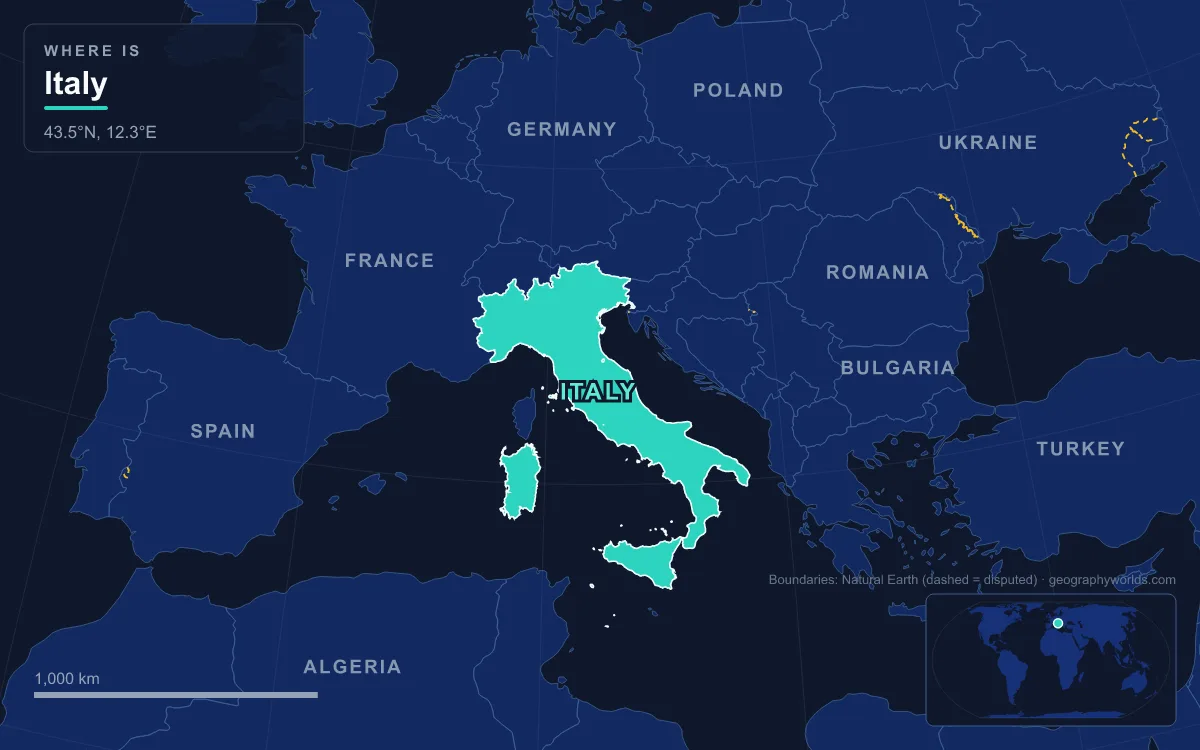
From Carducci's Tuscany to Messner's Dolomites, these records span the whole peninsula and its islands. To place their home towns on the map, see our guide to Italy's regions and their capitals, or start with Rome, the capital, where Fermi and Parisi were born and Montessori opened her first school.