
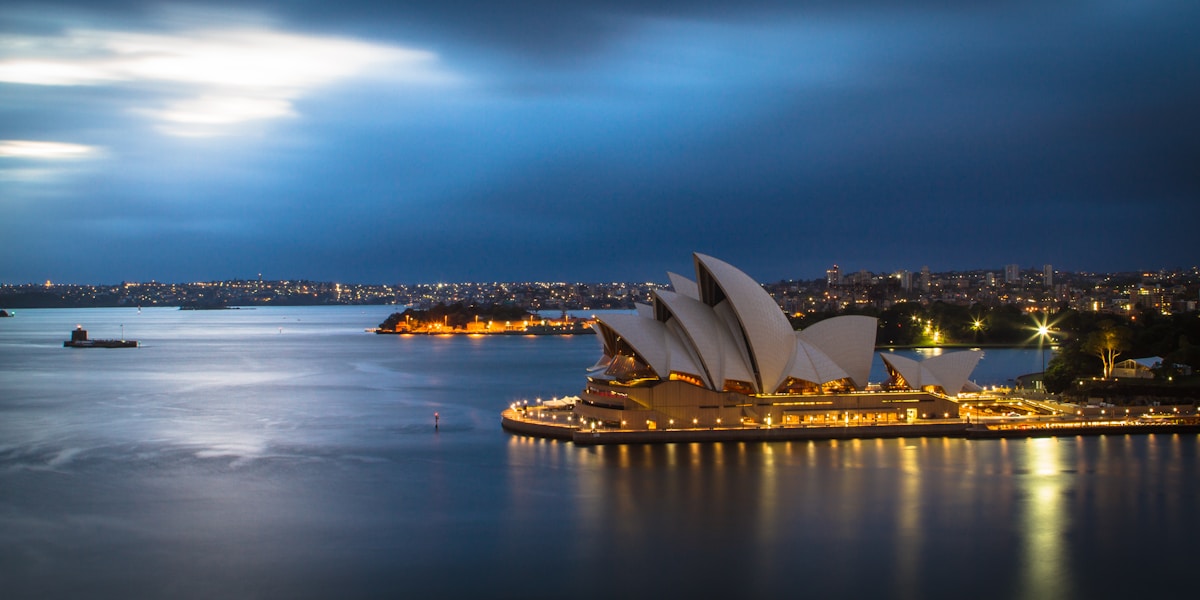
The Sydney Opera House, perched on Bennelong Point in Sydney Harbour, is one of the most iconic buildings of the 20th century. Designed by Danish architect Jorn Utzon and opened in 1973, its interlocking shell-shaped roof structures have become a universal symbol of creativity and modern architectural ambition.
Introduction
Inscribed as a UNESCO World Heritage Site in 2007, the Sydney Opera House was recognized as a masterpiece of 20th-century architecture that brings together multiple strands of creativity and innovation in both structural engineering and architectural form. It hosts over 1,500 performances each year and attracts more than 10 million visitors annually to its harbourside precinct.

Architecture & Design
- Architect: Jorn Utzon (Denmark)
- Roof Shells: Over 1 million tiles
- Height: 67 m at highest point
- Total Area: 1.8 hectares
The Opera House's revolutionary design features a series of interlocking shell-shaped roofs, or "sails," clad in over one million self-cleaning Swedish-made ceramic tiles. The roof structure was the subject of intense engineering challenges; Utzon spent four years developing the solution of deriving all shells from sections of a single sphere, enabling prefabrication.
The building contains multiple performance venues including the Concert Hall (2,679 seats), the Joan Sutherland Theatre (1,507 seats), the Drama Theatre, the Playhouse, and the Studio. The interiors were redesigned after Utzon's departure from the project in 1966, though he later reconciled with the project and created design principles for future interior renovations.
UNESCO Inscription
- Year Inscribed: 2007
- Criteria: Cultural (i)
- Significance: Masterpiece of 20th-century architecture
The Sydney Opera House was inscribed under criterion (i) as a masterpiece of human creative genius. It was one of the youngest buildings ever to receive World Heritage status. UNESCO noted that the building represents a daring and visionary experiment that has had an enduring influence on the emergent architecture of the late 20th century.
The nomination highlighted how the Opera House brought together architecture, structural engineering, and the performing arts in a single unified design concept. Its innovative construction methods, including the use of precast concrete ribs for the roof shells, influenced building technology worldwide.
Construction History
- Design Competition: 1956 (233 entries)
- Construction: 1959-1973
- Original Budget: AUD 7 million
- Final Cost: AUD 102 million
The Opera House's construction history is one of the most dramatic in architectural history. Jorn Utzon won an international design competition in 1957, selected from 233 entries by a jury that included Finnish architect Eero Saarinen. Construction began in 1959, but the engineering challenges of building the roof shells proved far more complex than anyone anticipated.
Cost overruns and political disputes led to Utzon's resignation in 1966, and he never returned to see the completed building. The project was finished by a team of Australian architects. Queen Elizabeth II opened the building on October 20, 1973. The final cost of AUD 102 million was 14 times the original estimate, funded largely by a state lottery.
Cultural Impact
- Annual Performances: 1,500+
- Annual Visitors: 10.9 million
- Resident Companies: 7 performing arts companies
- Economic Impact: AUD 775 million annually
The Opera House is home to seven resident performing arts companies, including Opera Australia, the Sydney Symphony Orchestra, the Australian Ballet, and the Sydney Theatre Company. It hosts over 1,500 performances annually across genres from opera and ballet to contemporary music and comedy.
Beyond its role as a performing arts venue, the Opera House has become Australia's most famous landmark and a global symbol of architectural innovation. Its image appears on everything from currency to tourism campaigns, and it generates an estimated AUD 775 million in economic activity annually for the state of New South Wales.
Visitor Experience
- Guided Tours: Daily, multiple languages
- Backstage Tours: Available
- Harbour Location: Bennelong Point, Circular Quay
- Best Views: From Mrs Macquaries Chair, ferry, or Harbour Bridge
Visitors can experience the Opera House through guided tours that explore the building's architecture, history, and performance spaces. Backstage tours offer access to areas normally reserved for performers, including dressing rooms and the stage machinery. The building's harbourside location makes it a centerpiece of Sydney's Circular Quay precinct.
The Opera Bar and Bennelong restaurant offer dining with harbour views, while the building's forecourt hosts free outdoor events and screenings. Some of the best views of the Opera House come from across the harbour at Milsons Point, from the deck of a Sydney ferry, or from the Sydney Harbour Bridge walkway.
Key Facts
- The Sydney Opera House was designed by Danish architect Jorn Utzon, who won an international competition in 1957.
- Over one million self-cleaning ceramic tiles cover the iconic roof shells.
- The building cost AUD 102 million, 14 times the original budget of AUD 7 million.
- It was inscribed as a UNESCO World Heritage Site in 2007, one of the youngest buildings to receive the honor.
- More than 10 million people visit the Opera House precinct each year.
Fun Facts
- Jorn Utzon never saw the completed Opera House in person; he left Australia in 1966 and never returned, though he was later reconciled with the project.
- The roof tiles are designed to be self-cleaning, but the building still requires regular maintenance by abseilers who rappel down the shells.
- Paul Robeson was the first person to perform at the Opera House site, singing to construction workers during their lunch break in 1960.
- The building's sails can be illuminated with projected artwork during the annual Vivid Sydney festival, transforming them into massive light sculptures.
Final Thoughts
The Sydney Opera House stands as proof that visionary architecture can transcend its original purpose to become a symbol of an entire nation. Despite its troubled construction history, the building that Jorn Utzon imagined rising from the harbour has become one of the most beloved and recognized structures on Earth, a place where architectural daring and the performing arts meet against one of the world's great natural backdrops.
Test Your Knowledge!
Think you know your UNESCO World Heritage Sites? Try our interactive quiz!
Play Geography Games →