
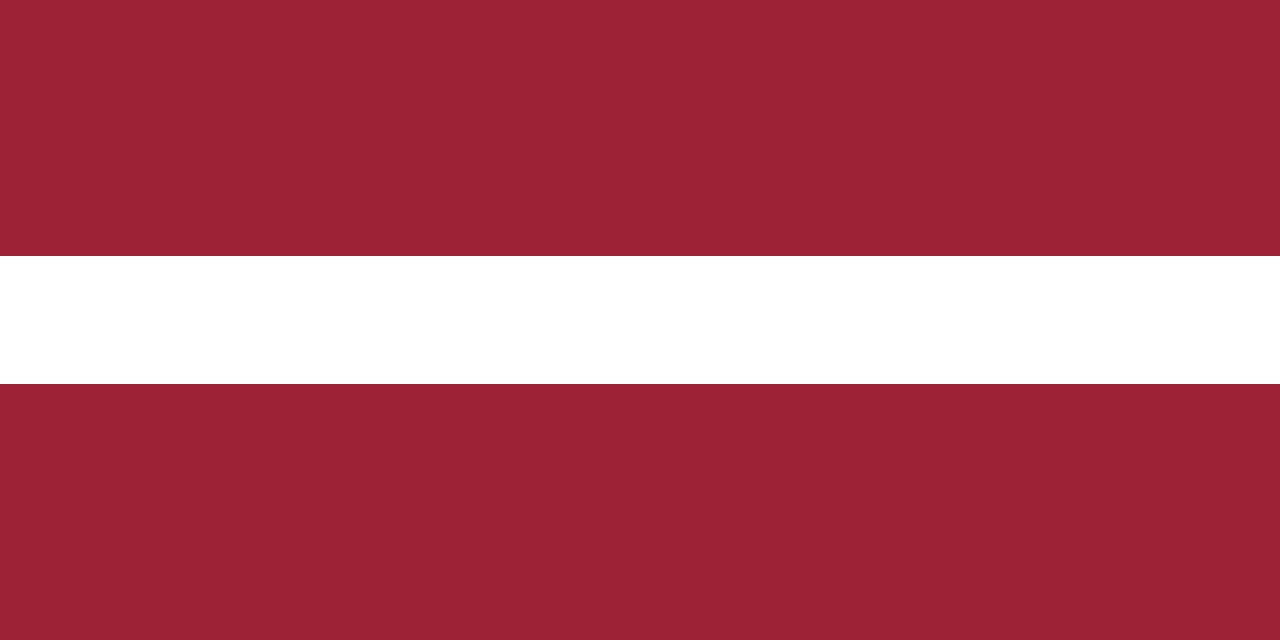
Among the flags of the world, few carry a color as instantly recognizable and as deeply tied to legend as the deep red of Latvia. This Baltic nation flies a banner of a dark carmine field crossed by a single narrow band of white, a design so old that its roots reach back into the medieval chronicles of northern Europe. It is at once one of the simplest national flags in appearance and one of the most storied in origin, a quiet emblem that carried the memory of independence through decades of foreign rule before returning to the masts of a free country.
A Flag Born From Legend
The story Latvians most often tell about their flag is not about geometry or politics but about blood. According to a tale rooted in the thirteenth century, a Latvian tribal leader was mortally wounded in battle and wrapped in a white sheet. The edges of the cloth that touched his body were stained dark with his blood, while the center, where his body lay, stayed pale. When his warriors raised that sheet as a rallying banner, they carried it to victory. Whether the legend is literal history or folk memory, it gives the flag a meaning that has endured for centuries: the red recalls the readiness of Latvians to give their lives for their land, while the white stripe marks the honesty and freedom they fought to protect.
That narrative matters because it ties the colors to sacrifice rather than to heraldry imported from elsewhere. The legend is woven into national consciousness and is taught to children alongside the flag itself, making the banner feel less like an official device and more like an inheritance passed down from ancestors.
The Colors and What They Mean
The Latvian flag uses just two colors, and one of them is genuinely unusual. The field is carmine, a dark, slightly brownish red that is sometimes described as maroon or "Latvian red." It is noticeably deeper than the bright scarlet seen on many other national flags, and this particular shade is so distinctive that it is essentially unique among the world's banners. The single horizontal band running through the middle is white, kept deliberately narrow so that the red dominates the overall impression.
The symbolism flows directly from the founding legend. The carmine stands for the blood shed in defense of the homeland and for the strength and resolve of the Latvian people. The white represents truth, freedom, justice, and the purity of the nation's ideals. Because the red is so dark and the white so slender, the two never feel balanced in the way that equal tricolor stripes do; instead the white reads as a single luminous line cutting across a sea of deep red, echoing the image of the pale center of that bloodstained sheet.
Design and Proportions
In structure the flag could hardly be simpler. It is a rectangular field of carmine divided by one horizontal white stripe placed across the center. The proportions are what give it its character. The flag is set at a ratio of two units tall to three units wide, and the field is split so that the white stripe is narrow while the two red bands above and below it are each much thicker. The standard division gives the red sections together a far larger share of the surface than the white, with the white forming roughly the central fifth of the height.
This restraint is intentional. There is no coat of arms, no star, no canton, and no additional emblem of any kind. The entire identity of the flag rests on the precise shade of red and the proportion of the stripe. That minimalism makes the banner easy to recognize at a distance and impossible to confuse with a busy, symbol-laden design, while still demanding that the carmine be reproduced faithfully to stay true to the original.
From Medieval Chronicle to Modern Republic
Latvia's flag has one of the longest documented histories of any national banner. A red-white-red cloth is referenced in a medieval chronicle dating to around 1280, describing the militia of a Latvian region marching under such colors. That early appearance makes it one of the oldest flag designs still in use anywhere in the world, even though it spent long stretches of history dormant.
The modern revival came in the early twentieth century, when Latvian nationalists adopted the red-white-red banner as the symbol of their independence movement. When Latvia first declared statehood after the First World War, the flag was formally embraced and its exact carmine shade and proportions were standardized. That independence, however, did not last. Through the middle of the century Latvia was absorbed into the Soviet Union, and flying the red-white-red flag became a punishable act. The banner survived in exile communities, in private homes, and in memory.
As Soviet control weakened, the flag re-emerged as the rallying emblem of the renewed push for sovereignty, and it was officially restored as the national flag in 1990, on the eve of Latvia regaining full independence. Its return to public buildings was, for many Latvians, the most visible proof that their country had come back to life. You can learn more about the country's wider story in our latvia country guide.
How It Compares to Similar Flags
At first glance a horizontal red-white-red arrangement invites comparison with Austria, which uses the same red-white-red sequence of bands. The differences, though, are clear once you look closely. Austria's flag uses three stripes of equal height in a bright, true red, while Latvia's red is far darker and its white stripe is much thinner than the two surrounding red bands. The unequal proportions and the distinctive carmine tone set the Latvian banner apart immediately.
It is also worth contrasting Latvia with its Baltic neighbors. Estonia flies a blue-black-white horizontal tricolor and Lithuania a yellow-green-red one, so although the three countries share a region and a history of regaining independence around the same time, their flags have nothing visually in common. Among flags that lean on a deep, brownish-red rather than vivid scarlet, Latvia's carmine genuinely stands alone, which is part of why the shade has become a point of national pride in its own right.
The Flag in National Life Today
In modern Latvia the flag is far more than a fixture on government buildings. It is raised on national holidays, most notably Independence Day in November and the day marking the restoration of independence in May, and citizens are encouraged to display it from their homes. It appears at the country's beloved nationwide Song and Dance Festival, where massed choirs perform under a sea of red-white-red, and it travels with Latvian athletes to international competitions, where fans wave it in the stands.
The colors have also seeped into everyday design, appearing on scarves, ribbons, and sportswear during major events. Because the flag was once forbidden, its public display still carries an emotional charge for older generations who remember when raising it was an act of defiance. That memory keeps the banner from ever becoming merely decorative.
Interesting Facts About the Latvian Flag
- Its carmine shade is so specific that it is often called "Latvian red" and is considered unique among national flags.
- The red-white-red design is referenced in a chronicle from around 1280, making it one of the oldest flags in the world.
- The white stripe is deliberately narrower than the red bands, unlike the equal stripes of Austria's similar flag.
- Flying the flag was banned during the Soviet era, so its restoration in 1990 became a symbol of renewed freedom.
- According to legend, the colors come from a white sheet stained red with the blood of a wounded Latvian leader.
- Latvia sits in Northern Europe on the Baltic Sea, between Estonia and Lithuania.
Frequently Asked Questions
When was the Latvian flag adopted?
The modern flag was officially restored in 1990, as Latvia moved toward regaining its independence from the Soviet Union. The design itself, however, is far older, with the red-white-red banner first having been used during Latvia's earlier period of independence in the twentieth century and traced back to a medieval chronicle from around 1280.
What do the colors of the Latvian flag mean?
The deep carmine red represents the blood shed by Latvians defending their homeland and their willingness to fight for freedom, while the narrow white stripe stands for truth, honesty, and the ideals of liberty. The meaning is tied to a legend about a wounded leader wrapped in a white sheet stained with his blood.
Who designed the Latvian flag?
There is no single named designer. The flag grew out of a centuries-old folk tradition and a medieval account rather than being invented by one person. When Latvia declared independence in the twentieth century, the historic red-white-red design was adopted and its exact shade and proportions were formalized.
What continent is Latvia on, and which flags is it most similar to?
Latvia is in Northern Europe, on the eastern shore of the Baltic Sea. Its flag most closely resembles Austria's red-white-red banner, but Latvia uses a much darker carmine red and a noticeably thinner white stripe, which distinguishes the two at a glance.