
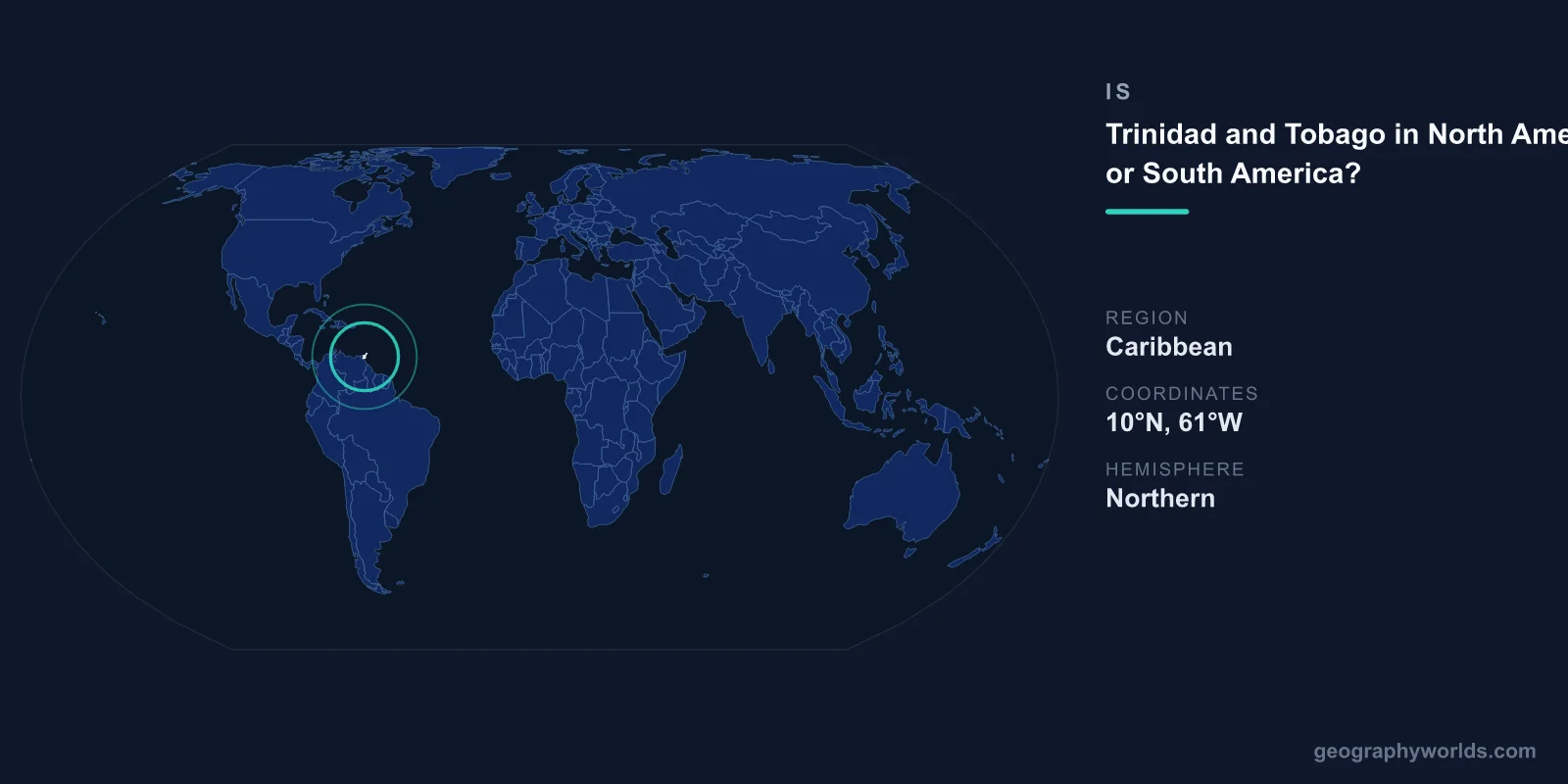
Trinidad and Tobago is most commonly classified as part of North America, but it is geologically tied to South America, sitting on the same continental shelf just 11 km off the coast of Venezuela. The honest answer is that this twin-island nation straddles a continental boundary, which is exactly why the question comes up so often. By the political and cultural convention used by the United Nations and most atlases, it belongs to the Caribbean subregion of North America. By physical geography, it is a detached fragment of the South American mainland.
The Short Answer and Why It Is Not Simple
If you need a single answer for a quiz or a homework question, say North America. International bodies such as the United Nations place the Caribbean within the North American continent, and Trinidad and Tobago is treated as a Caribbean state. The country is a founding member of CARICOM (the Caribbean Community) and aligns politically, economically, and culturally with its island neighbours to the north rather than with the South American republics.
That said, the more precise and interesting truth is that Trinidad in particular is geologically South American. Unlike most Caribbean islands, which were formed by volcanic or coral activity in the open sea, Trinidad sits on the continental shelf of South America and shares the same underlying landmass as Venezuela.
The Geology: A Piece of South America
During the last Ice Age, when sea levels were far lower, Trinidad was physically connected to the South American mainland. As the glaciers melted and the oceans rose, the low-lying land bridge flooded, separating the island from Venezuela across the shallow Gulf of Paria. The narrowest gap between Trinidad and the mainland is only about 11 kilometres.
This shared origin shows up everywhere in the island's natural environment. Trinidad's plants and animals are far closer to those of the Venezuelan mainland than to the rest of the Caribbean. The island is home to mainland South American species such as howler monkeys, ocelots, capybaras, and roughly 470 species of birds, including the scarlet ibis. Most genuinely oceanic Caribbean islands have a far poorer and more isolated set of wildlife. Tobago, the smaller island about 30 km to the northeast, is volcanic in origin and sits closer to the true Caribbean island arc.
Where Exactly Is Trinidad and Tobago?
Trinidad and Tobago is the southernmost nation in the Caribbean, lying off the northeastern tip of Venezuela. Trinidad, the larger island, is dominated by the Northern Range mountains, with central plains and oil-rich southern lowlands. Tobago lies to the northeast across a stretch of open water. Key facts include:
- Total area: about 5,131 km², making it one of the smaller nations in the Americas
- Capital: Port of Spain, on the northwest coast of Trinidad
- Population: roughly 1.4 million people
- Official language: English
- Nearest mainland: Venezuela, about 11 km across the Gulf of Paria
- Region: the southern Caribbean, at the edge of the South American shelf
Culture: Firmly Caribbean
While the rocks beneath Trinidad belong to South America, the country's identity is unmistakably Caribbean. Trinidad and Tobago is the birthplace of the steel pan, calypso, and soca music, and its Carnival is one of the largest and most celebrated in the world. The population is one of the most ethnically diverse in the Western Hemisphere, blending people of Indian, African, European, Chinese, Middle Eastern, and indigenous descent.
Economically, the nation is a Caribbean energy powerhouse rather than an agricultural island. It is one of the wealthiest countries in the region thanks to large reserves of oil and natural gas. Trinidad also hosts the Pitch Lake, the largest natural deposit of asphalt on Earth, a direct product of the same petroleum geology it inherited from the mainland. For a fuller picture of its history, economy, and travel highlights, see our trinidad and tobago country guide.
So Which Continent Should You Choose?
It depends on what kind of answer the question is asking for. For political geography, official statistics, and most school exams, the correct answer is North America, because the Caribbean is grouped with that continent. For physical or continental geography, a strong case can be made for South America, since Trinidad rests on the South American continental shelf and was once joined to it. Both answers can be defended, which is precisely why Trinidad and Tobago is one of the most debated countries in continental classification.
Frequently Asked Questions
Is Trinidad and Tobago part of the Caribbean?
Yes. Trinidad and Tobago is firmly part of the Caribbean and is a founding member of CARICOM. The Caribbean is conventionally counted as a subregion of North America, which is why the country is usually labelled North American.
How close is Trinidad to South America?
Very close. Trinidad lies only about 11 km from the coast of Venezuela across the Gulf of Paria, and it sits on the same continental shelf. This is the closest any Caribbean nation comes to the South American mainland.
Why is Trinidad considered geologically South American?
Trinidad was connected to the South American mainland during the last Ice Age and was separated only when rising sea levels flooded the low land between them. Its wildlife, rocks, and oil deposits all match the Venezuelan mainland rather than typical oceanic Caribbean islands.
What continent is Trinidad and Tobago in for the Olympics or international sport?
For sport and most international organisations, Trinidad and Tobago competes and is grouped with North America and the Caribbean, for example within CONCACAF for football rather than the South American CONMEBOL.