
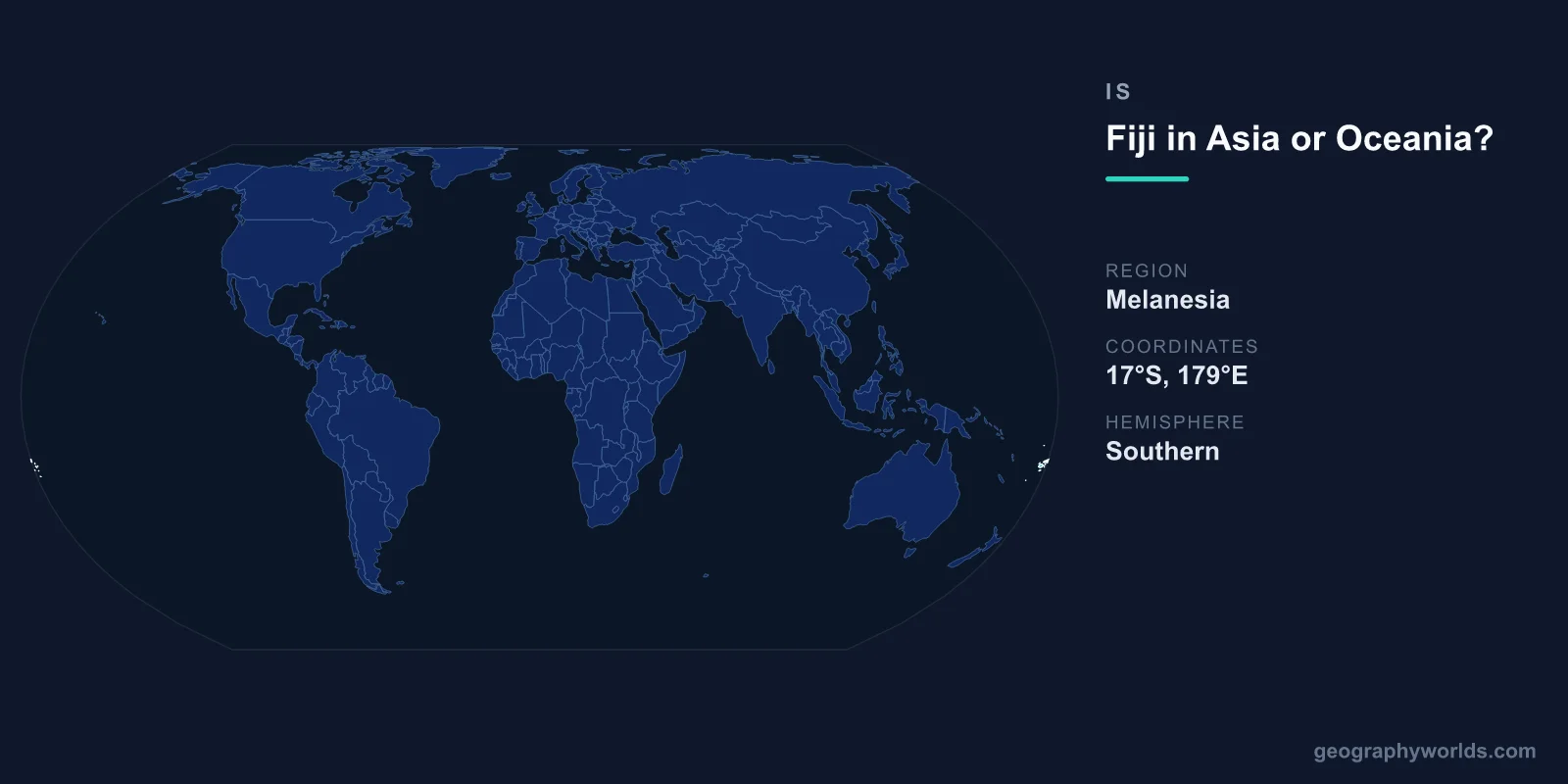
Fiji is in Oceania, not Asia. It lies in the South Pacific Ocean within the Melanesian subregion, sitting at the cultural crossroads where Melanesia meets Polynesia. Although it is an island nation with strong Asian cultural ties, every standard geographic scheme places Fiji firmly within Oceania, the region encompassing the islands of the Pacific along with Australia and New Zealand.
Why Fiji Belongs to Oceania
Continents and world regions are defined by tectonic plates, ocean basins, and the geographic clustering of landmasses. Fiji is an archipelago of more than 330 islands scattered across the tropical South Pacific, roughly 2,000 km north of New Zealand and thousands of kilometres from the Asian mainland. There is no land bridge, shared continental shelf, or proximity that would connect it to Asia.
Oceania is the accepted geographic region for the Pacific islands, and it is conventionally divided into three cultural-geographic subregions: Melanesia, Micronesia, and Polynesia. Fiji falls within Melanesia, alongside neighbours such as Vanuatu, the Solomon Islands, New Caledonia, and Papua New Guinea. Because of its eastern position, Fiji also shares many traits with nearby Polynesian nations like Tonga and Samoa, which is why it is often described as a bridge between the two.
Why People Confuse Fiji with Asia
The confusion is understandable. Several factors blur the picture for casual map-readers:
- The "Asia-Pacific" label. Many businesses, airlines, and organisations group the entire region under a single "Asia-Pacific" banner for convenience, which can imply Fiji is part of Asia when it is not.
- Indo-Fijian heritage. During British colonial rule, tens of thousands of indentured labourers were brought from India to work Fiji's sugarcane plantations. Their descendants, the Indo-Fijians, make up a substantial share of the population, giving the islands a visible South Asian cultural layer through Hindi, Hinduism, Islam, and Indian cuisine.
- Remoteness. Fiji is far from any continental landmass, so people unfamiliar with Oceania's geography struggle to slot it onto a continent at all.
None of these change the underlying geography. Culturally diverse as it is, Fiji is a Pacific Island country and a core member of Oceania.
Fiji's Place in the Pacific
Fiji's two largest islands, Viti Levu and Vanua Levu, hold most of its land area and population, including the capital, Suva, on Viti Levu's southeastern coast. The terrain ranges from rugged volcanic mountains in the interior to coastal mangroves, white-sand beaches, and the coral reefs the country is famous for. About 110 of the islands are inhabited.
The 180th meridian and the International Date Line pass close to Fiji, placing it among the first inhabited places on Earth to greet each new day. This eastern position in the Pacific is also why Fiji has historically functioned as a regional hub, hosting the main campus of the University of the South Pacific and serving as an aviation and shipping crossroads for the smaller island nations around it.
Key Facts About Fiji
- Region: Oceania (Melanesia subregion)
- Capital: Suva
- Area: approximately 18,274 km²
- Population: around 900,000
- Official languages: English, Fijian (iTaukei), and Fiji Hindi
- Number of islands: over 330, about 110 inhabited
- Largest islands: Viti Levu and Vanua Levu
For a deeper look at the country's history, culture, and travel highlights, see our fiji country guide.
Culture at a Crossroads
Fiji's identity reflects centuries of layered influence. Indigenous iTaukei traditions remain central, expressed through the ceremonial drinking of kava, a mildly sedative beverage made from the roots of a pepper plant and shared at gatherings to mark respect and community. Overlaid on this are the Indo-Fijian customs that arrived in the colonial era, plus the Polynesian and European contacts that shaped trade and language. The result is a genuinely multicultural Pacific nation rather than an Asian one, even though Asian heritage forms an important strand of its social fabric. Fiji is also a sporting powerhouse in rugby sevens, having won Olympic gold in 2016 and again in 2020, a source of immense national pride.
Frequently Asked Questions
Is Fiji a part of Asia?
No. Fiji is not part of Asia. It is an independent island nation in the South Pacific Ocean and belongs to the region of Oceania, specifically the Melanesian subregion. Its distance from the Asian continent and its Pacific location place it well outside Asia.
What continent is Fiji on?
Fiji is not on a continental landmass at all. It is an oceanic archipelago, and in continental terms it is grouped with Oceania, the region that also includes Australia, New Zealand, and the other Pacific islands. Some classification systems associate Pacific island nations like Fiji with Australia as the nearest continent.
Is Fiji in Melanesia or Polynesia?
Fiji is officially classified within Melanesia, but it sits on the boundary with Polynesia and shares cultural traits with both. This dual character is why Fiji is often called a meeting point between the two Pacific subregions.
Why does Fiji have a large Indian population?
During British colonial rule, indentured labourers were brought from India to work on sugarcane plantations. Their descendants, the Indo-Fijians, became a major part of Fiji's population and gave the country its strong South Asian cultural presence, even though Fiji itself is geographically in Oceania.
