
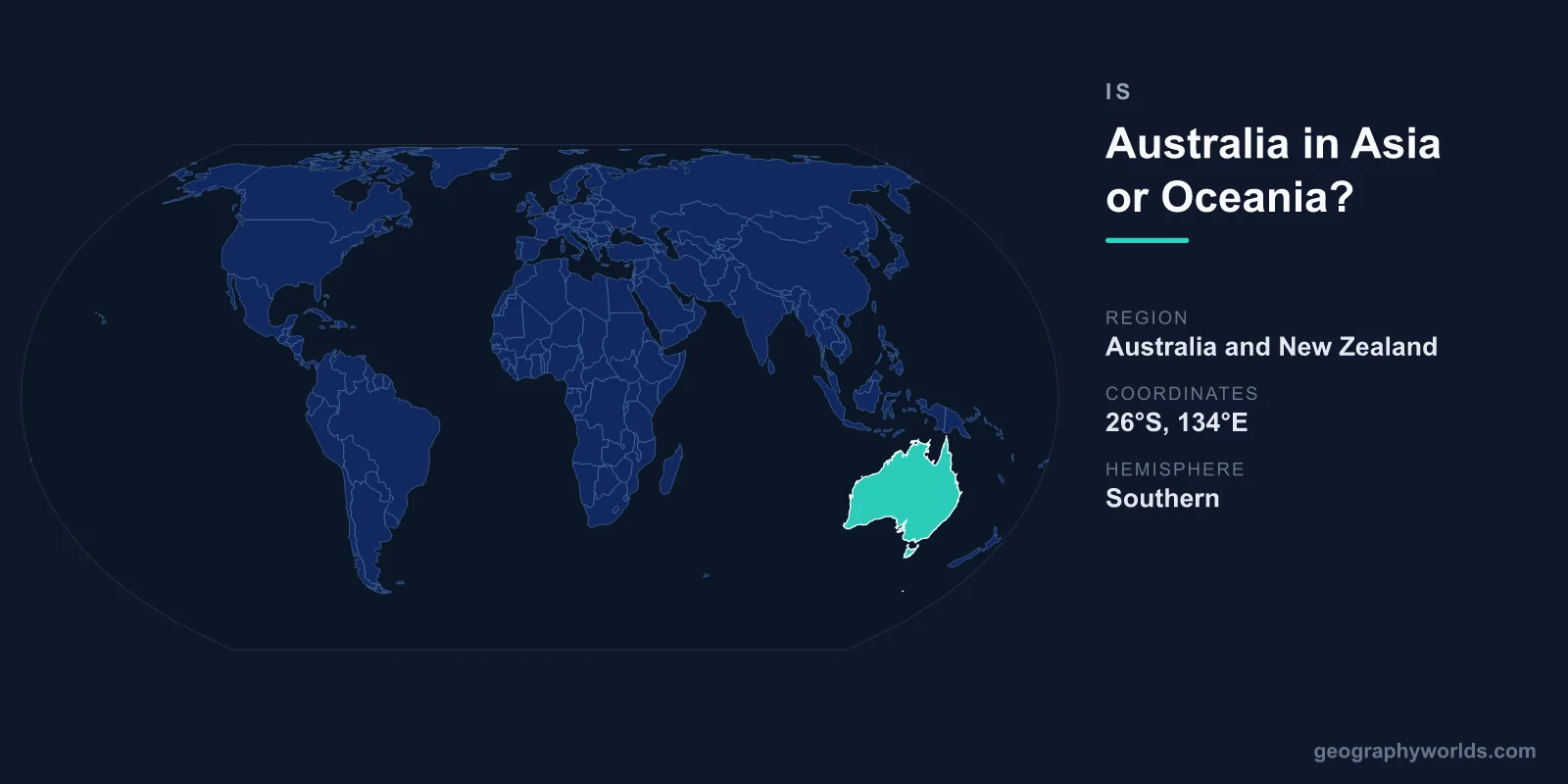
Australia is in Oceania, not Asia. It is the largest country in the Oceania region and also functions as a continent in its own right, occupying its own continental landmass between the Indian and Pacific Oceans. While Australia maintains close economic and diplomatic ties with Asia, it is geographically, tectonically, and culturally classified as part of Oceania.
Why Australia Belongs to Oceania
Oceania is the geographic region that encompasses Australia, New Zealand, and the thousands of islands scattered across the Pacific Ocean, including Melanesia, Micronesia, and Polynesia. Within this region, Australia stands out as by far the largest landmass, covering roughly 7,692,024 km² — making it the sixth-largest country on Earth and the only one large enough to be considered a continent on its own.
In the widely taught seven-continent model used across English-speaking countries, Australia (sometimes labelled "Australia and Oceania") is counted as a separate continent, entirely distinct from Asia. The Australian mainland sits on its own continental shelf and tectonic plate, the Australian Plate, which is gradually drifting north toward Asia at a few centimetres per year — but remains a separate geological unit.
Why People Confuse Australia With Asia
The mix-up is understandable, because Australia is deeply tied to its northern neighbours in practical terms. Several factors fuel the confusion:
- Regional labels: Terms like "Asia-Pacific" and "APAC" are everywhere in business, finance, and diplomacy, and Australia is almost always included in them.
- Organisations: Australia is a founding member of APEC (Asia-Pacific Economic Cooperation) and participates in forums such as the East Asia Summit and the ASEAN Regional Forum.
- Proximity: Australia's nearest neighbour, Indonesia, is an Asian nation lying only a few hundred kilometres to the north across the Timor and Arafura Seas.
- Alternative models: Some countries teach a six-continent model that does not treat Oceania as a continent, blurring the lines further.
None of these change the underlying geography. Membership in an economic bloc is a political choice, not a statement about which continent a country physically occupies.
Australia's Geographic Setting
Australia is an island continent surrounded entirely by water — the Indian Ocean to the west and south, the Pacific Ocean to the east, and the Timor, Arafura, and Coral Seas to the north. It is the flattest and, after Antarctica, the driest inhabited continent on the planet. The Great Dividing Range runs down the eastern seaboard, separating the fertile coastal strip from the vast, arid interior known as the Outback.
This isolation, which has lasted for tens of millions of years, gave rise to wildlife found nowhere else. Marsupials such as kangaroos and koalas, egg-laying monotremes like the platypus and echidna, and an extraordinary array of reptiles and birds all evolved in relative seclusion. That distinct natural history is itself a marker of just how separate Australia has been from the Asian mainland.
Key Facts About Australia
- Region/Continent: Oceania (also a continent of its own)
- Area: approximately 7,692,024 km² (sixth-largest country)
- Capital: Canberra
- Largest city: Sydney
- Population: roughly 26 million people
- Official language: English (no constitutionally enshrined national language, but English in practice)
- Surrounding oceans: Indian and Pacific
For a deeper look at the nation's history, geography, and culture, see our australia country guide.
Oceania at a Glance
Although Australia dominates Oceania in land area, the region is remarkably diverse. New Zealand lies to the southeast, Papua New Guinea to the north, and a constellation of island nations — Fiji, Samoa, Tonga, Vanuatu, the Solomon Islands, and many more — spreads across the Pacific. Together these countries share maritime culture and Pacific identity, even though they span enormous distances. Australia's size means it accounts for the overwhelming majority of Oceania's total population and economy, which is partly why the entire continent is sometimes informally referred to simply as "Australia."
Frequently Asked Questions
Is Australia a country or a continent?
It is both. Australia is the world's only nation that occupies an entire continent, which is why it is described as both a country and a continent. The continent is part of the wider Oceania region.
Is Australia part of Asia?
No. Australia is not part of Asia geographically. It is grouped with Asia only in economic and political contexts, such as the "Asia-Pacific" region or APEC membership, but it sits on its own continental plate in Oceania.
What continent is Australia on?
Australia is on the continent of Australia (often called "Australia and Oceania" or simply Oceania). In the seven-continent model, it is a distinct continent separate from Asia, Africa, Europe, the Americas, and Antarctica.
What is the difference between Oceania and Australasia?
Oceania is the broad region covering Australia, New Zealand, and the Pacific islands. Australasia is a narrower term that usually refers just to Australia, New Zealand, and sometimes neighbouring islands like New Guinea. Oceania is the more inclusive geographic term.