

Malta is in Europe. It is a southern European island country, a member of the European Union since 1 May 2004 and of the eurozone since 2008, and the United Nations counts it in Southern Europe. The doubt comes from its position and its rocks: the archipelago sits 81 km south of Sicily but lies on the African tectonic plate, it is farther south than Tunis, and its national language, Maltese, descends from the Arabic once spoken in Sicily. Politically, culturally and by every standard classification, though, the answer is Europe, in the way Sicily, which shares the same plate, is also Europe.
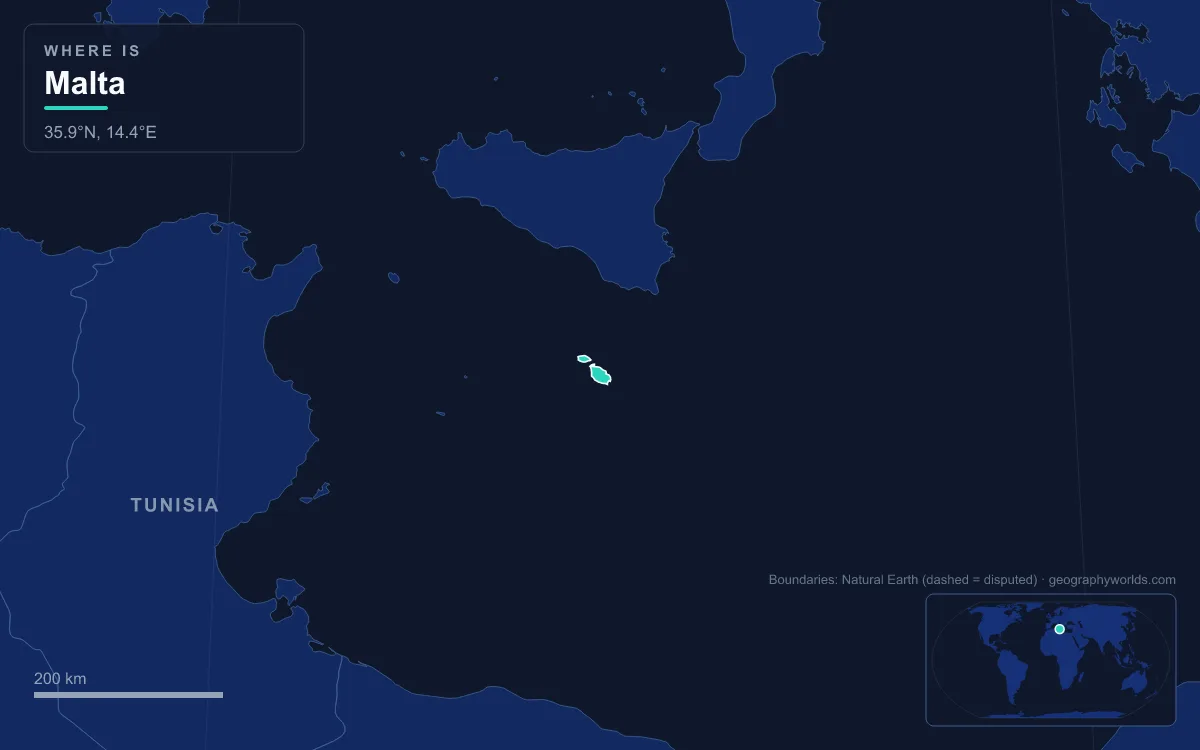
81 Kilometres from Sicily, Nearly 300 from Africa
Malta is an archipelago in the central Mediterranean, south of Italy, east of Tunisia and north of Libya. Only the three largest islands are inhabited: Malta itself, the largest, easternmost and most populated; Gozo, the northernmost and more rural; and little Comino between them. Uninhabited islets include Cominotto, Filfla and the St Paul’s Islands. Together they cover about 316 km², which makes Malta the smallest EU member state by area and one of the ten smallest countries in the world. The 2021 census counted 519,562 people, so it is also among the most densely populated.
The nearest neighbour is Sicily, across the Malta Channel. The channel is about 81 km wide at its narrowest and 102 km at its widest, and it is shallow, no more than 171 m deep. Ferries run across it to Italy. The African coast is much farther: the islands lie nearly 300 km from Libya to the south and from Tunisia to the west and south-west. Italy’s own southernmost island, Lampedusa, is actually closer to Africa than Malta is: it lies 113 km from Tunisia and 205 km from Sicily.
Latitude is what confuses people. Malta lies farther south than Tunis, the Tunisian capital, so on a map it can look as if it is tucked under North Africa. But latitude is not the test of a continent. Measured by distance, Malta is three to four times closer to Europe than to Africa, and its links, from ferries and flights to trade and family ties, run overwhelmingly north to Sicily and the rest of Italy. The neighbouring island is described in our guide to Sicily.
A Limestone Plateau on the African Plate
The geological case for Africa is real but limited. The Maltese islands stand on the Malta plateau, a shallow shelf formed from the high points of a former land bridge between Sicily and North Africa, which was cut off as the sea rose after the last ice age. The archipelago sits on the African tectonic plate, as does most of Sicily. If plates defined continents, much of Sicily would be African too, and nobody argues that Palermo or Catania is in Africa.
The rocks themselves are sedimentary layers laid down from the late Oligocene to the late Miocene, then broken by faults in the Pliocene. Geologists divide them into a sequence that runs, from oldest, through the Lower Coralline Limestone, the Globigerina Limestone, the Blue Clay, the Greensand and the Upper Coralline Limestone. These soft and hard limestones supplied the stone for the islands’ temples, fortresses and towns. The real plate boundary lies about 200 km to the north, along the subduction zone where the African plate meets the Eurasian plate.

The landscape is hilly, with terraced fields and an indented coast full of natural harbours. The highest point is Ta’ Dmejrek, just 253 m above sea level, near the village of Dingli on the western cliffs. Malta has no permanent rivers or lakes; only a few watercourses, at Baħrija, l-Imtaħleb and San Martin, carry fresh water all year. The climate is Mediterranean, with mild, rainy winters and hot, dry summers, much like Sicily’s.
Phoenicians, Arabs and Normans: 1000 BC to 1091
Malta’s history has swung between the two shores of the Mediterranean. The first settlers, hunter-gatherers who arrived between about 8000 and 6500 BC, probably came from Sicily, as did the Neolithic farmers who followed by about 5400 BC. Their descendants built the megalithic temples now listed by UNESCO, beginning with Ġgantija on Gozo, dated to around 3600 BC and older than the pyramids of Egypt.

Phoenician traders from the eastern Mediterranean settled the islands some time after 1000 BC as a stop on the route to the Strait of Gibraltar, with their main port on the Grand Harbour, which they called Maleth. After 332 BC Malta passed to Carthage, the great Phoenician city in what is now Tunisia, so for more than a century it was effectively governed from Africa, until the Punic Wars. Rome took the islands in 218 BC, during the Second Punic War, and attached them to the province of Sicily; Byzantine rule followed from 533.
The decisive African episode came in 870, when Arab forces from the Aghlabid emirate, which ruled from Ifriqiya in present-day Tunisia and was then conquering Sicily, captured Malta after a violent struggle. The island was left almost empty until settlers came from Muslim Sicily in 1048–1049, bringing Siculo-Arabic, the ancestor of Maltese. In 1091 Roger I, the Norman count of Sicily, attacked Malta and tied it to the new Kingdom of Sicily. Catholicism was restored under the Archdiocese of Palermo, and the expulsion of the remaining Muslims was complete by 1249. From then on, Malta’s rulers, church and trade all looked north.
Knights, Napoleon and the British Crown, 1530–1979
On 23 March 1530 the Holy Roman Emperor Charles V granted Malta to the Knights Hospitaller, the military religious order driven from Rhodes by the Ottomans in 1522. The rent was one falcon a year. In 1565 the Knights, led by Jean Parisot de Valette and helped by Maltese, Spanish and Portuguese forces, held out against the Ottoman Great Siege, one of the defining battles between Christian Europe and the Ottoman Empire. Afterwards they built the fortified capital that bears de Valette’s name; you can read more about it in our post on Valletta, Malta’s capital.
Napoleon seized the islands in June 1798 on his way to Egypt, but the French garrison was unpopular and surrendered in 1800 to a Maltese uprising backed by a British blockade. The Treaty of Paris made Malta part of the British Empire in 1814. It became the base of the Royal Navy’s Mediterranean Fleet, and in the Second World War its siege by Italian and German air forces led King George VI to award the George Cross to the whole island on 15 April 1942. The cross still appears on the national flag. Malta became independent in 1964 and a republic in 1974, and the last British forces left on 31 March 1979, now celebrated as Freedom Day.
Maltese, the Euro and EU Membership Since 2004
Malta’s language is the strongest link to North Africa. Maltese is a Semitic language that grew out of medieval Siculo-Arabic, and it is the only Semitic language officially written in the Latin script and the only Afroasiatic language with official status in the European Union. After the Norman conquest it developed on its own, cut off from Classical Arabic, and absorbed so much from Italian and Sicilian that about half its vocabulary now comes from them, with roughly a third from the original Arabic base and English supplying 6 to 20 percent. A 2016 study found Maltese speakers understand less than a third of everyday Tunisian or Libyan Arabic. The first written reference to the language, as lingua maltensi, is in a will of 1436, and it replaced Italian as an official language in 1934, alongside English.
Both remain official. In 2022 the National Statistics Office found that 90 percent of residents had at least basic Maltese, 96 percent English and 62 percent Italian, making Malta one of the most multilingual countries in the EU. Catholicism is the state religion, though the constitution guarantees freedom of religion.
The political answer was settled by vote. Malta signed an association agreement with the European Economic Community in December 1970 and applied for membership in July 1990. In a referendum on 8 March 2003 about 54 percent voted in favour, on a 91 percent turnout, the highest of any EU accession referendum. Malta joined the EU on 1 May 2004 and adopted the euro in 2008, and it is also part of the Schengen Area. Its capital, Valletta, is the EU’s smallest at just 0.61 km², and was a European Capital of Culture in 2018. Membership also gives Malta’s position between the continents a practical edge: since the late 20th century the islands have become a stopping point on migration routes from North Africa towards Europe, and as an EU and Schengen state Malta is bound by the Dublin Regulation to process asylum claims from people who arrive there first. In other words, the EU’s own rules treat Malta as Europe’s southern frontier, not as part of Africa. So Malta is a European country that happens to sit on an African plate, with a language that carries Arabic roots; the rest of the islands’ story, from Gozo’s beaches to Comino’s Blue Lagoon, is in our Malta island guide.