
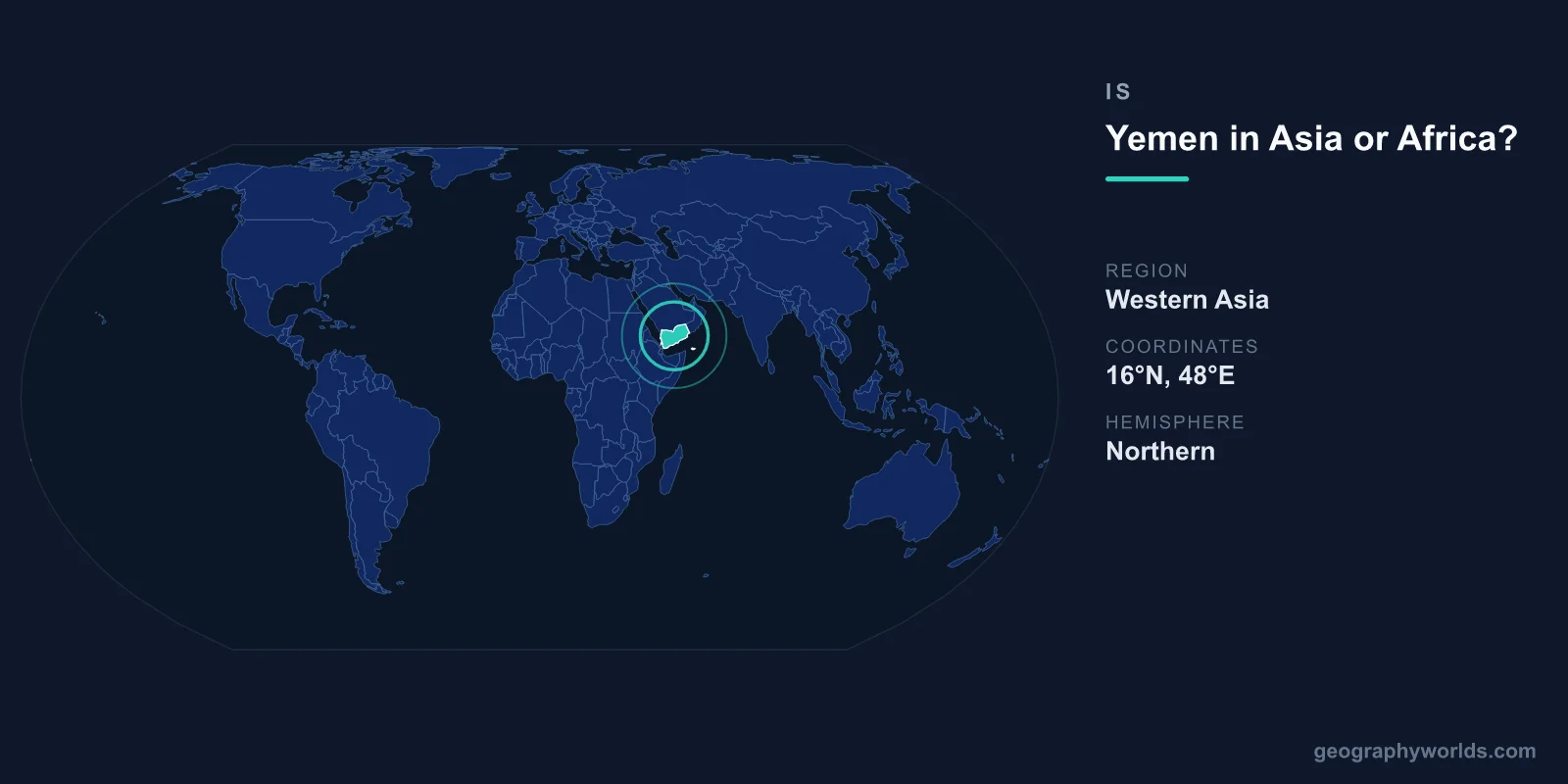
Yemen is in Asia, not Africa. It occupies the southwestern tip of the Arabian Peninsula, which is firmly part of the Asian continent. The confusion is understandable: Yemen sits closer to the Horn of Africa than almost any other Asian nation, separated from the continent of Africa by a sea channel barely wider than a major river is long. But every standard geographic classification places Yemen in Western Asia, alongside its neighbors Saudi Arabia and Oman.
Where Exactly Is Yemen?
Yemen lies at the southern and southwestern corner of the Arabian Peninsula. It borders Saudi Arabia to the north and Oman to the east, while its long coastlines face the Red Sea to the west and the Gulf of Aden and Arabian Sea to the south. Its capital, Sanaa, sits high in the western mountains. With an area of around 527,968 km², Yemen is one of the larger countries in the Middle East, and its roughly 33 million people make it among the most populous on the peninsula.
Because the Arabian Peninsula is the landmass that joins Asia to Africa at the Sinai, geographers have long classified all of it as Asian. Yemen, sitting at the peninsula's far tip, inherits that classification without ambiguity, even though it is the part of Asia that reaches furthest toward Africa.
Why People Think Yemen Might Be in Africa
The single biggest reason for the confusion is the Bab-el-Mandeb Strait. This narrow waterway separates Yemen from Djibouti and Eritrea on the African side, and at its tightest point it is only about 30 km wide. On a clear day, the coast of Africa is visible from Yemen's shore. That visual closeness makes the continental divide feel far more arbitrary than the wide oceans that separate other continents.
There are deeper reasons too. Geologically, the Arabian Plate split away from the African Plate relatively recently, and the Red Sea rift is still slowly widening the gap between them. Many of Yemen's landscapes, climate patterns, and even some wildlife echo those of nearby East Africa. Historically, trade, migration, and cultural exchange across the strait have linked Yemen tightly to the Horn of Africa for thousands of years, blurring the sense of a hard boundary.
The Curious Case of Socotra Island
Yemen's island of Socotra adds another twist to the question. Located in the Arabian Sea roughly 350 km south of the mainland, Socotra is politically and administratively Yemeni, yet it sits much closer to the Horn of Africa. Biologically, it has more in common with Africa than with Arabia: it is famous for bizarre, otherworldly endemic species such as the dragon's blood tree, found nowhere else on Earth. The island is a UNESCO World Heritage Site precisely because so much of its plant and animal life is unique.
So while Socotra is sometimes described as biogeographically African, it remains Asian by political and continental classification, as part of the Republic of Yemen. It is a good example of how continental borders are human conventions that do not always line up neatly with biology or geology.
Yemen's Geography and Landscape
Yemen is more varied than the flat deserts most people associate with Arabia. Its western highlands rise above 3,600 m, the tallest mountains on the entire Arabian Peninsula, and these heights catch enough rainfall to support terraced farming of coffee and grains. Move eastward and the land flattens into arid desert that merges with Saudi Arabia's vast Rub' al Khali, the Empty Quarter.
- Continent: Asia (Western Asia / Middle East)
- Region: Southern Arabian Peninsula
- Capital: Sanaa
- Area: approximately 527,968 km²
- Population: approximately 33 million
- Official language: Arabic
- Bordering countries: Saudi Arabia and Oman
This combination of mountains, coast, and desert gives Yemen one of the most distinctive physical geographies in the region, and explains why its history as the ancient Kingdom of Sheba and a hub of the frankincense trade was built on agriculture and seaborne commerce rather than oil alone.
A Bridge Between Two Continents
Perhaps the best way to understand Yemen's placement is to see it as Asia's doorstep to Africa. The Bab-el-Mandeb Strait it overlooks is one of the world's most strategically important shipping chokepoints, linking the Red Sea and the Suez Canal route to the Indian Ocean. Much of the trade between Europe and Asia passes within sight of Yemen's coast. That position has shaped Yemen's culture, language, and economy, weaving together Arabian, African, and Indian Ocean influences while leaving its continental identity squarely in Asia. For a fuller picture of the country, its regions, and its heritage, see the yemen country guide.
Frequently Asked Questions
Is Yemen part of the Middle East?
Yes. Yemen is considered part of the Middle East, a region of Western Asia. It is a member of the Arab League and shares deep cultural, linguistic, and religious ties with its Arabian neighbors.
How far is Yemen from Africa?
At the Bab-el-Mandeb Strait, Yemen is only about 30 km from the African coast at Djibouti. This is one of the shortest distances between any two continents that are separated by water.
Is Socotra in Africa or Asia?
Socotra is politically part of Yemen and therefore classified as Asian, even though it lies closer to the Horn of Africa and shares much of its unique wildlife with that region.
What continent is the Arabian Peninsula on?
The entire Arabian Peninsula, including Yemen, Saudi Arabia, Oman, and the Gulf states, is part of the continent of Asia.